Investing in Renewable Energy in 2026 – Guide

In the face of the climate emergency, how can you align your savings with your convictions without sacrificing performance potential? The renewable energy (RES) sector has established itself as an obvious answer, turning an ecological imperative into a strategic investment opportunity.
Far from being a niche investment, investing in the energy transition has become a pillar of wealth diversification, on a par with real estate or traditional equities. It not only helps grow your capital, but also enables you to contribute concretely to a more sustainable future.
Why invest your savings in renewable energy?
Investing in renewable energy first and foremost means positioning yourself within a structural growth trend. The IPCC’s recommendations are clear: to contain global warming, investment in RES must be multiplied. This political momentum translates into massive support from governments and companies, creating a favorable and increasingly competitive market environment.
Beyond the environmental impact, this sector offers tangible financial advantages. First, decoupling. Energy infrastructure, such as wind or solar farms, has historically shown low correlation with traditional asset classes (listed equities, etc.). This feature helps reduce a portfolio’s overall volatility and cushion shocks during periods of turbulence in financial markets.
Lastly, committing to green finance offers a local, concrete dimension. Financing a photovoltaic plant or a wind farm near you means contributing directly to your region’s economic development while making an investment that makes sense.
A brief definition of renewable energy
To properly understand the scope of the investment, it is useful to recall what renewable energy is. Unlike fossil fuels (coal, oil, gas), whose reserves are limited, RES comes from sources that naturally replenish and are considered inexhaustible on a human timescale.
There are mainly five major families:
- Solar energy : captured via photovoltaic or thermal panels.
- Wind energy : derived from the power of the wind, harnessed by onshore or offshore wind farms.
- Hydropower : generated by the force of water (dams, run-of-river plants).
- Biomass : produced by burning organic matter (wood, agricultural waste) or through anaerobic digestion.
- Geothermal energy : which harnesses the Earth’s natural heat.
These energies are often described as “clean energy” because their use generates very little—if any—greenhouse gas emissions, the main drivers of global warming.
How to invest in renewable energy: the 5 main options
One of the sector’s major strengths is the diversity of investment vehicles available. Whether you are a beginner saver or a seasoned investor, there is a solution suited to your risk profile, investment horizon, and capital.
1. Direct investment via participatory financing (crowdfunding)
This is the most direct route to finance specific projects. Specialized online platforms allow you to invest your savings—often starting from a few dozen euros—into the construction of a solar plant or a wind farm near you.
You lend money to the project developer in the form of green bonds (“green bonds”) in exchange for a fixed annual return. The impact is tangible, and monitoring your investment is generally simplified via an online dashboard. This approach does, however, require analyzing the quality of the projects and operators, and diversifying across several plants to pool risk. To learn more, you can read our guide to crowdfunding.
2. Shares in companies in the sector
Another method is to buy shares of publicly listed companies operating in the RES sector. These may be manufacturers of wind turbines, producers of solar panels, or developers and operators of farms.
This strategy is liquid and easy to access via a standard securities account (CTO) or a Plan d'Épargne en Actions (PEA) (French equity savings plan). However, the value of your investment will be directly correlated with stock market movements, and therefore potentially more volatile. The impact is also less direct than project financing.
Watch out for capital risk
Whether via shares, funds, or direct projects, investing in renewable energy offers no capital guarantee. Unlike a regulated savings account, the value of your investment can fluctuate up or down. It is crucial to invest only amounts you are prepared to lose.
3. Investment funds and thematic ETFs
For those seeking instant diversification, investment funds are a top solution. They allow you to invest in a basket of dozens—or even hundreds—of clean-energy companies.
There are two types of funds:
- Actively managed funds (FCP, SICAV) : a manager selects the companies they consider most promising. Fees are generally higher.
- ETFs (Exchange Traded Funds) : these funds simply replicate the performance of a specialized stock market index, such as the S&P Global Clean Energy. This is known as passive management, which results in much lower fees.
These eco-friendly ETFs are available via an Assurance vie, a CTO, or a PEA.
4. The Assurance vie wrapper
A multi-support Assurance vie contract is an excellent way to access most of the options mentioned above. Within the unit-linked portion (UC) of your contract, you can hold individual shares, units of RES-focused investment funds, thematic ETFs, or bond funds made up of green bonds.
The main advantage of Assurance vie lies in its attractive taxation on gains after 8 years of holding. However, keep in mind that capital invested in UC is not guaranteed and remains subject to market fluctuations.
5. Infrastructure and private equity funds
This option is generally reserved for more experienced investors with more substantial capital. Infrastructure funds make it possible to directly finance large-scale projects (offshore wind farms, giant solar farms, etc.) at different stages of development (design, construction, or operation).
Private equity funds, for their part, invest in unlisted companies in the sector. These investments offer high return potential but come with higher risk and a multi-year lock-up period.
Comparative diagram of the different renewable energy investment options, showing the level of risk versus the potential return for each vehicle.
A complementary approach: financing decarbonization via the carbon market
Investing in the construction of new renewable capacity is crucial, but another strategy—just as powerful—consists in making fossil fuels economically less viable. This is the principle of the European regulated carbon market (EU ETS), a system designed to impose a cost on CO2 emissions from the most polluting industries.
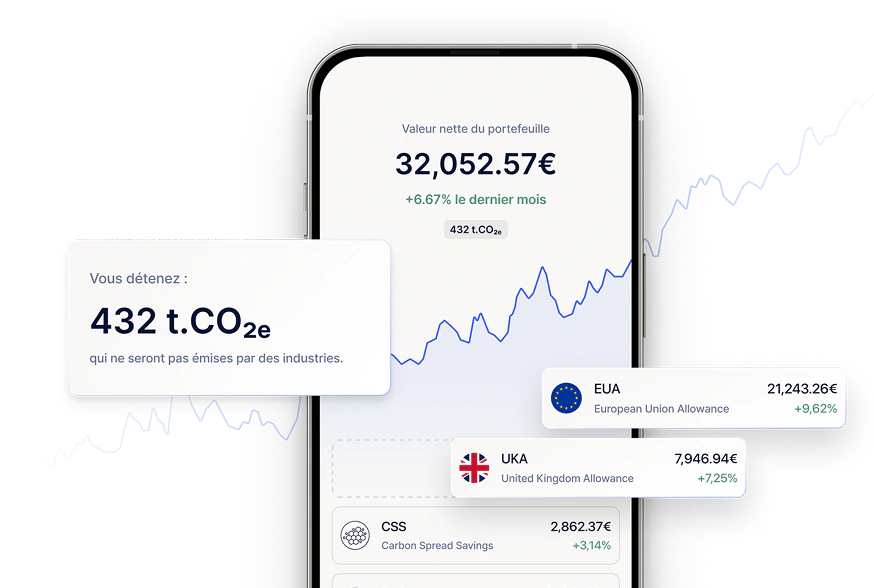
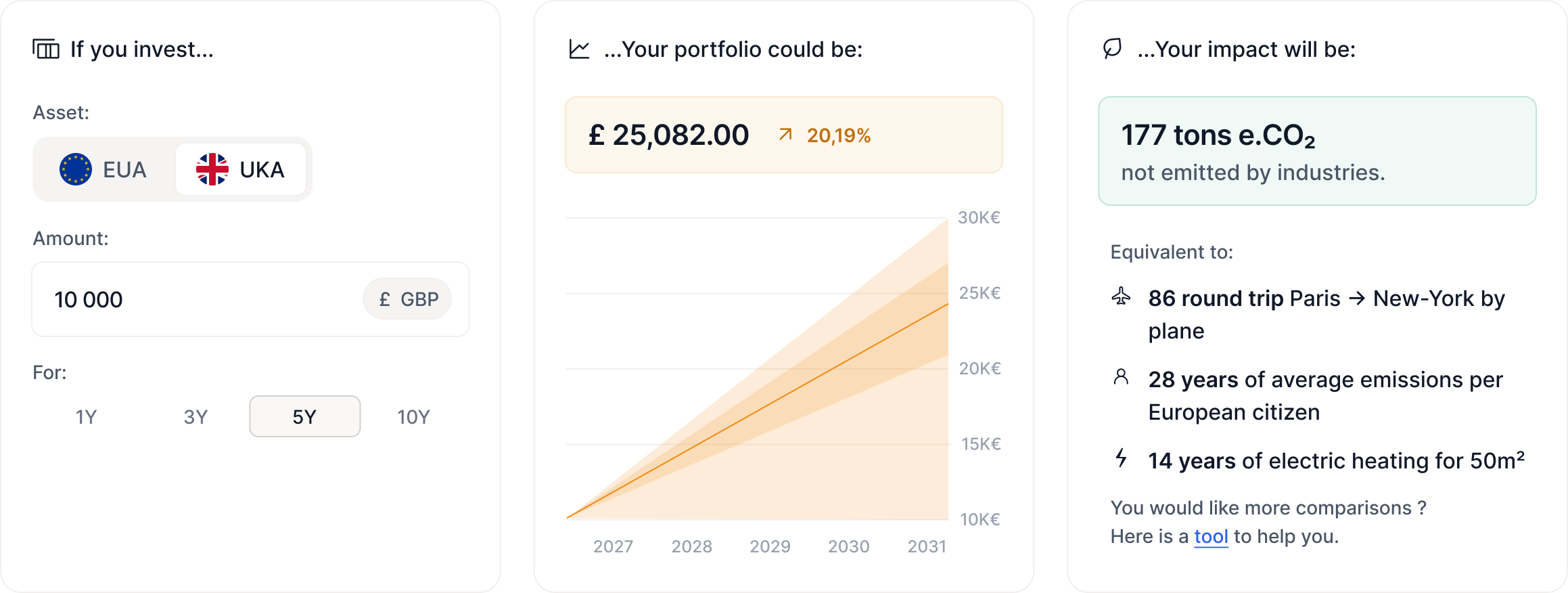
Until recently, this market was the preserve of institutional investors. As the leading European platform, we have opened access to the carbon market to retail investors. The mechanism is simple and direct: by buying carbon emission allowances (EUA) via our platform, you remove them from circulation. Each allowance withdrawn is one fewer right to pollute for an industrial player, which creates upward pressure on the carbon price.
By doing so, you make investments in decarbonization technologies and renewable energy more profitable for companies, thereby accelerating the transition. This investment, accessible from 1 000 €, combines financial return potential that is decoupled from traditional markets with direct, measurable climate impact.
Expert tip
Diversification is not only about asset classes, but also about impact strategies. Combining an investment in the creation of green infrastructure (via crowdfunding or RES funds) with an investment in the destruction of incentives to pollute (via the carbon market) can create a portfolio that is not only more resilient, but also more coherent in its ecological mission.
What risks and criteria should you assess before investing?
Like any investment, responsible investing in green energy involves risks that you need to understand before committing.
- Market risk : For shares and funds, the value of your investment will depend on the overall economic outlook and investor sentiment.
- Project risk : For direct investment, a project may face construction delays, technical issues, or breakdowns, affecting profitability.
- Regulatory risk : RES support policies may change, which could impact the profitability of future projects.
- Interest rate risk : Rising rates can make financing new projects more expensive and affect the valuation of existing infrastructure.
Before you start investing, ask yourself the right questions: what is my investment horizon? What level of risk am I willing to accept? What type of impact am I looking for (local, global)? The answers will guide your choice toward the most suitable vehicle.
Practical checklist to start your green investment
To get started with confidence, follow these key steps:
- Define your objectives : Are you primarily looking for returns, ecological impact, diversification, or a combination of all three?
- Assess your profile : Be honest about your risk tolerance and time horizon. A crowdfunding project locked up for 5 years is not suitable if you need your money in 2 years.
- Choose your vehicle : Crowdfunding for something tangible, ETFs for simplicity, Assurance vie for tax advantages, the carbon market for decoupled impact... select the tool that matches your objectives.
- Select a trusted intermediary : Whether it’s a platform, a broker, or an advisor, check its reputation, its transparency on fees, and regulatory compliance.
- Analyze in detail : Read the documentation (fund prospectus, project details). Do not rely solely on marketing claims.
- Start gradually and diversify : Do not invest all your savings at once. Start with a reasonable amount and spread it across multiple projects, funds, or strategies to smooth risk.
- Monitor your investments : Regularly review the performance of your investments and how well they still match your initial objectives.
Investing in renewable energy is a powerful approach that aligns the search for meaning with financial performance. Thanks to the range of options available, every saver can now become a player in the energy transition by choosing the strategy that suits them best. It is a commitment to your portfolio, but also to our collective future.
FAQ
What is the average return on an investment in renewable energy?
There is no single answer, because returns depend entirely on the investment vehicle chosen. Crowdfunding bond projects often offer fixed returns between 5 % and 8 % per year. Shares and ETFs have higher return potential but with far greater volatility and risk of loss. Past performance is never indicative of future performance.
Do you need a large amount of capital to start investing?
No—one of the sector’s key advantages is accessibility. You can invest in projects via participatory financing platforms starting from 10 or 20 euros. Similarly, buying one unit of a specialized ETF can be done for a few dozen euros via an online broker.
Does investing in a RES company share have the same impact as financing a project directly?
The impact is not the same in nature. Financing a new project directly (crowdfunding) contributes directly to increasing clean energy production capacity. Buying a share on the secondary market finances another investor who sells their security; the money does not go directly to the company to build a new plant. However, it supports the company’s valuation, which can help it raise funding more easily in the future. The impact is therefore more indirect.
Is investing via the carbon market a form of investing in RES?
It is a complementary and indirect strategy. By buying and withdrawing carbon allowances, you do not finance the construction of a wind turbine. However, you increase the cost of pollution for industries. This makes alternatives, such as renewable energy, more competitive and accelerates their adoption. It is therefore a powerful lever for the decarbonization of the economy, which is the ultimate goal of deploying RES.
Go further: invest in the carbon market
Homaio gives you access to European carbon allowances (EUAs), an asset class that combines potential financial performance with direct climate impact. Diversify your wealth with an asset uncorrelated from traditional markets, accessible from €1,000.