Passing on your wealth in 2026: plan ahead and protect it

How can you make sure the fruits of a lifetime’s work are passed on to your loved ones under the best conditions, without inheritance tax taking too large a share of your estate? It’s a legitimate question that deserves careful thought. Far from being a topic to address only at an advanced age, estate planning is an act of foresight that helps protect your family, ensure your wishes are respected, and optimize taxation.
Organizing the transfer of your assets is, above all, a way to take control of your future and that of your loved ones. Whether you want to help your children get started in life, protect your spouse, or simply ensure a fair and peaceful distribution of your assets, several solutions exist. Planning ahead is your greatest asset for turning a legal and tax obligation into an opportunity to secure the future.
Why plan ahead for passing on your wealth?
Waiting until the last minute to organize the transfer of your assets is a common mistake. In France, inheritance and gift taxes can be particularly high, reaching up to 60% for transfers outside the immediate family circle. Planning ahead not only makes it possible to significantly reduce this tax burden, but also to avoid potential family conflicts by clarifying the distribution while you are still alive.
Transfer taxation varies greatly depending on the relationship between the donor (the person giving) and the beneficiary. Understanding these rules is the first step in building an effective strategy.
Taxation in the direct line (parents/children)
An allowance of 100 000 € applies from each parent to each child, and this allowance renews every 15 years. Beyond that, the progressive scale applies:
Taxation between spouses or PACS partners
The situation is very different between gifts and inheritance.
- Inheritance: The surviving spouse or PACS partner is fully exempt from inheritance tax.
- Gift: An allowance of 80 724 € applies (renewable every 15 years). Beyond that, a progressive scale is applied.
Watch out for the status of an unmarried partner
Cohabitation offers no legal protection in inheritance matters. In the absence of a will, your unmarried partner inherits nothing. If they are named as a legatee by will, they will be taxed at 60% on the value of the assets received, after a symbolic allowance of 1 594 €. Planning ahead is therefore absolutely crucial to protect them.
Taxation for other beneficiaries
For siblings, nephews/nieces, or third parties, taxation is much heavier, with low allowances and high rates:
These figures speak for themselves: without a strategy, a significant share of your wealth can go in taxes.
Solutions for passing on assets during your lifetime: gifting
Giving part of your wealth before your death is the most direct method to help your loved ones and optimize your estate. It is a generous act, but one that must be properly structured.
A simple gift and a hand-to-hand gift
The simplest way to give is the hand-to-hand gift. It consists of physically handing over movable property: a sum of money, jewelry, a car, a securities portfolio... Although simple, this gift must be declared to the tax authorities so that the allowance can apply and the 15-year period starts running.
A simple gift by notarized deed is mandatory for real estate. It formalizes the transfer of ownership and ensures complete legal security.
The shared gift: for lasting family peace
The shared gift is a powerful tool to avoid future disputes. Unlike a simple gift, the assets given as part of a shared gift are not revalued at the date of death.
Their value is fixed on the day of the gift. This guarantees perfect fairness between heirs and prevents a child who received an asset that greatly increased in value from being accused of having been favored. It can even be “transgenerational,” allowing you to pass assets directly to your grandchildren.
Allowances: how much can you give without paying tax?
The tax system encourages early transfers through allowances that renew periodically. Here are the main limits to know:
- 100 000 € per parent to each child, every 15 years.
- 31 865 € per grandparent to each grandchild, every 15 years.
- 80 724 € between spouses or PACS partners, every 15 years.
- A family gift of cash sums (separate from the hand-to-hand gift) allows you to give an additional 31 865 € exempt from duties, subject to conditions (donor under 80, beneficiary an adult).
By using these allowances strategically every 15 years, it is possible to pass on a very significant share of your wealth completely tax-free.
Preparing your estate: tools for what comes after
If gifting organizes transfers during your lifetime, other tools help define precisely what will happen to your assets after your death.
The will: expressing your final wishes
A will is a written document in which you designate the people who will receive your assets (legatees) and in what proportions. It allows you to distribute your wealth according to your wishes, going beyond the statutory rules of inheritance.
For example, you can favor one heir, benefit a loved one who is not a legal heir (such as an unmarried partner), or bequeath an asset to an association.
However, you must respect the “reserved portion”. In France, part of your wealth is mandatorily reserved for your descendants (or for your spouse if there are no descendants). You can dispose freely only of the remaining share, called the “disposable portion”.
The “gift to the last surviving spouse”
Also called a “gift between spouses,” this notarized deed increases the share of inheritance for the surviving spouse. It gives them broader options over the estate, allowing them to choose among several distributions (for example, the entire estate in usufruct or a portion in full ownership). It is an essential tool for protecting your spouse, especially when the wealth is mostly made up of separate property.
Advanced wealth optimization strategies
Beyond gifts and wills, more sophisticated structures make it possible to refine your transfer strategy.
Life insurance: a favorable tax framework
Life insurance is often described as the “Swiss Army knife” of wealth management—and rightly so. Capital passed on through a life insurance policy upon the insured’s death does not form part of the estate. It is subject to specific taxation that is far more favorable.
- For payments made before age 70: each designated beneficiary benefits from an allowance of 152 500 €. Beyond that, taxation is 20%.
- For payments made after age 70: the overall allowance is 30 500 € (to be shared among all beneficiaries), and the remaining capital is then reintegrated into the standard estate.
This tool is ideal for passing capital to people who are heavily taxed under standard inheritance rules (unmarried partner, nephews/nieces, friends...).
Split ownership: giving without giving up
Split ownership consists of separating full ownership of an asset into two parts:
- Usufruct: the right to use the asset and receive its income (live in an apartment or rent it out).
- Bare ownership: the right to dispose of the asset (sell it), but without being able to use it.
Giving the bare ownership of an asset (often real estate) to your children while keeping the usufruct is a very effective strategy. Gift duties are calculated only on the value of the bare ownership, which is discounted depending on the usufruct holder’s age. When the latter dies, the usufruct ends and the children automatically become full owners, with no inheritance tax to pay.
Advice beyond tax
A successful transfer cannot be reduced to numbers and allowances. I have supported families where the shared gift, perfectly optimized on paper, created tensions because communication had broken down. Talking about your intentions, explaining your choices, and listening to everyone’s expectations is just as fundamental as the notarized deed itself. It is the oil in the gears that guarantees family peace.
The Société Civile Immobilière (SCI) to pass on a real estate asset
Creating an SCI to hold real estate wealth makes its transfer much easier. Rather than giving a piece of a wall, you give shares.
This method makes it possible to transfer an asset gradually, by giving shares every 15 years to fully use the allowances, while keeping management rights and therefore control of the asset. It is also an excellent way to avoid joint ownership, which is often a source of conflict.
What if we thought about passing on assets beyond traditional wealth?
Organizing your estate also means questioning the nature of the assets you wish to bequeath. Beyond real estate and traditional financial investments, new forms of wealth are emerging, combining potential returns with personal convictions.
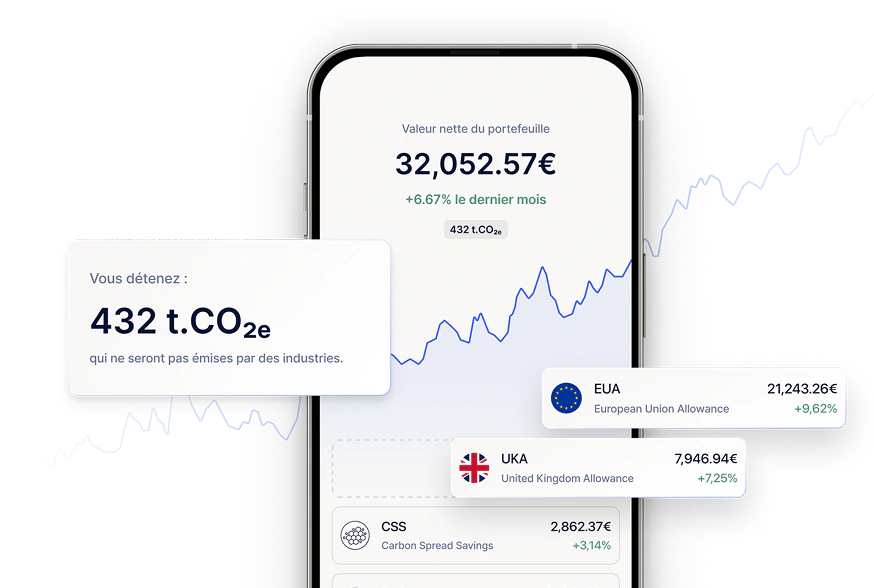
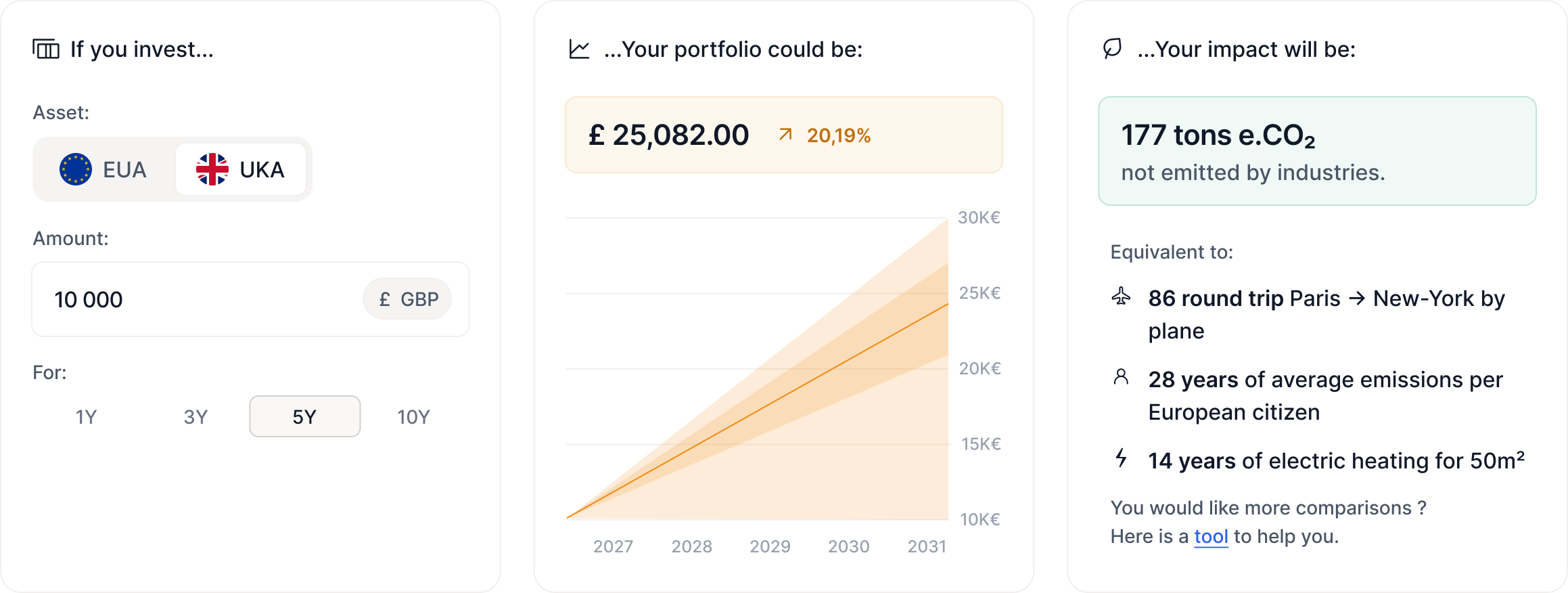
With this in mind, innovative solutions make it possible to diversify a portfolio. Some investors turn to assets with a dual objective: financial performance and a positive environmental impact. This is the case with investment in European carbon allowances (EUA), a market that has so far been reserved for institutional investors.
Our platform, Homaio, was created precisely to open this access to individuals. The principle is simple: by purchasing carbon allowances through our service, you withdraw them from the regulated market. Mechanically, this reduces the number of “rights to pollute” available to European industries, encouraging them to accelerate their decarbonization.
This financial asset, uncorrelated with traditional markets, then becomes a full component of your wealth. It can be integrated into a transfer strategy in the same way as an equity portfolio or SCI shares. It is a way to pass on not only financial value, but also a meaningful legacy aligned with tomorrow’s climate challenges.
Passing on your wealth is a long-term project that requires reflection and advice. The solutions are numerous and can be combined to create a tailor-made strategy, adapted to your family and wealth situation and your personal objectives. Don’t wait to ask the right questions and consult professionals, such as a notary or a wealth management advisor, who can guide you. The key is to act early to ensure a peaceful future for those you love.
Frequently asked questions
What is the main difference between a gift and an inheritance?
A gift is an act by which you transfer part of your wealth during your lifetime. Inheritance, on the other hand, organizes the transfer of all your assets after your death. A gift allows you to plan ahead, use renewable tax allowances, and control the distribution, whereas inheritance is endured and subject to strict legal rules if nothing has been prepared.
Can I completely disinherit one of my children?
No, under French law, that is not possible. The law protects so-called “reserved heirs” (primarily children). A share of your wealth, the “reserved portion,” must be allocated to them. You can dispose freely by will or gift only of the “disposable portion,” which is the remaining share.
How often can I make a gift without paying tax?
The main tax allowances (for example, the 100 000 € from a parent to a child) renew every 15 years. This means you can give up to that amount every 15 years to the same person completely tax-free. This period is fiscal: if you give more than the allowance allowed over a 15-year period, gift duties will be due on the excess.
Is writing a will mandatory?
No, a will is not mandatory. In its absence, the law designates your heirs and their respective shares, according to an order of priority (the “statutory order of inheritance”). However, a will is strongly recommended if you want to deviate from these rules: to favor your spouse, allocate a specific asset to a person, or pass on part of your wealth to someone who is not a legal heir (unmarried partner, friend, association).
Go further: invest in the carbon market
Homaio gives you access to European carbon allowances (EUAs), an asset class that combines potential financial performance with direct climate impact. Diversify your wealth with an asset uncorrelated from traditional markets, accessible from €1,000.