Alternative investments 2026: definition, benefits and risks

An alternative investment is an investment that is not part of traditional categories such as listed equities, bonds, or cash. It includes a wide range of assets such as unlisted real estate, private equity, or infrastructure. Its main objective is portfolio diversification.
Financial markets can sometimes seem complex, and you may hear about new forms of investing. Alternative investments are gaining visibility, but they are still often misunderstood by the general public. Behind this term lies a broad diversity of assets, each with its own rules, potential, and risks.
Alternative investment: a simple definition
An alternative investment refers to any asset class that falls outside the three major traditional categories:
- Equities (shares in companies listed on the stock exchange).
- Bonds (debt securities issued by governments or companies).
- Cash (current accounts, savings accounts, etc.).
These investments stand out due to their nature, how they work, and often their low correlation with traditional stock markets. They may include physical assets (real estate, forests) or investments in unlisted companies. Their management is generally more complex and they were historically reserved for institutional investors.
What are the main alternative investments?
The universe of alternative investments is vast. Here are the most common categories, explained simply.
Real estate and property investing
Real estate is one of the best-known alternative investments. This is not only about buying your primary residence, but investing in properties intended for rental or resale. For individuals, access is often through pooled funds such as SCPI (Sociétés Civiles de Placement Immobilier), which make it possible to invest in a diversified real-estate portfolio (offices, retail, warehouses) by buying units.
Private equity and private debt
Private Equity, or private equity investing, involves investing directly in the equity of companies that are not listed on the stock exchange. The goal is to finance their development (creation, growth, transmission) in order to realize a capital gain when selling the stake, generally after several years.
Private debt works on a similar principle, but instead of taking an equity stake, investors lend money to those same companies in exchange for interest payments. These two types of assets finance what is known as the “real economy”.
[image alt="Diagram illustrating the difference between public markets (listed shares) and private markets (private equity)."]
Infrastructure, commodities, and other assets
This category brings together tangible assets that are essential to the functioning of the economy:
- Infrastructure: airports, highways, energy networks, wind farms. These projects often offer stable, long-term income.
- Commodities: gold, oil, industrial metals, agricultural products. Their value fluctuates with global supply and demand.
- Forests and farmland: tangible investments whose value is uncorrelated with financial markets.
- Collectibles: art, wine, classic cars. These markets are very specific and require deep expertise.
Hedge funds and liquid alternative strategies
“Hedge Funds” are investment funds that use complex management strategies in an attempt to generate performance regardless of market conditions (up or down). Although often classified as “alternative”, some of their equivalents for the general public (so-called “absolute return” funds) can offer daily liquidity, like a traditional equity fund.
Why investors are interested: diversification, returns, decoupling
The main appeal of alternative investments lies in diversification. By introducing into a portfolio assets whose value does not move in the same way as equities and bonds, an investor can potentially reduce the overall risk of their wealth. This is known as decoupling (low correlation).
For example, the value of an office portfolio or a forest is not directly impacted by a sharp stock market crash. This decoupling is never perfect, but it can help cushion shocks in traditional markets.
Some investors also turn to these assets in search of a different return potential, in exchange for higher risk and a longer time horizon.
A word from the expert
Historically, periods of high inflation have often highlighted the limits of portfolios made up only of equities and bonds. In this context, tangible assets such as real estate or infrastructure have sometimes held up better, underscoring the structural importance of diversification beyond listed financial markets alone.
What are the risks of alternative investments?
Alternative investments are not a miracle solution and come with specific risks that are essential to understand before making any commitment.
Risk of capital loss and volatility
As with any investment, the risk of capital loss is very real. The value of alternative assets can fall, and you may not recover your entire initial investment. Past performance is never a guarantee of future performance.
Illiquidity, long horizon, and valuation
This is one of the major risks. Unlike a share that can be sold in a few seconds, many alternative investments are illiquid. This means your money may be locked up for several years (often between 5 and 10 years, or even longer). It is therefore crucial to invest only money you will not need in the short or medium term.
The valuation of these assets is also less transparent. The price of an unlisted company or an infrastructure project is not displayed in real time, which makes it more complex to assess.
Pay attention to the investment horizon
Illiquidity is not a flaw, but an intrinsic feature of many alternative assets. Before investing, the question is not “what will the return be?” but “for how long am I certain I won’t need this money?”. If the answer is not clear, this type of investment is probably not suitable.
Fees, complexity, and lack of transparency
Managing alternative investments requires advanced expertise, which translates into fees that are often higher than for traditional funds (entry fees, annual management fees, performance fees).
How they work can be complex for non-specialists to grasp. It is essential to read all legal documentation carefully and not hesitate to ask questions to fully understand where and how your money will be invested.
[image alt="Simple infographic comparing liquidity and time-horizon characteristics for equities, bonds, and alternative investments."]
How can individuals access alternative investments?
Access to alternative investments has gradually become more democratized, but it remains regulated.
Funds, regulated vehicles, and minimum investment
For individuals, access is almost exclusively via investment funds. These funds pool the savings of many investors and allocate them to different projects or assets. They can take several legal forms (FCPR, FPCI, SLP, etc.), each with its own rules.
The minimum investment has long been very high, restricting these investments to wealthy clients. Today, it is possible to find solutions accessible from a few thousand, or even a few hundred euros, notably via online platforms or life insurance contracts.
ELTIFs: what you need to understand
The ELTIF (European Long-Term Investment Fund) is a European label created to facilitate retail investors’ access to long-term projects such as infrastructure or the financing of unlisted companies.
Its regulatory framework aims to offer greater investor protection, while enabling the financing of the real economy. It is one of the vehicles helping to make private equity and other illiquid assets more accessible.
Alternative investments vs. traditional investments: what are the differences?
Warning: All investments involve a risk of capital loss. The information presented in this article is for informational purposes only and does not in any way constitute investment advice, a recommendation, or a solicitation to buy or sell. It is essential to be supported by a professional for any wealth-management decision.
FAQ on alternative investments
What is an alternative investment?
An alternative investment is an investment outside the traditional categories of listed equities, bonds, and cash. It may include, for example, real estate, private equity, infrastructure, or commodities. The goal is often to diversify your wealth and reduce correlation with traditional financial markets.
What are alternative investments?
The main alternative investments include:
- Unlisted real estate (via funds such as SCPI).
- Private Equity (investing in unlisted companies).
- Private debt (loans to unlisted companies).
- Infrastructure (highways, airports, renewable energy).
- Commodities (gold, oil, etc.).
- Tangible assets such as forests, farmland, art, or wine.
What are the best alternative funds?
There is no single “best alternative fund” in absolute terms. Choosing a fund depends entirely on each investor’s personal situation: their objectives, investment horizon, risk tolerance, and the amount they wish to allocate. A ranking would be misleading, because a fund suitable for one person may not be suitable for another. The analysis of the management strategy, fees, risk level, and the quality of the management company should be carried out with the help of a professional financial advisor.
Where should you invest 10.000 € today?
This question cannot have a single, universal answer, because it falls under personalized investment advice, which this article does not provide. Allocating 10 000 € depends on your goal (preparing for retirement, buying a property, growing savings), your time horizon (do you need this money in 1, 5, or 20 years?), and your sensitivity to risk. For an appropriate answer, it is essential to consult a wealth management advisor who will carry out a full review of your situation.
Go further: invest in the carbon market
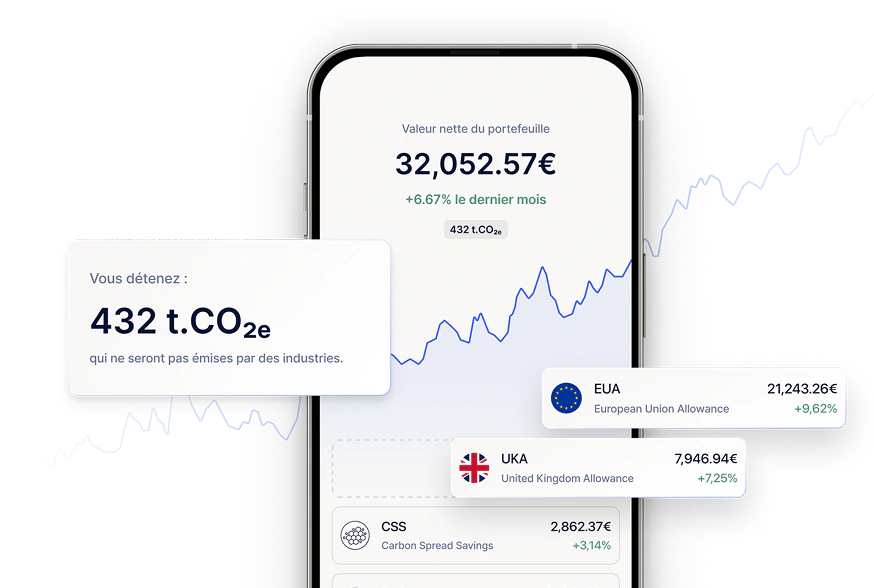
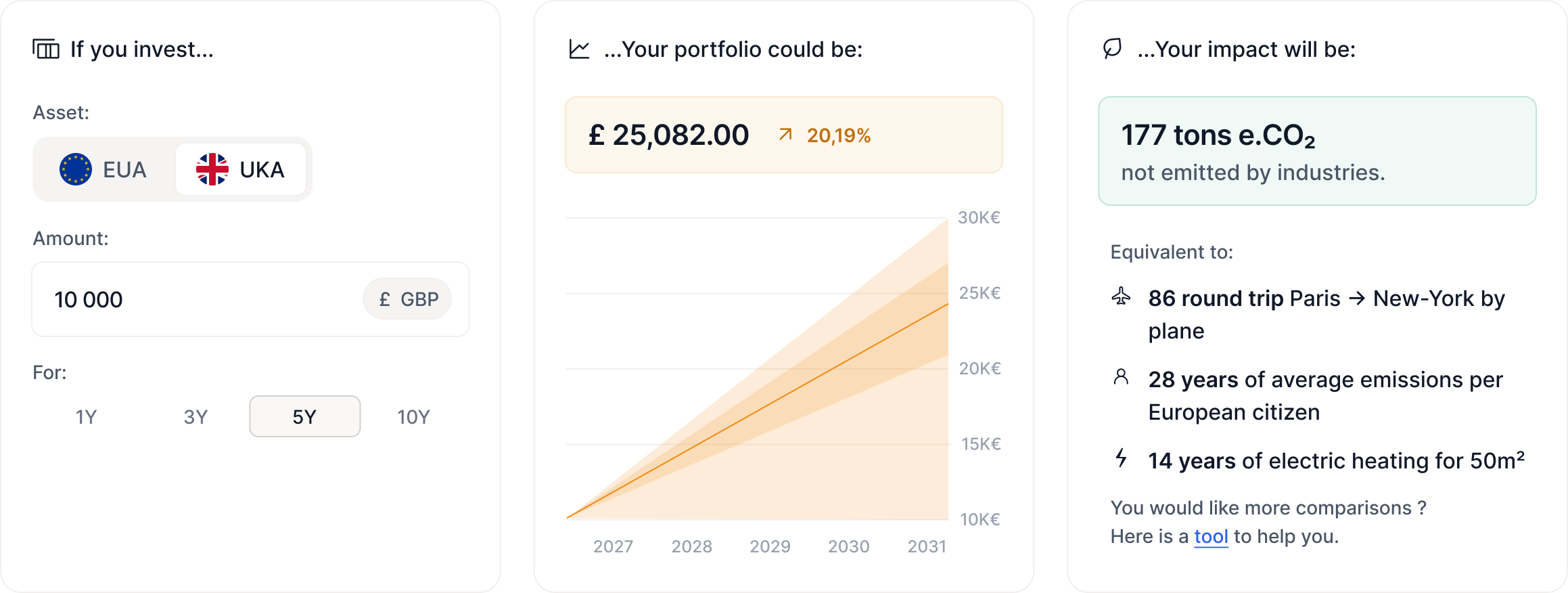
Homaio gives you access to European carbon allowances (EUAs), an asset class that combines potential financial performance with direct climate impact. Diversify your wealth with an asset uncorrelated from traditional markets, accessible from €1,000.