Safe haven asset: definition, examples, and limitations

A safe haven asset is a financial asset that tends to preserve, or even increase, its value during an economic crisis or market uncertainty. Investors turn to it to protect their wealth from the volatility of other investments. Gold is often cited as the prime example, but other assets such as certain currencies or government bonds can also play this role, especially in the event of war or high inflation.
Understanding what a safe haven asset is is essential for deciphering financial market movements in times of crisis. These assets are not a guarantee of profit, but they are perceived as an anchor of stability when other investments, such as CAC 40 stocks, are struggling.
Warning: This content is for informational purposes only and does not constitute investment advice. Past performance is not indicative of future performance. Any investment decision must be made based on your personal situation, your objectives, your investment horizon, and your risk profile.
Safe haven asset: a simple definition and what it is for
A safe haven asset is, above all, a protection instrument. Its main characteristic is that it is uncorrelated, or negatively correlated, with equity markets. Concretely, when the stock market falls, a safe haven asset tends to remain stable or see its value increase.
This mechanism is explained by investor psychology. In times of uncertainty (economic crisis, geopolitical tensions, high inflation), fear outweighs risk appetite. Investors then sell assets deemed risky, such as stocks, in large numbers to buy assets perceived as safer.
This flight to quality increases demand for safe haven assets and, consequently, supports their price. Their main role is therefore not to generate a high return in normal times, but to preserve capital when markets are in the middle of a storm. A synonym often used is “safe investment”, although the notion of a “haven” places more emphasis on behavior during a crisis.
Not to be confused
A safe haven asset is not necessarily a risk-free investment. It differs from a “defensive asset” (such as shares in consumer staples companies) which tends to hold up better during recessions but remains correlated with the equity market.
Why investors seek safe haven assets during a crisis
The appeal of safe haven assets is a reflex of caution driven by risk aversion. Several types of crises can trigger this movement:
- Economic and financial crises: During a stock market crash or a recession, confidence in the economy collapses. Investors seek to lock in gains or limit losses by turning to tangible assets or assets backed by very solid entities.
- Periods of high inflation: When a currency loses value, assets that preserve purchasing power become attractive. This is historically the case for gold or real estate, which are real assets with limited supply.
- Geopolitical tensions and wars: Political uncertainty and major conflicts push investors toward assets that do not depend on a single country or political system. Gold, due to its physical and universal nature, is often favored in this context.
- Sovereign debt crises: If a state is on the verge of default, confidence in its currency and its bonds erodes. Capital then moves toward the bonds and currencies of states deemed more reliable.
In all these scenarios, the safe haven asset acts like an insurance policy within a diversified investment portfolio.
What are the main safe haven assets?
No asset can claim to be a safe haven asset in all circumstances. Their relevance depends on the nature of the crisis. Here is an analysis of the main assets considered havens by investors.
Gold, the benchmark safe haven asset
Gold is often described as the “ultimate safe haven asset”. This status is based on millennia of history, during which it served as a medium of exchange and a store of value.
- Advantages: Its value is intrinsic and universally recognized. It depends neither on a company’s performance nor on a government’s monetary policy. It is a tangible, scarce, and durable asset. Its liquidity is excellent in the global market.
- Limitations: Gold generates no income (no interest and no dividends). Holding it physically involves costs (storage, insurance) and risks. Its taxation can be specific. Its price can be volatile in the short term.
Silver: a partial haven but more volatile
Silver is sometimes nicknamed “poor man’s gold”. It shares certain characteristics with gold, but its market is smaller and more volatile.
- Advantages: Like gold, it is a tangible and recognized precious metal. It is more accessible due to its lower price.
- Limitations: Silver has a dual role: monetary and industrial. Around half of demand comes from industry (electronics, solar panels, etc.). In the event of an economic recession, this industrial demand can fall and weigh on its price, limiting its role as a haven. Its volatility is much higher than that of gold.
Government bonds from solid countries
Sovereign bonds issued by states deemed very reliable (such as Germany, Switzerland, or the United States) are a classic safe haven asset in financial markets. Buying a bond means lending money to a state in exchange for interest.
- Advantages: The risk of default is considered almost zero for the best issuers. They generate a regular and predictable income (the coupon). They often benefit from a “flight to quality” during crises.
- Limitations: Their value is very sensitive to changes in interest rates. If policy rates rise, the value of older bonds (with lower rates) falls. Inflation can also erode the real return on the investment.
Strong currencies such as the Swiss franc or the dollar depending on the context
Some currencies are perceived as more stable than others thanks to the strength of the economy and the political system that supports them.
- Advantages: The Swiss franc (CHF) benefits from Switzerland’s political neutrality and economic stability. The US dollar (USD) is the world’s main reserve and trading currency, which creates strong demand in the event of a global crisis. The Japanese yen (JPY) has also played this role in the past.
- Limitations: Currencies are subject to central bank decisions and monetary policies. Currency risk is permanent: one currency can depreciate against another, causing a loss for the investor.
Real estate: a possible haven, but not in all scenarios
Real estate, “bricks and mortar”, is often seen as a hedge against inflation and a source of stable income.
- Advantages: It is a tangible asset that meets a fundamental need (housing). It can generate regular rental income. Over the long term, it has historically tended to appreciate.
- Limitations: Real estate is very illiquid: selling a property can take months. Acquisition and holding costs are high (notary fees, taxes, maintenance). Its value depends heavily on the local market and credit rates. It is not a good haven in the event of a real estate crisis or a sharp rise in rates.
[image alt="Comparative table of the characteristics of different safe haven assets: gold, bonds, currencies, and real estate."]
How to recognize a good safe haven asset
Several criteria can be used to assess an asset’s ability to play the role of a haven:
- Liquidity: Can the asset be bought or sold quickly, in large quantities, and without significantly impacting its price?
- Longevity: Has the asset proven its ability to retain value over very long periods and through different crises?
- Universal recognition: Is its value recognized by as many people as possible, beyond borders?
- Limited supply: Is its quantity limited, thereby protecting it from devaluation through excessive creation?
- Decorrelation from markets: Does its price move independently of, or inversely to, equity markets during periods of stress?
What is the best safe haven asset depending on the context?
There is no universal “best” safe haven asset. The choice depends entirely on the nature of the threat an investor is seeking to protect against.
- In the event of high inflation: Real assets such as gold and real estate are often favored because their value tends to rise with the general price level.
- In the event of a stock market crash or recession: Government bonds from the safest countries and strong currencies attract capital fleeing equity market risk.
- In the event of war or a major geopolitical crisis: Gold has historically been favored for its physical nature, anonymity, and independence from any political system.
Diversification among several types of safe haven assets is an approach often observed to guard against different scenarios.
Why a safe haven asset can also fall
The term “haven” can be misleading. It guarantees neither capital preservation nor positive performance. Any safe haven asset carries risks and can see its price fall.
- The bubble effect: If a crisis pushes too many investors to rush into the same asset (for example, gold), its price can rise excessively and form a bubble. When the crisis ends and confidence returns, investors sell the safe haven asset to move back into equity markets, causing its price to fall.
- Risks specific to each asset: Government bonds fall when interest rates rise. Gold can suffer from a strong appreciation of the dollar (its price being denominated in USD). Real estate can collapse in the event of a credit crisis.
- Lack of yield: Assets such as gold do not produce cash flows. In periods of calm and economic growth, they can underperform other investments that generate dividends or interest.
No guarantee
Safe haven status is not permanent and is based on investors’ collective confidence. An asset considered a haven today might not be one tomorrow. Past performance is never a guarantee of the future.
[image alt="Chart illustrating the volatility of a safe haven asset like gold, with peaks and troughs."]
FAQ on safe haven assets
What are safe haven assets?
The main safe haven assets are gold, silver, government bonds from the countries considered most reliable (such as the United States or Germany), and certain strong currencies like the Swiss franc or the US dollar. Real estate can also be considered a safe haven asset in certain contexts, particularly against inflation.
What is the best safe haven asset?
There is no absolute “best” safe haven asset. The choice depends on the type of risk you want to protect against. Gold is often favored in the event of a systemic crisis or inflation, while government bonds and strong currencies are sought during conventional stock market crises.
What is the ultimate safe haven asset?
Gold is historically and culturally considered the ultimate safe haven asset. Its status is based on its scarcity, durability, universal recognition, and independence from governments and financial systems. It has served as a store of value for thousands of years.
What are safe haven assets in the event of war?
In times of war, investors mainly turn to tangible and portable assets, such as gold and other precious metals. The currencies of neutral countries or countries geographically far from the conflict (for example, the Swiss franc) as well as the bonds of states perceived as very stable are also considered havens.
Go further: invest in the carbon market
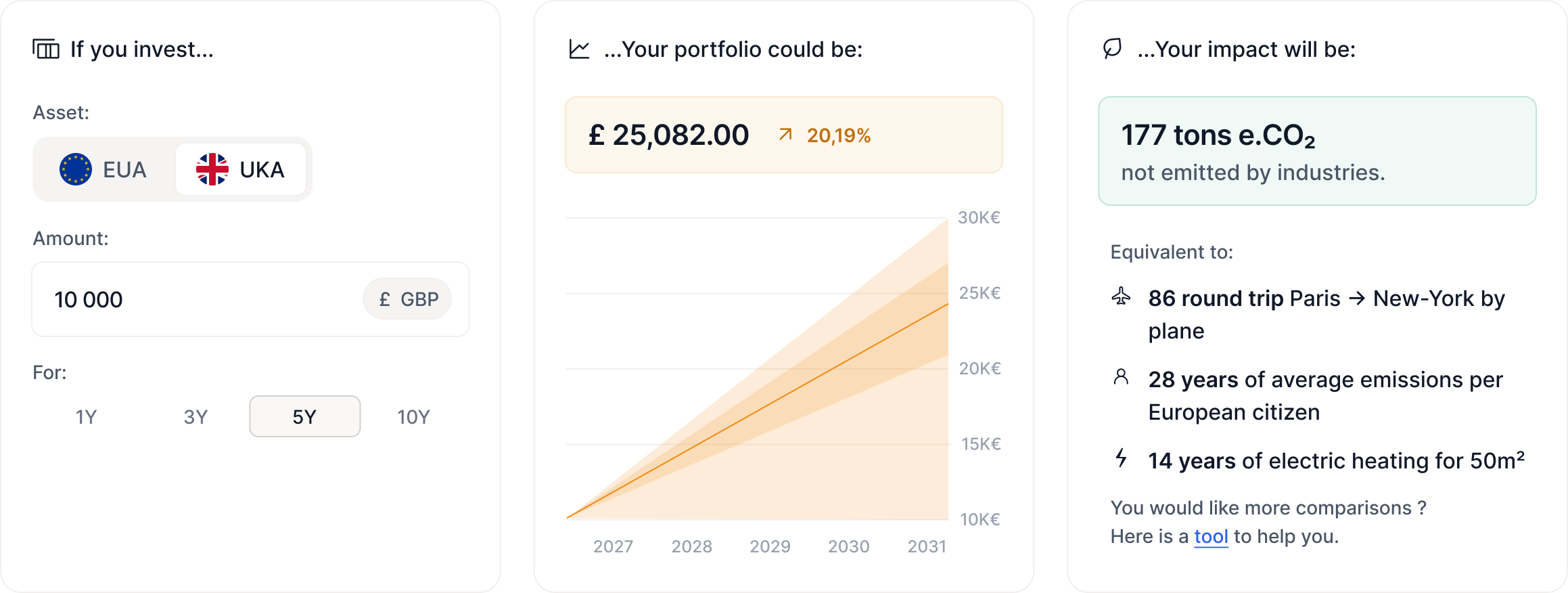
Homaio gives you access to European carbon allowances (EUAs), an asset class that combines potential financial performance with direct climate impact. Diversify your wealth with an asset uncorrelated from traditional markets, accessible from €1,000.