Sustainable development 2026: strategies and concrete actions

In the face of the climate and social emergency, how can you rethink your model of society to guarantee a viable future for everyone? Sustainable development is no longer a simple option, but the only path to shared prosperity that respects the limits of your planet.
Far from being an abstract concept, it is a concrete roadmap, engaging states, businesses, and citizens alike. It invites you to transform your modes of production, consumption, and investment to build a future where the economy serves human well-being and the health of the ecosystem.
What is sustainable development?
The concept of sustainable development was formalized for the first time in 1987 in the Brundtland Report, commissioned by the United Nations. It is defined there as “development that meets the needs of the present without compromising the ability of future generations to meet their own needs.”
This definition, which has become a global reference, is based on two fundamental ideas:
- The concept of “needs”, giving absolute priority to the essential needs of the most disadvantaged.
- The idea of “limitations”, recognizing that the state of our technologies and our social organization imposes constraints on the environment’s ability to meet present and future needs.
Intergenerational and universal scope
Beyond its main definition, sustainable development asserts a dual responsibility. On the one hand, a responsibility over time: you have the right to use the Earth’s resources, but the duty to ensure their long-term preservation for generations to come. On the other hand, a responsibility in space: every human being has an equal right to the planet’s resources, a principle of the universal destination of goods.
This notion emerged following a growing awareness, from the 1970s onward, of the finiteness of your world. Successive ecological crises—global warming, biodiversity collapse, resource scarcity—have shown that your model of economic growth was not infinite, because planetary resources are finite. Sustainable development is therefore the response to this systemic crisis.
The three pillars: an essential balance
To be truly effective, a sustainable development strategy must be based on the balance of three interdependent dimensions, often called the “three pillars.” This balance was enshrined at the Rio Earth Summit in 1992. A project is considered sustainable only if it is economically efficient, socially equitable, and environmentally sustainable.
Economic pillar
Contrary to a common misconception, sustainable development is not the enemy of the economy. It aims to create wealth and ensure economic growth, but in a different way.
The objective is to promote an economically viable model that does not come at the expense of natural resources or social well-being. This implies rethinking production and consumption patterns, innovating to decouple growth from resource use, and ensuring a fairer distribution of the wealth generated.
Social pillar
The social pillar places people at the heart of development. It aims to guarantee everyone access to fundamental needs: health, education, housing, decent work, and security.
It involves fighting poverty and inequalities, promoting gender equality, and ensuring social cohesion. Development is not sustainable if it leaves part of the population behind or creates fractures within society. The participation of all stakeholders, from civil society to local communities, is essential to achieve this goal of equity.
Environmental pillar
This is often the most visible pillar. It consists of preserving the integrity of ecosystems, protecting biodiversity, and sustainably managing natural resources (water, energy, raw materials).
In the face of climate change, it requires a drastic reduction in greenhouse gas emissions and a transition to renewable energy. The point is not to put nature “under a bell jar,” but to recognize that your survival and your economy depend entirely on the health of your planet.
The 2030 Agenda and the 17 Sustainable Development Goals (SDGs)
To translate these broad principles into measurable action, UN member states adopted the 2030 Agenda in 2015. At the heart of this global action plan are the 17 Sustainable Development Goals (SDGs).
These goals are a universal roadmap to eradicate poverty, protect the planet, and ensure prosperity for all by 2030. They cover all the challenges of sustainable development, including:
- Fighting poverty (SDG 1) and hunger (SDG 2)
- Good health and well-being (SDG 3) and quality education (SDG 4)
- Gender equality (SDG 5)
- Clean water and sanitation (SDG 6)
- Affordable and clean energy (SDG 7)
- Decent work and economic growth (SDG 8)
- Climate action (SDG 13)
- Life below water (SDG 14) and life on land (SDG 15)
- Peace, justice and strong institutions (SDG 16)
These goals are indivisible and interconnected. Progress on one can have a positive impact on the others, while backsliding can hinder several. They serve as a reference framework for public policies, but also for corporate strategies and citizen initiatives.
The crucial role of businesses and finance
Sustainable development is no longer the preserve of governments and NGOs. Businesses are now recognized as essential players in this transition. Corporate Social Responsibility (CSR) is the application of these principles within organizations. It encourages them to reconcile economic performance, environmental protection, and social progress in their activities and in their interactions with stakeholders.
At the same time, the world of finance is undergoing a profound transformation. Sustainable finance and impact investing are gaining ground, driven by investors who are no longer satisfied with a purely financial return. They want their capital to actively contribute to solving social and environmental challenges. This new approach turns investing into a powerful lever for action.
Directing capital toward decarbonization
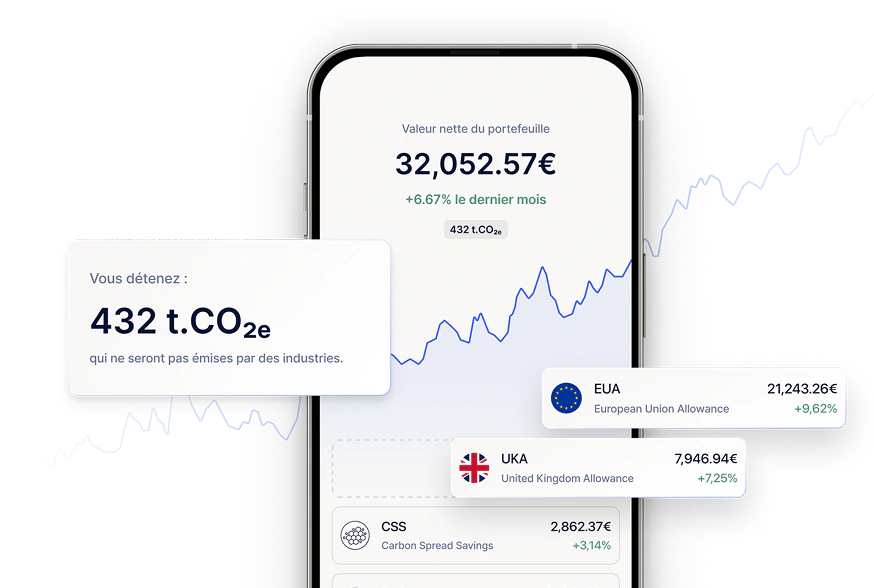
Innovative mechanisms are emerging to enable citizens to align their finances with their values. This is the case for platforms that open access to the regulated carbon market (EU ETS), one of the European Union’s main tools for achieving its climate objectives. Historically reserved for industrial players and institutions, this market is now accessible to individuals.
The principle is simple yet highly effective: by buying carbon emission allowances, investors remove them from circulation. This action mechanically reduces the number of “rights to pollute” available to the highest-emitting industries. The resulting scarcity drives up the price of CO2, making investments in clean technologies and decarbonization more profitable for companies.
Investment and risk
It is important to remember that investing in carbon markets, like any financial asset, involves a risk of capital loss. Its value fluctuates depending on political decisions, economic conditions, and supply-and-demand dynamics. It is not a guaranteed savings product. It is suitable for informed investors, aware of the risks and looking to diversify their portfolio while generating measurable environmental impact.
This type of responsible investment perfectly illustrates the convergence of the three pillars:
- Economic: It offers exposure to an asset uncorrelated with traditional financial markets, with performance potential.
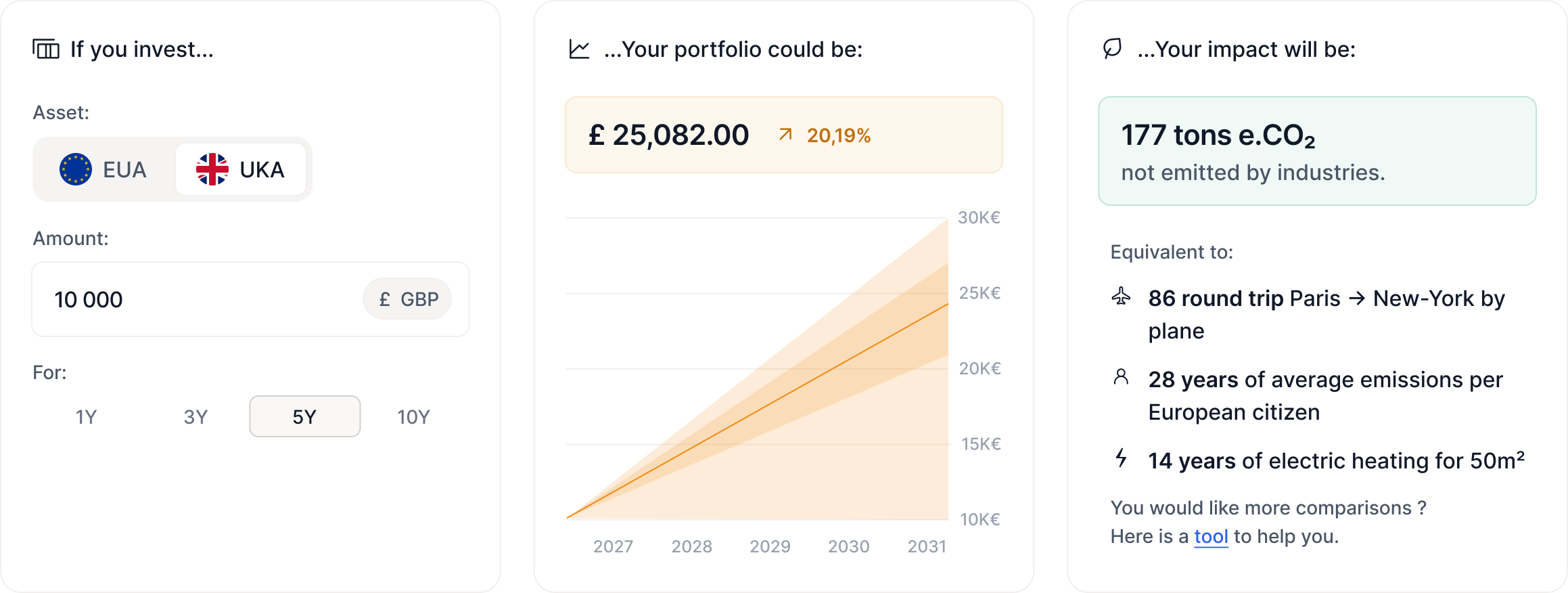
- Environmental: The impact is direct, concrete, and measurable. Each allowance held corresponds to one tonne of CO2 that will not be emitted.
- Social: By accelerating the ecological transition, it contributes to building a healthier environment and a more resilient economy for society as a whole.
By choosing to invest your money in solutions that promote a sustainable model of society, you are no longer merely financing the economy; you are actively participating in its transformation. If you are looking to design an investment portfolio aligned with your values, such options represent a major step forward.
Ultimately, sustainable development is a holistic vision that commits all of you. It is less and less a choice and more and more a necessity to ensure the long-term viability of your societies. From international frameworks such as the SDGs to individual actions, including corporate strategies and financial innovations, the tools to accelerate this transition exist. The coming years will be decisive in turning this vision into a shared reality.
FAQ: Frequently asked questions about sustainable development
What is the difference between sustainable development and degrowth?
Sustainable development and degrowth are two different responses to the ecological crisis. Sustainable development does not reject the notion of economic growth, but seeks to transform it to make it compatible with planetary boundaries and social equity (“green” or “qualitative” growth). Degrowth, on the other hand, is a more radical critique that considers any form of economic growth to be incompatible with environmental preservation. It advocates a planned reduction in production and consumption to return within planetary limits.
Are the 17 Sustainable Development Goals (SDGs) binding?
No, the 17 SDGs are not legally binding. They constitute an action framework and a political commitment made by the UN’s 193 member states. Each country is responsible for implementing its own national strategy to achieve these goals. However, there is a voluntary follow-up and review mechanism that encourages countries to report on their progress, creating a form of “peer pressure” to spur action.
How can an individual contribute to sustainable development through their finances?
You have several levers. First, you can turn to responsible savings and investment products, such as funds labeled ISR (Socially Responsible Investment) or Greenfin. For a more direct impact, you can look to green finance solutions such as crowdfunding for renewable energy projects or, as mentioned, investing in compliance carbon markets. The idea is to ensure that your money does not finance harmful activities and, better still, that it actively contributes to the ecological and social transition.
Go further: invest in the carbon market
Homaio gives you access to European carbon allowances (EUAs), an asset class that combines potential financial performance with direct climate impact. Diversify your wealth with an asset uncorrelated from traditional markets, accessible from €1,000.