Long-term investing: principles, investment vehicles, and best practices

Long-term investing is a financial strategy that consists of investing your capital over a period of several years, generally 8 years or more. The goal is to target potential capital growth by smoothing short-term market fluctuations, while benefiting from the power of compound interest.
This approach differs from emergency savings, which should remain liquid and risk-free, and from speculation, which seeks quick gains over a short period with very high risk. A long-term strategy requires patience, discipline, and a good understanding of your own objectives.
Important warning
This article is purely informational and educational. It does not constitute personalized investment advice or a buy recommendation in any way. Any investment involves risks, including a partial or total loss of the invested capital. Before any decision, it is essential to clearly define your objectives, your investment horizon and your risk tolerance, and to be supported by a professional if necessary.
Long-term investing: simple definition and key principles
Long-term investing is based on a simple idea: time is your best ally. Rather than reacting to the daily ups and downs of the markets, you give your capital time to grow.
From what duration do we talk about the long term?
There is no official definition, but experts generally agree on a period of at least 8 to 10 years. This time horizon makes it possible to get through economic cycles and reduce the impact of a potential stock market crisis on the overall performance of your portfolio.
The more distant your objective is (preparing for retirement, financing the studies of a recently born child), the longer your investment horizon.
Why time, diversification, and regular contributions matter
An effective long-term strategy is built on three fundamental pillars:
- The compound interest effect : Albert Einstein is said to have called it the "eighth wonder of the world." Concretely, the interest you earn generates new interest itself. Over a long period, this snowball effect can significantly increase the value of your initial capital.
- Diversification : The famous saying "don’t put all your eggs in one basket" is the golden rule. By spreading your investment across different vehicles (stocks, real estate, bonds...), different geographic areas and different sectors, you pool risks. To build a diversified investment portfolio, you need to understand correlation between assets.
- Regular contributions (DCA) : Investing a fixed amount at regular intervals (for example, 100 € per month) helps smooth the average purchase price of your assets. You buy more shares when markets fall and fewer when they rise. This method, called Dollar Cost Averaging, creates discipline and avoids trying to "predict" the best time to invest, which is often a mistake.
What is the best long-term investment?
It’s the question everyone asks, but the answer is disappointing: there is no long-term investment that is universally the "best".
There is no single best investment
The miracle product offering high returns, zero risk, and immediate availability does not exist. An investment suitable for a 25-year-old aiming to build capital for a project in 15 years will not be the same as for a 55-year-old looking to prepare for retirement.
The best investment is the one that fits your personal situation.
Choose based on objective, horizon, risk, liquidity, and taxation
To build your strategy, you need to analyze five criteria:
- Objective : Why are you investing? (retirement, real estate purchase, wealth transfer, financial independence...).
- Horizon : When will you need this money? (8, 15, 30 years...).
- Risk : What potential loss are you willing to accept in exchange for a higher expected return?
- Liquidity : Do you need to be able to access your money quickly? Some investments are "locked" for a certain period.
- Taxation : What is the tax framework of the investment at entry, during holding, and at exit?
The main long-term investments to know
To implement your strategy, you can combine different investment vehicles (the assets) within tax wrappers (the containers).
ETFs and the stock market for capital growth
Historically, long-term stock market investing is one of the best-performing asset classes over long periods, but also one of the most volatile.
ETFs (Exchange Traded Funds), also called "trackers", are funds that replicate the performance of a stock market index (such as the CAC 40 or the S&P 500). Most ETFs provide exposure to hundreds or even thousands of companies in a single purchase. They are appreciated for their very low management fees and simplicity. They are an excellent entry point to start investing.
Assurance vie and PER to hold your investments
It is crucial not to confuse the investment vehicle and the wrapper. Assurance vie and the Plan d'Épargne Retraite (PER) are advantageous tax wrappers that can hold different assets.
- Assurance vie : It is the "Swiss army knife" of savings. It lets you invest in euro funds (guaranteed capital, but low return) and/or Unit-Linked funds (UC), which are more dynamic vehicles (stocks, ETFs, SCPI...) but carry a risk of capital loss. Its tax treatment becomes particularly attractive after 8 years. Assurance vie stock market is therefore a very flexible option.
- PER : In the retirement savings context, the PER is a tunnel product. Amounts paid in are in principle locked until retirement (except for early release cases such as buying a primary residence). Its main advantage is that contributions can be deducted from taxable income, which is attractive for highly taxed taxpayers. Once in retirement, PER retirement savings offers an exit as a lump sum or as an annuity.
Real estate, SCPI, and other diversification solutions
Rental real estate investing is a long-term project par excellence. It enables you to build tangible wealth and receive regular income. However, it requires significant starting capital and active management.
For those who want to invest in property without the management constraints, SCPI (Sociétés Civiles de Placement Immobilier) are an alternative. You buy shares in a company that manages a real estate portfolio (offices, retail, warehouses...). SCPI security is perceived as high, although capital is not guaranteed. SCPI real estate offers potentially regular income, often distributed quarterly. Specialized platforms now make it easier to access this type of investment.
Other asset classes such as investment in forests or farmland (via an Agricole investissement) can also be part of a very long-term diversification strategy.
The pro tip
Never forget the rule of three horizons. Your savings should be split between the short term (emergency savings in passbook accounts), the medium term (projects in 5-8 years via a balanced assurance vie for example), and the long term (retirement, capital growth via PEA (French equity savings plan), PER, real estate). Never sacrifice your short-term safety for potential long-term gains.
Concrete examples based on objectives
These scenarios are illustrations and not recommendations.
Building capital over 10 to 20 years
A 30-year-old young professional could opt for a dynamic strategy. The objective is capital growth. A significant share of the portfolio could be allocated to global ETFs via a PEA (Plan d'Épargne en Actions) for its advantageous tax framework, with disciplined monthly contributions.
Preparing for retirement and understanding potential annuity income
A 45-year-old with strong saving capacity can accelerate retirement preparation. They could combine contributions to a PER for the tax advantage, and continue adding to a diversified assurance vie. The `hold` objective is essential: you must stay the course so that the capital is sufficient at the desired time. For more details, you can consult our guide on how to save for retirement.
Where to invest 10.000 € today based on your horizon
Investing 10 000 € depends entirely on the horizon and the risk you accept.
- Short horizon (less than 3 years) : The objective is capital preservation. Regulated passbook savings accounts (Livret A, LDDS) are the most suitable, even if their real return is often negative after inflation. This is not an investment.
- Medium horizon (3 to 8 years) : An assurance vie with a cautious allocation (e.g., 70% euro fund, 30% Unit-Linked funds) can be an option to seek a bit more performance while controlling risk.
- Long horizon (more than 8 years) : If you won’t need this money for a long time and you accept volatility, a PEA invested in equity ETFs is a commonly considered solution to maximize growth potential.
Mistakes to avoid in long-term investing
- Putting everything into a single investment : Lack of diversification is the greatest risk.
- Panicking and selling during a downturn : Crises are part of market life. A long-term strategy means not giving in to panic so you don’t lock in your losses.
- Ignoring fees : Management fees of 2% per year may seem low, but over 30 years they can reduce up to 40% of your final capital compared with fees of 0.5%.
- Forgetting to rebalance your portfolio : Once a year, it’s healthy to check whether your asset allocation still matches your initial strategy and adjust it if necessary.
- Not having emergency savings : Before any investing, make sure you have 3 to 6 months of expenses in a liquid, risk-free vehicle. This will prevent you from having to sell your long-term investments at the wrong time in case of an unexpected event.
FAQ: Frequently asked questions about long-term investing
What is the best long-term investment?
There is no universally "best" investment. The optimal choice depends entirely on your personal profile: your objectives (retirement, buying real estate...), your investment horizon (the number of years ahead of you), your risk tolerance, and your tax situation. Investments often cited for the long term include stocks (via a PEA or ETFs) for their growth potential and real estate (direct or SCPI) for income generation, but they carry risks of capital loss.
What is the 4% rule?
The "4% rule" is an empirical method suggesting that a retiree can withdraw 4% of the initial value of their investment portfolio each year (adjusting that amount for inflation) with a historically high probability of not running out of capital over 30 years. Note, this is not a guarantee: it was calculated using past performance of US markets and does not account for fees, taxation, and sharp market drops that can occur at the start of retirement. It should be considered as a rough rule of thumb.
How can you get an income of 1000 euros per month?
To obtain an income of 1000 € per month (i.e., 12 000 € per year), the capital required depends on the net return of your investments. Using the 4% rule as a very simplified calculation assumption, you would need capital of 300 000 € (because 12 000 € / 0,04 = 300 000 €). This figure is purely theoretical and guarantees nothing. The actual capital required will depend on the performance of your investments, the applicable taxation, and management fees.
Where to invest 10.000 € today?
The best way to invest 10 000 € depends on your horizon and your risk tolerance.
- For a short-term project (- of 3 years) and without risk : Regulated passbook savings accounts (Livret A, LDDS) should be prioritized to guarantee the capital.
- For a horizon of 3 to 8 years with moderate risk : An assurance vie with an allocation between euro funds and unit-linked funds can be a balanced solution.
- For a long-term objective (+ of 8 years) while accepting the risk of loss : A PEA invested in diversified ETFs is a common strategy to target capital growth.
Go further: invest in the carbon market
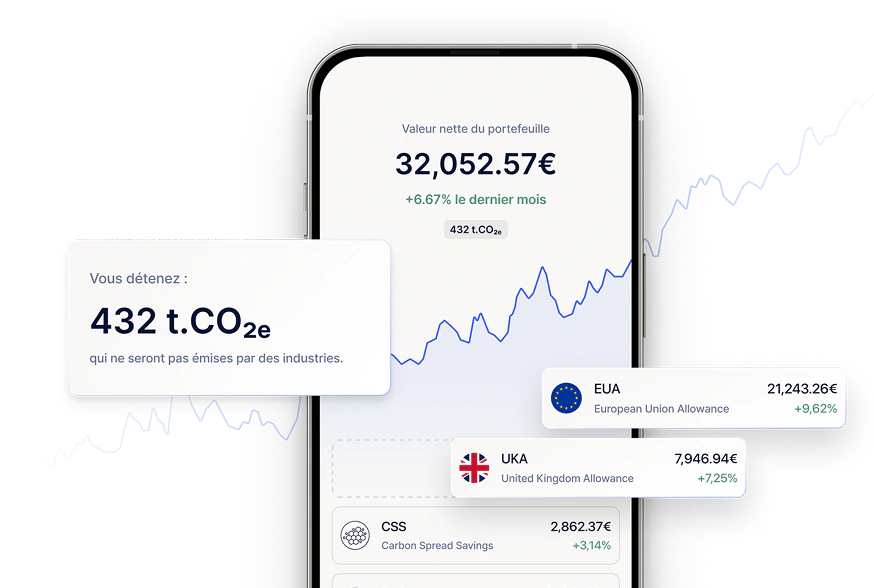
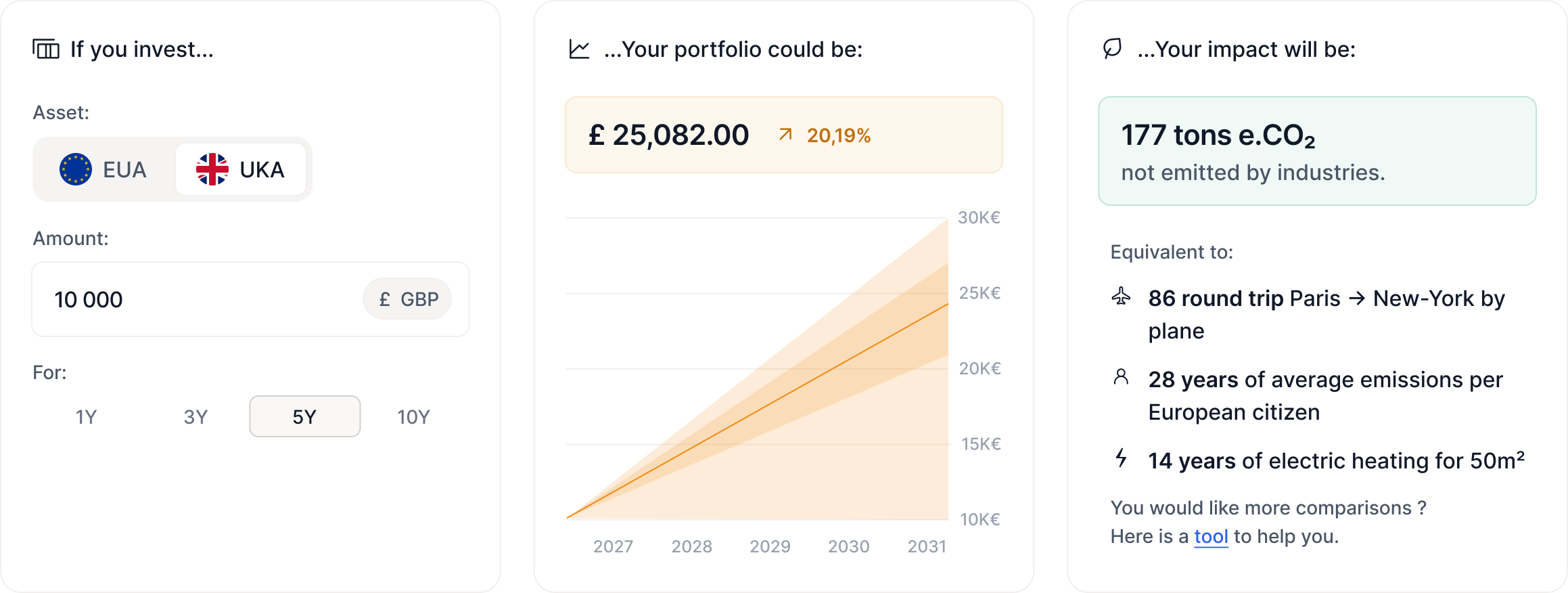
Homaio gives you access to European carbon allowances (EUAs), an asset class that combines potential financial performance with direct climate impact. Diversify your wealth with an asset uncorrelated from traditional markets, accessible from €1,000.