Investing €200 in 2026: a quick action plan

You set aside 200 euros each month and are wondering how to make it grow? Far from being a trivial amount, if invested wisely and regularly, it can lay solid foundations for your future wealth. The old idea that the stock market is reserved for the wealthiest is outdated. Today, investing with a small budget has never been more accessible.
The key to success lies not in the starting amount, but in consistency and the strategy you adopt. It’s over time that the magic of compound interest works. So, how can you turn those 200 euros a month into a real lever for your projects?
The crucial step: emergency savings first
Before thinking about performance, it is imperative to think about safety. Investing involves risks and should never be done at the expense of your day-to-day financial stability.
The first step, non-negotiable, is to build an emergency fund. This is a sum of money that is immediately available, placed in risk-free vehicles such as a Livret A or an LDDS.
This reserve should cover 3 to 6 months of your fixed expenses (rent, bills, food...). It will serve as a safety cushion in case of an unexpected event (job loss, urgent repair), preventing you from having to sell your investments in a hurry, potentially at a loss. Once this safety net is in place, you can start investing your 200 euros per month with greater peace of mind.
Investing €200 per month: strategies to get started
Investing a modest amount each month calls for specific strategies designed to optimize growth while keeping risks and fees under control.
The DCA method: smoothing risk and automating
The strategy best suited to regular contributions is DCA, or Dollar Cost Averaging. The principle is simple: you invest a fixed amount (here, 200 euros) at regular intervals (each month), regardless of market conditions.
When markets are rising, your 200 euros buy slightly fewer shares. When they are falling, the same amount allows you to acquire more. This mechanical approach smooths your average purchase price over the long term and spares you the stress of trying to “time” the market—an almost impossible mission even for professionals.
Our expert tip
Automation is your best ally. Set up a scheduled transfer from your current account to your investment account at the beginning of each month. This turns investing into a habit, like paying a bill, and ensures flawless consistency.
Diversification: the golden rule even with a small budget
“Don’t put all your eggs in one basket” is the mantra of any savvy investor. With 200 euros, it may seem difficult to diversify, but it is essential. Good diversification means spreading your capital across:
- Several dozen, or even hundreds, of companies.
- Different sectors (technology, healthcare, industry...).
- Several geographic areas (Europe, the United States, emerging markets...).
Buying a few individual stocks with 200 euros does not allow you to reach this level of diversification. If one of these companies goes through a rough patch, your entire portfolio suffers. Fortunately, there are solutions to get around this obstacle.
Which financial products for investing 200 euros?
The modern financial ecosystem offers tools perfectly suited to small budgets, enabling instant diversification at low cost.
ETFs (Trackers): the ideal entry point
ETFs (Exchange-Traded Funds), or trackers, are investment funds that replicate the performance of a stock market index, such as the CAC 40 or the U.S. S&P 500. By buying a single ETF share, you invest simultaneously in all the companies that make up that index.
For a 200-euro budget, ETFs are an almost perfect solution:
- Accessibility: an ETF share often costs a few dozen euros.
- Immediate diversification: an “MSCI World” ETF gives you exposure to more than 1,500 companies across more than 20 developed countries.
- Low fees: their management fees are up to 10 times lower than those of traditional investment funds.
- Simplicity: no need to analyze hundreds of individual stocks.
A monthly contribution of 200 euros into one or two well-chosen ETFs is a simple and effective strategy to get started in the stock market.
[image alt="Diagram comparing investment options for a small budget: ETFs, stocks, real estate"]
Buying individual stocks: possible, but with limitations
Buying shares of specific companies (such as Apple, LVMH, or Renault) is entirely possible. The price of a share ranges from a few euros to several hundred euros.
However, with 200 euros, you will be limited to a handful of holdings, which raises the diversification issue mentioned above. One solution is to use brokers that offer fractional shares, allowing you to buy a fraction of a share (for example, 50 euros worth of Amazon stock) and diversify your portfolio more easily.
Watch out for fees
With small amounts, the impact of brokerage fees is magnified. A €1 fee on a €200 order represents 0.5% of your investment. Favor online brokers offering very low pricing, or even free trades on certain order types, so as not to erode your performance.
Fractional real estate: paper real estate within reach
Real estate investing may seem out of reach with 200 euros per month. Yet SCPIs (Sociétés Civiles de Placement Immobilier) allow you to invest in an income-producing property portfolio (offices, retail, warehouses) by buying units. Some platforms even allow you to invest small amounts via scheduled contributions.
Another approach is real estate crowdfunding, which involves lending money, alongside other investors, to a developer to finance a construction project over a set period (generally 12 to 36 months), in exchange for an attractive return. To learn more, you can read our article explaining how crowdfunding works.
Which tax wrapper should you choose?
Choosing the account in which you will hold your investments is just as important as choosing the products themselves, because it determines your tax treatment.
The PEA: for its favorable tax treatment
The Plan d'Épargne en Actions (PEA) (French equity savings plan) is often considered the most attractive wrapper for investing in the stock market in France. You can open a PEA with just a few dozen euros.
Its main advantage is tax-related: after 5 years, the capital gains you realize are fully exempt from income tax (only social contributions of 17,2% remain due). The PEA is mainly intended for European stocks and ETFs, but some techniques using certain synthetic ETFs make it possible to gain exposure to global markets.
Life insurance: flexibility above all
Accessible from 100 euros, life insurance is a versatile contract. It allows you to invest in a secure euro fund and in Units de Compte (UC), which are more dynamic instruments (stocks, bonds, real estate...).
It offers lighter taxation after 8 years and advantages for inheritance planning. For an investment of 200 euros per month, an online life insurance policy, with low fees, can be an excellent option to easily diversify between safety and performance.
Beyond traditional markets: diversify with impact investing
Once your monthly investment strategy is firmly in place using traditional instruments, and as your capital grows, it may be wise to look for new sources of diversification. The goal is to find assets that are uncorrelated with traditional financial markets to strengthen your portfolio’s resilience.
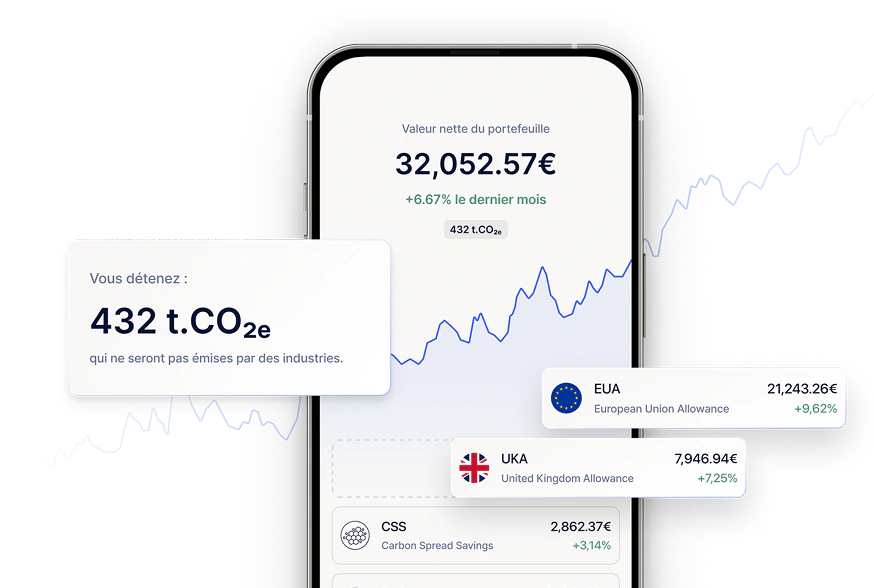
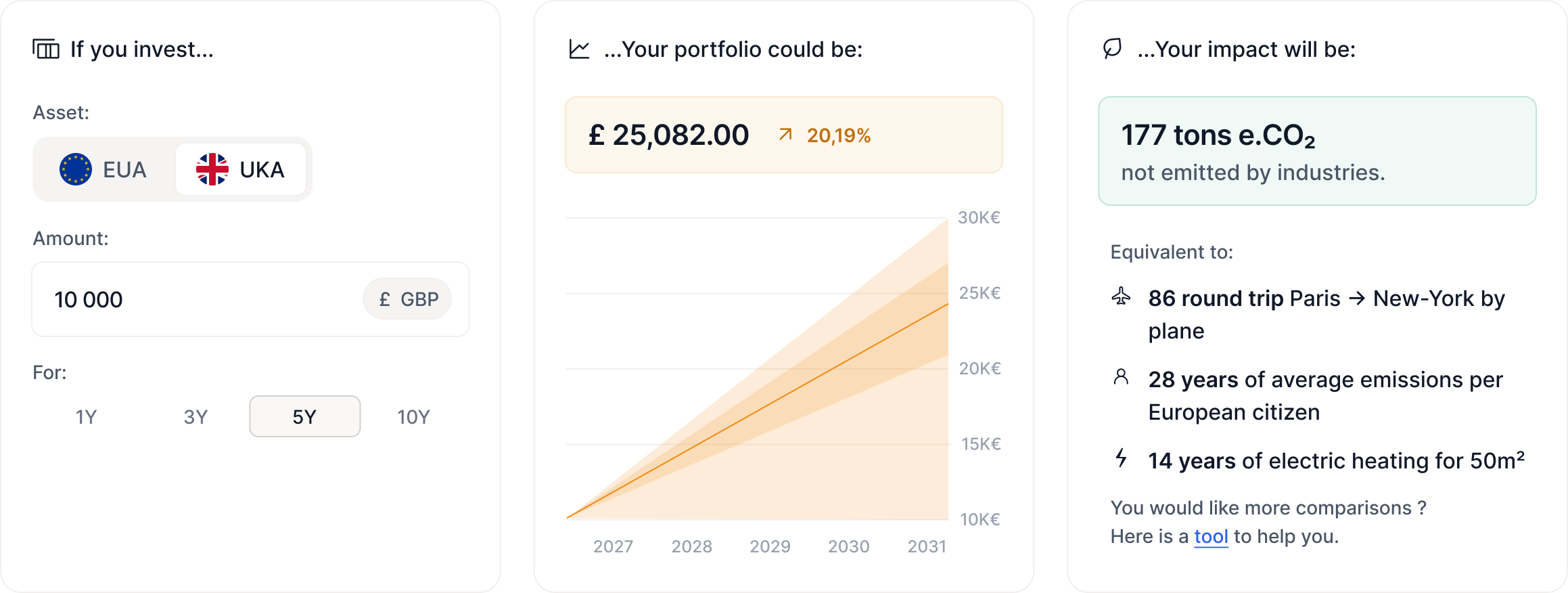
This is where innovative alternatives, such as investing in carbon allowances, become highly relevant. The European carbon allowance market (EU ETS) is a regulated mechanism in which industrial companies buy “rights to pollute.” Historically reserved for institutional investors, this asset is now accessible to individuals.
As French pioneers, we have opened access to this unique asset. By investing in carbon allowances, you are not only aiming for potential financial returns; you are actively participating in the ecological transition. Each allowance purchased and held is a right to pollute removed from the market, which increases pressure on industrials to reduce their emissions. It is a concrete way to align your finances with your convictions.
Although the minimum entry ticket of 1 000 € is higher than a monthly contribution of 200 euros, this asset class represents a relevant avenue for portfolio diversification to consider as a medium-term objective once your savings are firmly established.
Investing 200 euros per month is not a sprint, but a marathon. By starting early, staying consistent, and choosing suitable, diversified solutions such as ETFs, you put the odds in your favor to build meaningful capital over the long term. Patience and discipline are your best assets for turning this small monthly effort into a major financial success.
FAQ: Your questions about investing 200 euros
What is the best investment for 200 euros per month?
There is no single “best” investment, because everything depends on your risk profile, time horizon, and goals. However, for a beginner aiming for the long term, a popular and effective strategy is to invest in a broad ETF (MSCI World type) via a PEA. This approach offers excellent diversification at low cost and favorable tax treatment.
Should I be worried about fees with a small budget?
Yes, vigilance is essential. Fixed fees or high percentages can seriously impact the performance of small investments. It is crucial to use online brokers, PEA providers, or life insurance contracts offering very low transaction and management fees. For ETFs, favor those with annual fees below 0,50%.
Can I hope to become rich by investing 200 euros per month?
The goal is less about “getting rich” quickly than building solid capital over the long term. The power of compound interest is real: by investing 200 € per month with an average annualized return of 7% (the historical average performance of equity markets, not guaranteed for the future), you could accumulate more than 100 000 € in 20 years. It’s a powerful lever to prepare for retirement or fund a major project.
Is 200 euros too little to start?
Absolutely not. The most important thing in investing is not the starting amount, but starting as early as possible and being consistent. It’s better to invest 200 euros per month for 20 years than to wait 10 years to be able to invest 500 euros per month. Habit and time are your greatest allies.
Go further: invest in the carbon market
Homaio gives you access to European carbon allowances (EUAs), an asset class that combines potential financial performance with direct climate impact. Diversify your wealth with an asset uncorrelated from traditional markets, accessible from €1,000.