Plan Ahead for 2026: How to Invest €2,000 Effectively

Letting €2,000 sit idle in a current account means accepting a silent loss of purchasing power in the face of inflation.
With the expected decline in regulated savings account yields for 2026, the question of their relevance is more pressing than ever.
So how can you turn this sum—not into instant wealth, but into the first building block of a solid, thoughtful portfolio?
The 3 fundamental questions before investing your money
Investing without a strategy is like sailing without a compass.
Before choosing any investment, 90% of the classic mistakes can be avoided by honestly answering three questions.
These prerequisites define the framework for your future investment strategy.
Do you have an emergency fund?
This is the non-negotiable foundation. An emergency fund is a sum that is immediately available, equivalent to 3 to 6 months of your regular expenses.
It serves as a safety cushion to absorb unexpected events: a breakdown, a medical expense, a drop in income.
If your €2,000 is your only savings, its primary mission is to build this reserve.
It should be placed in a risk-free, liquid vehicle, such as the Livret A, the LDDS, or the LEP (if you are eligible).
This is not an investment—it’s insurance.
What is your investment time horizon?
The length of time you can lock up your money is the main factor that determines the level of risk you can tolerate.
A short-term project (less than 3 years), such as buying a car, requires secure investments.
A long-term goal (more than 8 years), such as preparing for retirement, makes it possible to invest in more volatile—but potentially more rewarding—assets.
Your time horizon is your best ally against market volatility.
What is your risk tolerance?
Beyond the time frame, there is your emotional ability to withstand fluctuations.
Could you watch your portfolio value drop by 20% without panicking and selling everything at the worst possible moment?
- A conservative profile will prioritize preserving capital, for example via euro funds.
- A balanced profile will accept some risk in pursuit of higher returns, mixing safety and equities.
- A dynamic profile will allocate the majority of their capital to higher-growth assets, such as equities or innovative investments.
Most reputable investment platforms offer questionnaires to help you objectively assess your profile.
Expert tip
With a starting capital of €2,000, diversification is your best shield. Trying to pick a few individual stocks ("stock picking") or buying a physical property is unrealistic and dangerous. The minimum entry tickets are too high. The solution lies in investment funds (ETFs, SCPI, etc.), which allow you, in a single transaction, to invest in hundreds of different assets.
Overview of solutions to grow €2,000
Once your profile is defined, a broad range of options opens up. Each solution serves different objectives.
Regulated savings accounts: the false good idea for investing
In 2026, with a Livret A that could stabilize around 1.5%, its role is clear: it protects your emergency fund, but does not grow it.
Against inflation—even moderate—its real return is often negative.
Think of these accounts as a secure parking place for your cash—not as a growth engine for your wealth.
Assurance vie: versatility in the service of your capital
A true Swiss Army knife of savings, Assurance vie allows you to combine within a single contract two types of vehicles:
- The euro fund: Guaranteed capital, with an average yield around 2.5% gross. This is the pillar of safety.
- Unit-linked investments (UC): Equities, bonds, real estate (via SCPI/SCI), ETFs... The return potential is much higher, but capital is not guaranteed.
With €2,000, you can easily build a tailored allocation. Its tax treatment becomes particularly attractive after 8 years, making it a preferred tool for medium- and long-term projects.
The PEA: the tax springboard for equity markets
The Plan d'Épargne en Actions (PEA) (French equity savings plan) is the go-to tax wrapper for investing in European companies.
Its main advantage is a full exemption from income tax on capital gains and dividends after 5 years of holding (only social charges of 17.2% remain due).
For a beginner, the best approach is not to choose individual stocks, but to opt for ETFs (Exchange-Traded Funds). A single ETF, such as an MSCI World (accessible within the PEA via synthetic versions), gives you exposure to more than 1,600 global companies with very low annual management fees (often below 0.2%). This is the simplest and most effective strategy to get started in the stock market and benefit from long-term market growth.
Accessible real estate: SCPI and crowdfunding
Real estate investing is no longer reserved for large portfolios. Two solutions stand out with a €2,000 entry ticket:
- SCPI (Sociétés Civiles de Placement Immobilier): You buy shares in a property portfolio managed by professionals. You receive rental income in proportion to your investment. The average yield is around 4.5% per year. This is a passive, pooled "paper real estate" approach.
- Real estate crowdfunding: Along with other investors, you participate in financing a property development project. The targeted return is higher (8 to 12%), but so is the risk (delays, developer default). The horizon is shorter, generally between 12 and 36 months. To learn more, you can consult our guide to crowdfunding.
A new asset class: climate investing
For those looking to diversify their portfolio beyond traditional assets and give meaning to their savings, a new frontier is opening up: investing in climate assets.
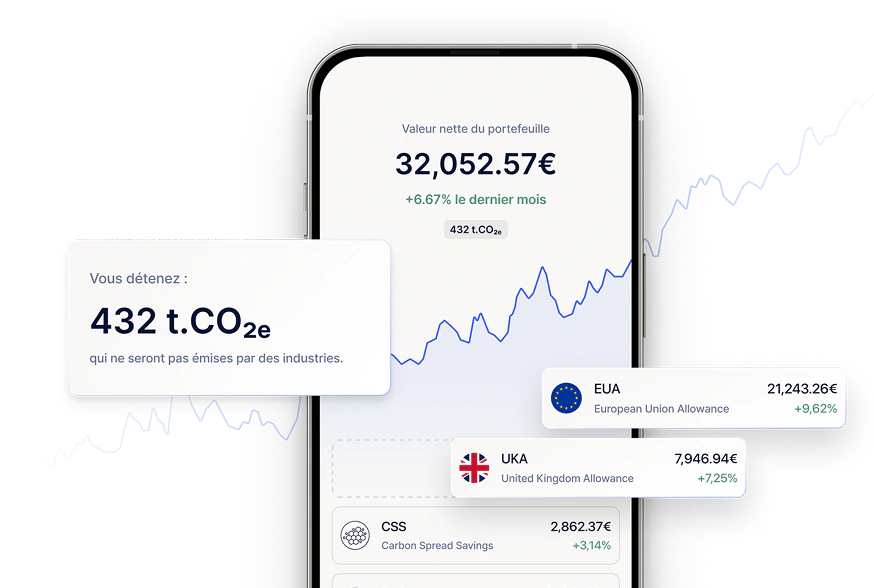
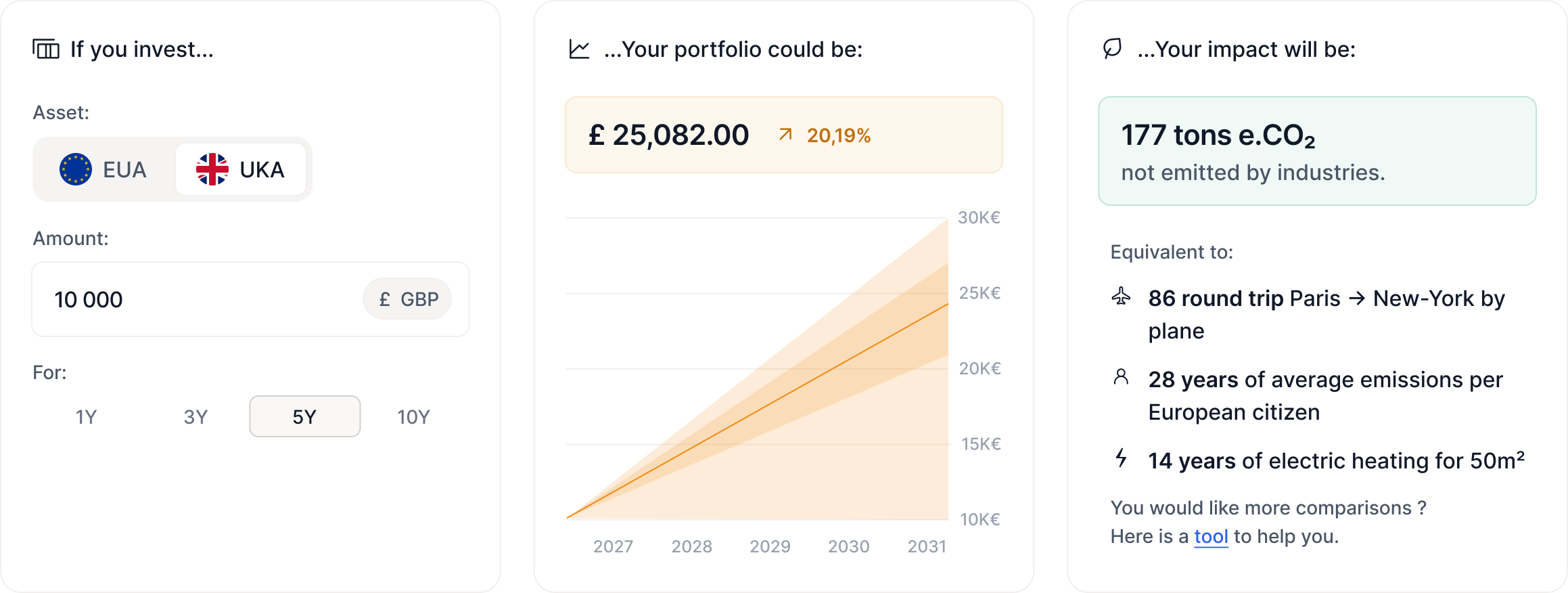
At Homaio, we were the first in Europe to give individuals access to the regulated market for carbon emission allowances (EU ETS).
In practical terms, investing in carbon via our platform means buying and removing from circulation "rights to pollute" from Europe’s largest industries.
This simple mechanism has a double effect:
- A direct environmental impact: Each allowance removed forces industrial players to cut emissions or pay more, thereby accelerating the ecological transition.
- Potential financial performance: The carbon price is a financial asset whose value fluctuates. Historically, this market has delivered high returns, uncorrelated with traditional equity markets.
Accessible from €1,000, this responsible investment makes it possible to add to your portfolio a dimension that is both performance-oriented and purpose-driven. The fee structure is transparent, with entry and management fees, but above all a total absence of exit fees.
[image alt="Diagram illustrating the diversification of a €2,000 investment portfolio across different asset classes."]
Example allocations for a €2,000 capital
There is no perfect allocation—only strategies suited to each profile. Here are three concrete examples, purely for illustration.
Warning
The following allocations are theoretical examples and in no way constitute investment advice. They must be adapted to your personal situation, your objectives, and your risk tolerance after consulting a professional if necessary.
Conservative profile: safety first (Horizon 3-5 years)
The goal is to preserve capital with a return slightly higher than regulated savings accounts.
- 80% (€1,600) in euro funds via an Assurance vie: For safety and relative availability.
- 20% (€400) in a bond ETF or SCPI via an Assurance vie: To capture a bit of additional return with controlled risk.
Balanced profile: a mix of growth and stability (Horizon 5-8 years)
The goal is to find a middle ground between market performance and safety.
- 50% (€1,000) in euro funds via an Assurance vie: The portfolio’s safety base.
- 50% (€1,000) in an MSCI World ETF via a PEA: To gain diversified, tax-optimized exposure to global growth.
Dynamic profile: targeting long-term performance (Horizon > 8 years)
The goal is to maximize capital growth by accepting higher volatility.
- 70% (€1,400) in ETFs via a PEA: Core allocation to equity ETFs (MSCI World, S&P 500) for performance.
- 30% (€600) in impact diversification: A portion in real estate crowdfunding for short/medium-term returns and/or a portion in climate assets such as carbon allowances to combine impact and diversification through low correlation.
This strategy helps you design a diversified investment portfolio by incorporating modern asset classes.
Investing €2,000 in 2026 is not about finding the "deal of the century"—it’s about putting a rigorous method in place. The key to success lies in clearly defining your objectives and using powerful diversification tools such as ETFs, Assurance vie, the PEA, and new impact investment opportunities. By laying these solid foundations, this sum—however modest—can truly work for you and for your future projects.
FAQ: Your questions about investing €2,000
Can I invest €2,000 by buying individual stocks directly?
Technically, yes. In practice, it’s a very bad idea. With €2,000, you could only buy a few different stocks. Your portfolio would be extremely concentrated and therefore very risky. If one of those companies runs into trouble, your entire capital is at risk. ETFs were created precisely to solve this problem by providing instant diversification at low cost.
What is the best tax wrapper to start with?
There is no single "best" wrapper in absolute terms.
- The PEA is ideal if your goal is to invest 100% in European equities for more than 5 years to maximize the tax advantage.
- Assurance vie is more versatile. It lets you mix secure vehicles (euro funds) and riskier assets (unit-linked investments) and benefit from very favorable taxation after 8 years. It is often the most flexible choice for a first investment.
Is investing riskier with a small amount?
Risk does not depend on the amount invested, but on the assets you choose. Investing €2,000 in a single speculative stock is infinitely riskier than investing the same sum in a diversified global ETF. Risk management comes through diversification, which is accessible even with small amounts thanks to modern solutions.
How long does it take to see results?
Investing in risk assets (equities, real estate...) is a marathon, not a sprint. You should aim for an investment horizon of at least 5 years, and ideally 8 years or more, to smooth out market volatility and give compound interest time to work. Any expectation of quick gains is more about speculation than investing.
Go further: invest in the carbon market
Homaio gives you access to European carbon allowances (EUAs), an asset class that combines potential financial performance with direct climate impact. Diversify your wealth with an asset uncorrelated from traditional markets, accessible from €1,000.