How to invest 100 euros in 2026: 10 practical options

Far from being anecdotal, this first step of 100 euros is the most important. It gets you moving, teaches you the right habits, and positions you to benefit from time. The goal isn’t to chase an immediate, spectacular gain, but to set up a strategy that will put your money to work for you, year after year.
Suggested videos Search
YouTube videos
How to invest 100 euros in 2025? (5 techniques)
Matthieu Louvet - S'investir
How to invest in the stock market? The beginner’s guide (2026)
Finary
Invest 100€ in 2026: the 7 best investments (+ demo)
Matthieu Louvet - S'investir

How to invest 100€ according to a multi-billionaire
Emilio
Before investing 100 €: 4 mistakes to avoid
Before discovering where to put your money, it’s crucial to sidestep common traps. For a beginner, avoiding a mistake often costs less than finding the “perfect investment.”
Mistake #1: Thinking the Livret A is an investment
The Livret A is reassuring, accessible, and everyone has one. But it shouldn’t be confused with an investment. It’s a rainy-day savings tool, essential for tough times, but certainly not a growth engine for your wealth.
Its return, even if it sometimes seems attractive, structurally struggles to beat inflation over the long term. Putting 100 € into a Livret A is like putting your money in a freezer: it doesn’t lose nominal value, but its purchasing power slowly erodes. If your goal is to grow your capital, you need to look beyond it.
Mistake #2: Waiting until you have “enough” money to start
“I’ll wait until I have 1 000 € or 5 000 € to really invest.” That sentence is probably the biggest obstacle to building wealth. Waiting for the perfect moment or the ideal amount is the best way to never get started.
Investing is a habit, like working out. You don’t start by running a marathon, but with a first jog. These 100 euros are your first step. They help you understand the mechanics, get comfortable with a platform, and start the compounding curve. You don’t invest because you have a lot of money; you invest to have more over time.
Mistake #3: Investing without understanding, by following trends
Buying a stock because it’s on the front page or investing in a cryptocurrency because everyone is talking about it is a recipe for failure. “Blind” investing is a bet, not a strategy. Many jump in without knowing what the company actually does or how the underlying asset works.
Even with 100 euros, take the time to learn. Understand the rules of the game, the associated risks, and the fundamental reasons for your choice. Starting with solid foundations is the key to staying the course. To help you, there are many resources to learn the basics of stock market investing.
Mistake #4: Multiplying apps and platforms
When you’re starting out, it’s tempting to download multiple apps: one for stocks, one for crypto, another to test crowdfunding. You think you’re optimizing, but you’re mostly creating confusion.
Managing multiple accounts, tracking multiple strategies, and learning different interfaces quickly becomes a mental load. The secret, especially with a small budget, is simplicity. Choose one or two reliable platforms that match your goals and focus on them. Discipline is easier to maintain when the process is clear and streamlined.
The preliminary strategy: pay yourself first and define your goals
Even before choosing a vehicle, two steps are fundamental. The first is a golden rule of personal finance: pay yourself first. As soon as your salary comes in, set aside the 100 € (or more) you’ve decided to allocate to your projects. Don’t wait until the end of the month to see what’s left. By prioritizing saving, your budget will naturally adapt to what you have left to live on. To help you, most platforms allow you to set up scheduled transfers.
The second step is to make sure you have a solid emergency fund. This safety cushion, equivalent to 3 to 6 months of expenses, should be placed in liquid, risk-free options like the Livret A. It will prevent you from having to sell your investments in a hurry (and potentially at a loss) to cover an unexpected expense. Long-term investing can only start once this safety net is in place.
10 practical options to invest 100 euros in 2026
Once the basics are in place, here is an overview of practical solutions to put your 100 euros to work, ranked by risk level and time horizon.
Capital-guaranteed options (short-term horizon)
These options are ideal for short-term projects (less than 2 years) or for the safest portion of your wealth.
1. The Livret A and the LDDS
As we’ve seen, these aren’t growth investments, but they remain the best option for your emergency fund. Capital is 100% guaranteed, fully liquid, and interest is exempt from income tax and social charges. It’s the foundation of any wealth pyramid.
2. Bank “super savings accounts”
Offered by online banks, these accounts often provide boosted introductory rates over a short period (e.g., 4% for 3 months). Their average annual return can therefore exceed that of the Livret A, even after taxation (30% flat tax). They are a good alternative for short-term savings once regulated savings-account ceilings have been reached.
Growth-oriented options (long-term horizon)
To target a higher return, you need to accept some risk and commit to a longer time horizon (at least 5 years).
3. The stock market via ETFs (trackers)
This is probably the simplest, most effective, and most diversified way to invest 100 € in the stock market. An ETF (Exchange Traded Fund) is a basket of stocks that replicates the performance of a stock market index.
An MSCI World ETF, for example, lets you invest in a single transaction in more than 1 400 large companies across 23 developed countries (Apple, Microsoft, LVMH, etc.). It’s the ultimate diversification tool.
Accessible via a Plan d'Épargne en Actions (PEA) (French equity savings plan) for optimized taxation or a life insurance policy (assurance-vie), regular investing into ETFs is a powerful long-term strategy.
4. Fractional shares
Some stocks like LVMH or Hermès are worth several hundred—or even thousands—of euros, making them inaccessible with 100 €. Fractional shares solve this problem. Specialized brokers let you buy a fraction of a share (0.1 or 0.05, for example), giving you access to the world’s largest companies even with a small budget.
5. Real estate crowdfunding
Crowdfunding allows individuals to lend money to finance real estate development projects. With a minimum ticket often set at 100 €, you can participate in a deal and aim for attractive returns (generally between 8% and 12% per year). Be careful: capital is not guaranteed and funds are locked until the end of the project (12 to 36 months). It is therefore essential to research the platform and the projects on offer. To better understand how it works, you can consult our guide on what crowdfunding is.
6. SCPIs within assurance-vie
Sociétés Civiles de Placement Immobilier (SCPI) let you invest in commercial real estate (offices, retail) and receive rental income. Buying a unit is expensive (several hundred euros), but many assurance-vie contracts allow you to invest in SCPI units with much smaller amounts, making rental real estate accessible from as little as 100 €.
7. Cryptocurrencies
Highly volatile and speculative assets, cryptocurrencies like Bitcoin or Ethereum can deliver spectacular performance, but also massive losses. If you decide to allocate part of your capital to them, it should remain very minor (1% to 5% of your total wealth) and correspond to money you are prepared to lose. The advantage is that you can start with just a few euros.
Watch the risk
Never invest in a product you don’t understand perfectly. The volatility of crypto-assets makes them suitable only for informed investors who are aware of the risk of a total loss of capital.
Alternative and impact-focused options
8. Aim higher: impact investing in carbon allowances
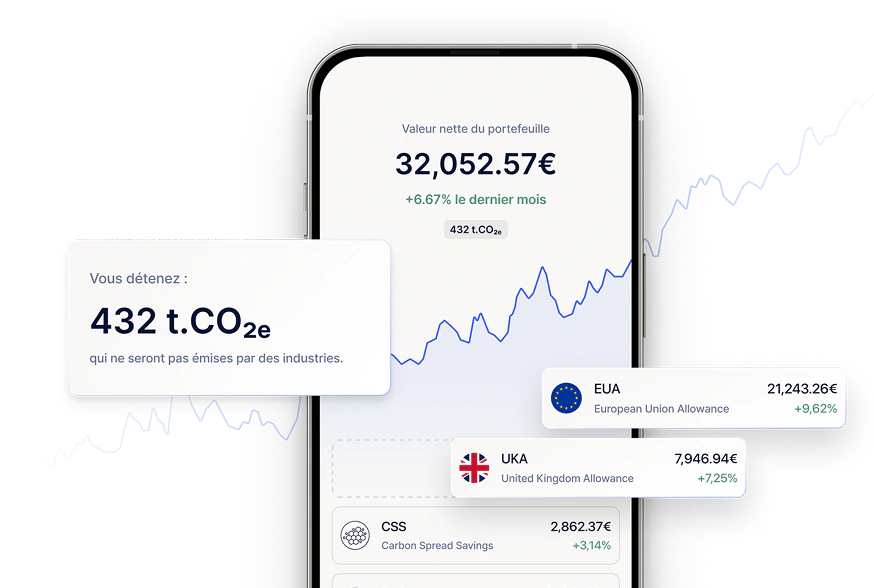
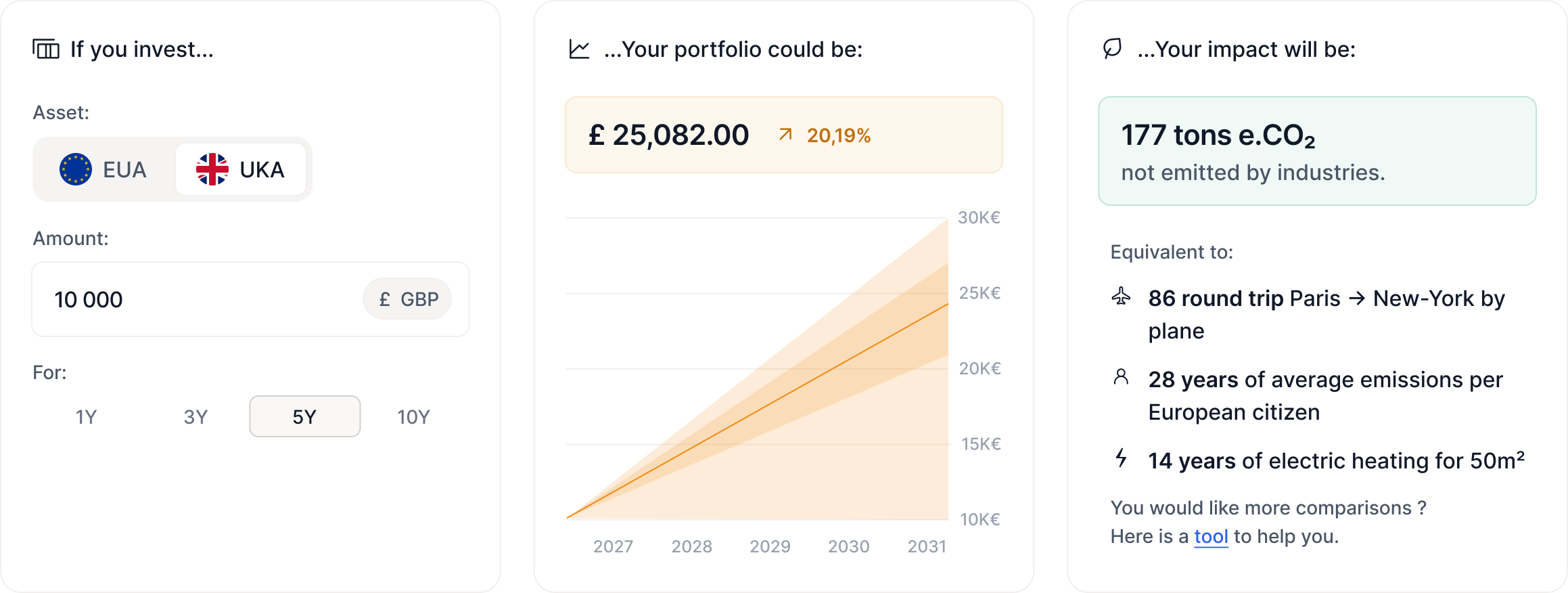
Although this option is not accessible with only 100 euros, it is essential to know about it for your future investments. The carbon allowances market, historically reserved for institutional investors, is now opening up to individuals. The principle is simple: by buying “rights to pollute” on the regulated European market (EU ETS), you remove them from circulation. Fewer allowances available means a higher cost of pollution for industrials, pushing them to accelerate decarbonization.
Pioneering platforms in France enable this type of responsible and sustainable investing, generally starting from 1 000 €. It is a full-fledged asset class, uncorrelated with traditional financial markets, aligning performance potential with concrete climate action. An interesting avenue to diversify a portfolio with meaning.
9. Invest in yourself
It may be the most profitable investment of all. Using 100 € to buy books, take an online course, or acquire a new skill can have an infinite return on investment for your career and future income. Never underestimate the power of knowledge.
10. Solidarity microcredit
Some platforms let you lend small sums of money to micro-entrepreneurs in developing countries. With 100 €, you can finance several projects (agriculture, crafts, small retail). The financial return is often nil or very low, but the social return is immense. It’s an investment that gives meaning to your savings.
How should you allocate your 100 euros? Portfolio examples
The ideal allocation depends on your risk profile, time horizon, and goals. Here are three examples to illustrate:
These allocations are only examples. The important thing is to build a portfolio that fits you and that you feel comfortable holding through the long term. A solid diversification strategy is essential to manage risk.
Starting to invest with 100 euros is not only possible—it’s also the smartest decision you can make for your financial future. The biggest risk isn’t investing poorly, but not investing at all. By choosing simple solutions like ETFs, clearly defining your goals, and investing regularly, you set in motion the powerful engine of compound interest.
Every euro counts. Don’t wait for the “right time” or until you have more money. The right time is now. Your future self will thank you.
FAQ: Your questions about investing with 100 euros
What is the best investment for 100 euros?
There is no absolute “best” investment. The ideal solution depends on your profile: your age, your investment horizon (when will you need this money?), and your risk tolerance. For a beginner aiming for the long term, a World ETF (MSCI World) within a PEA (French equity savings plan) is often considered an excellent starting point because of its simplicity and broad diversification.
Is it possible to invest 100 euros per month?
Yes—and it’s even the best strategy. It’s called DCA (Dollar Cost Averaging). By investing a fixed amount at regular intervals, you smooth your entry price in the markets. You buy more units when markets fall and fewer when they rise. This disciplined approach reduces the impact of volatility and removes the stress of having to “find the right time” to invest.
What fees should you anticipate with a small budget?
Fees can quickly eat into the performance of a small portfolio. Favor platforms with low (or even zero) transaction fees and investment products with low annual management fees. ETFs, for example, have very low management fees (often below 0,50% per year), unlike many actively managed funds. Always read the broker’s and the product’s fee schedule carefully before investing.
Should you choose a PEA, a securities account, or assurance-vie to get started?
To invest in European stocks and ETFs, the PEA (Plan d'Épargne en Actions) is often the most tax-efficient after 5 years of holding. Assurance-vie is more versatile (it provides access to euro funds, SCPIs, etc.) and offers inheritance advantages, but its management fees are often a bit higher. A standard securities account (CTO) offers the most flexibility (access to global stocks, ETFs not eligible for the PEA), but its taxation is less favorable. For a beginner with 100€, the PEA is an excellent choice to start investing in the stock market.
Go further: invest in the carbon market
Homaio gives you access to European carbon allowances (EUAs), an asset class that combines potential financial performance with direct climate impact. Diversify your wealth with an asset uncorrelated from traditional markets, accessible from €1,000.