Alternative investing in 2026: a guide to understanding risks, categories, and diversification

Warning: This content is provided for informational and educational purposes only. It does not constitute investment advice, a personalized recommendation, or a solicitation to buy or sell. Any investment involves risks, including a risk of total or partial loss of the invested capital. Past performance is not indicative of future results. It is recommended to consult a professional adviser before any investment decision.
Beyond equities and bonds that drive traditional financial markets, there is a more discreet investment universe: alternative investments. Often perceived as complex or reserved for an elite, they are attracting growing curiosity from investors looking for new sources of diversification.
But what is an alternative investment? It is simply an asset class that doesn’t fit into traditional boxes such as listed stocks, government or corporate bonds, or cash. This universe brings together a wide range of strategies and vehicles, from unlisted real estate to cryptocurrencies, including financing fast-growing companies.
This guide aims to demystify these investments: define what they are, present their main families, assess their potential value for a portfolio, and, above all, highlight the risks and essential precautions before venturing into them.
Alternative investing: a simple definition
An investment is called “alternative” because it offers an alternative to traditional financial investments, which can be bought and sold easily on public stock markets (such as Euronext).
The main characteristic of these assets is that they often evolve on private markets, which are less regulated and less liquid than public markets. Their value is generally less correlated with the stock market’s day-to-day fluctuations, which means they don’t necessarily react in the same way to economic crises or central bank announcements.
In short, an alternative investment is defined by what it is not: neither a TotalEnergies share nor a French government bond. It is a broad set of investment opportunities with very specific rules, risks, and time horizons.
What are the main alternative investments?
The alternative universe is extremely broad. To make it clearer, you can group them into three major families, each with its own risk, liquidity, and accessibility characteristics.
Real estate, infrastructure, and real assets
This category includes tangible assets—things you can “touch.”
- Unlisted real estate : This involves investing in real estate (offices, retail, housing) via vehicles such as SCPI (Sociétés Civiles de Placement Immobilier) or real estate crowdfunding platforms.
- Infrastructure : These are investments in projects essential to society, such as highways, airports, wind farms, or fiber-optic networks. Access is almost exclusively via specialized funds.
- Various tangible assets : This category includes more original investments such as forests, vineyards, works of art, classic cars, or precious metals. They require very specialized expertise, and their liquidity is often very low.
Private equity, private debt, and private markets
This family concerns the direct financing of the real economy—i.e., companies that are not listed on the stock exchange.
- Capital investment (or Private Equity) : This involves taking an equity stake in unlisted companies to finance their development, transfer, or turnaround. The investment horizon is long (often 8 to 10 years) and the risk of capital loss is high.
- Private debt : Instead of taking an equity stake, investors lend money directly to companies. It is an alternative to traditional bank loans. This asset class is generally reserved for professional investors.
Hedge funds, commodities, and cryptocurrencies
This last family brings together more speculative assets and strategies.
- Hedge Funds (or hedge funds) : These are funds using very complex and aggressive management strategies (short selling, leverage, etc.) to try to generate performance regardless of market conditions. They are reserved for so-called “sophisticated” investors, and minimum investments are very high.
- Commodities : Investing in oil, gas, gold, copper, or wheat. This is a market known for high volatility, directly linked to global geopolitical and economic conditions. To learn more, see our guide on investing in gold via ETFs.
- Cryptocurrencies : Bitcoin, Ethereum, and other crypto-assets are considered alternative investments due to their novelty and (historical) decoupling from traditional markets. Their volatility is extreme, and the risk of a total loss of capital is a reality that should never be forgotten.
Why are some investors interested in them for diversification?
The main appeal of alternative investing lies in diversification. The old saying “don’t put all your eggs in one basket” takes on its full meaning here.
The goal is low correlation. Ideally, when equity markets fall, a well-constructed portfolio of alternative assets might suffer less, or even continue to appreciate, because the drivers of its performance are different. For example, the value of a wind farm depends on electricity feed-in tariffs, not directly on the CAC 40.
Some investors also look to alternatives for:
- A different return potential : By accepting higher risk and lower liquidity, investors hope to achieve higher performance than traditional markets over the long term. However, this expectation is never guaranteed.
- Access to the real economy : Investing in private equity makes it possible to directly finance SMEs and innovative start-ups.
- Protection against inflation : Some real assets, such as real estate or infrastructure, have revenues that can be indexed to inflation, offering potential protection.
To go further in building a resilient wealth plan, discover how to design a diversified investment portfolio.
Beware of unrealistic promises
Diversification is not insurance against losses. An alternative investment is still an investment, with its own risks. Correlation is not always perfect: during major systemic crises, it is common to see all asset classes fall at the same time.
What risks and limitations should you know before investing?
Alternative investing is not a road paved with gold. It is essential to understand and accept its constraints, which are far more significant than for traditional investments.
- Risk of capital loss : It is fundamental. For many alternatives, especially private equity or cryptocurrencies, the risk of losing 100% of your investment is real.
- Illiquidity : This is the main drawback. Your money can be locked up for several years (often between 5 and 12 years for private equity). It is impossible to recover your funds before the scheduled maturity, even in an emergency.
- High fees : Managing these assets requires rare expertise, which comes at a cost. Management, subscription, and performance fees (“carried interest”) are often much higher than for a simple ETF.
- Complexity and lack of transparency : Understanding how a private debt fund works or how a start-up is valued requires specific skills. The available information is far less abundant than for listed companies.
- High minimum investment : Historically, these investments were reserved for institutions with minimum investments of several hundred thousand euros. Although access is becoming more democratized, minimum amounts often remain significant.
How can retail investors access alternative investments?
While these investments were once inaccessible, several solutions now allow retail investors to gain exposure—provided they remain cautious.
Alternative funds, AIFs, and intermediated solutions
For the general public, access is almost exclusively via funds that pool capital from many investors to invest it across different projects.
In Europe, these funds are often structured as AIFs (Alternative Investment Funds). This regulatory label provides a legal framework, but does not guarantee performance or capital.
You can find these funds through:
- Life insurance contracts or PER : Some unit-linked options provide exposure to real estate (SCPI), private equity (FCPR, FPCI), or infrastructure funds.
- Specialized online platforms : Crowdfunding (real estate, SME financing) has made alternative investing more accessible, with minimum investments sometimes reduced to a few hundred euros.
- Private banks and wealth management advisers : They offer specialized funds to clients with more substantial wealth.
Selection criteria: fees, liquidity, horizon, understanding
Before subscribing to an alternative investment product, always ask yourself these four questions:
- Fees : What are all the fees—at entry, during the life of the product, and at exit? Are they clearly explained?
- Liquidity : For how long will my money be locked up? What are the exact exit conditions?
- Investment horizon : Is the lock-up period compatible with my life plans?
- Understanding : Do I really understand what I’m investing in? Is the fund’s strategy clear to me?
If the answer to any of these questions isn’t perfectly clear, it is probably wiser to abstain.
Alternative investing vs. traditional investments: what are the differences?
The following table summarizes the main distinctions to keep in mind.
An expert perspective
Experience shows that investors who succeed with alternatives are those who approach them with the same rigor as an entrepreneur. They study the file in depth, understand that risk is real, and above all, they allocate only a portion of their wealth that they can afford to lose and to tie up over a very long period.
What place do they have in a diversified portfolio?
Alternative investing should not be the first building block of your wealth plan. It is an upper floor—only to be considered once the foundations are firmly in place.
For a beginner saver, the priority remains building an emergency fund in liquid, risk-free vehicles (such as the Livret A), then building a core portfolio with diversified traditional assets (via ETFs, for example).
Alternative investments can then act as a lever for additional diversification, as a minority and carefully considered portion of overall wealth (often 5% to 15% for the most sophisticated portfolios). This allocation depends entirely on your personal situation, your goals, your time horizon, and your risk tolerance. If you want to start investing, it is crucial to do so progressively and in an informed way.
FAQ on alternative investing
What is an alternative investment?
An alternative investment is an investment that is not part of traditional categories such as listed stocks, bonds, or cash. It covers a wide range of assets, from private markets to real estate to cryptocurrencies, often characterized by low liquidity and a long-term horizon.
What are alternative investments?
The most common examples are capital investment (private equity), private debt, real estate (via SCPI or crowdfunding), infrastructure, commodities, hedge funds, art, forests, vineyards, and more recently crypto-assets.
What are the 3 types of investment?
Investments are generally classified into three broad categories:
- Tangible investments : These are physical, tangible assets, such as real estate, a machine tool, or a work of art.
- Intangible investments : These are not material, such as a patent, a trademark, or spending on research and development.
- Financial investments : These concern capital placements, such as stocks, bonds, and most alternative investments (fund units, etc.).
Where should you invest 10.000 € today?
There is no single answer to this question, because the best investment depends entirely on your investor profile (age, family and professional situation), your goals (preparing for retirement, a real estate purchase, etc.), your investment horizon, and your risk tolerance.
For an amount of 10 000 €, most complex alternative investments (such as direct private equity) are inaccessible due to their high minimum investment requirements. The priority is often to build a solid, diversified core portfolio, potentially via wrappers such as the PEA or life insurance, focusing on liquid, low-fee assets (such as ETFs). Before deciding where to invest your money, it is strongly recommended to consult a professional financial adviser who can analyze your situation in a personalized way.
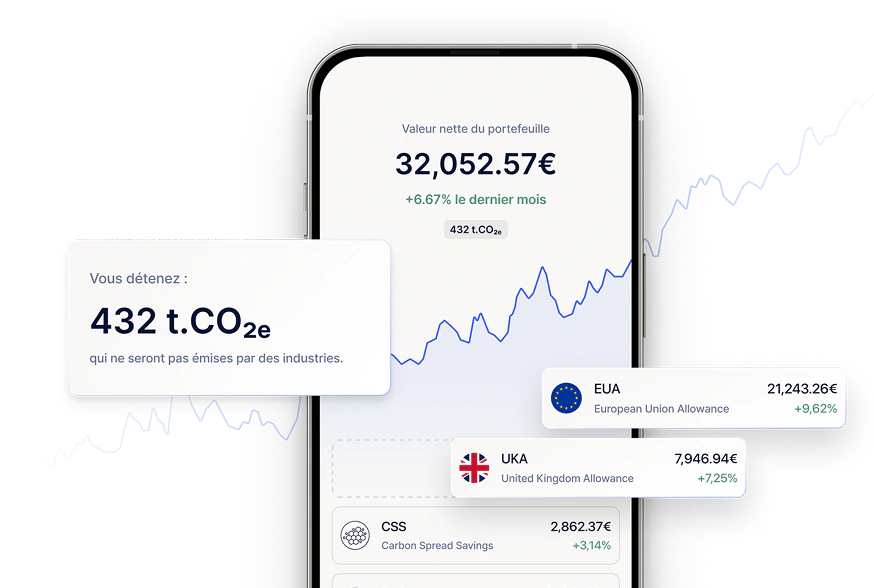
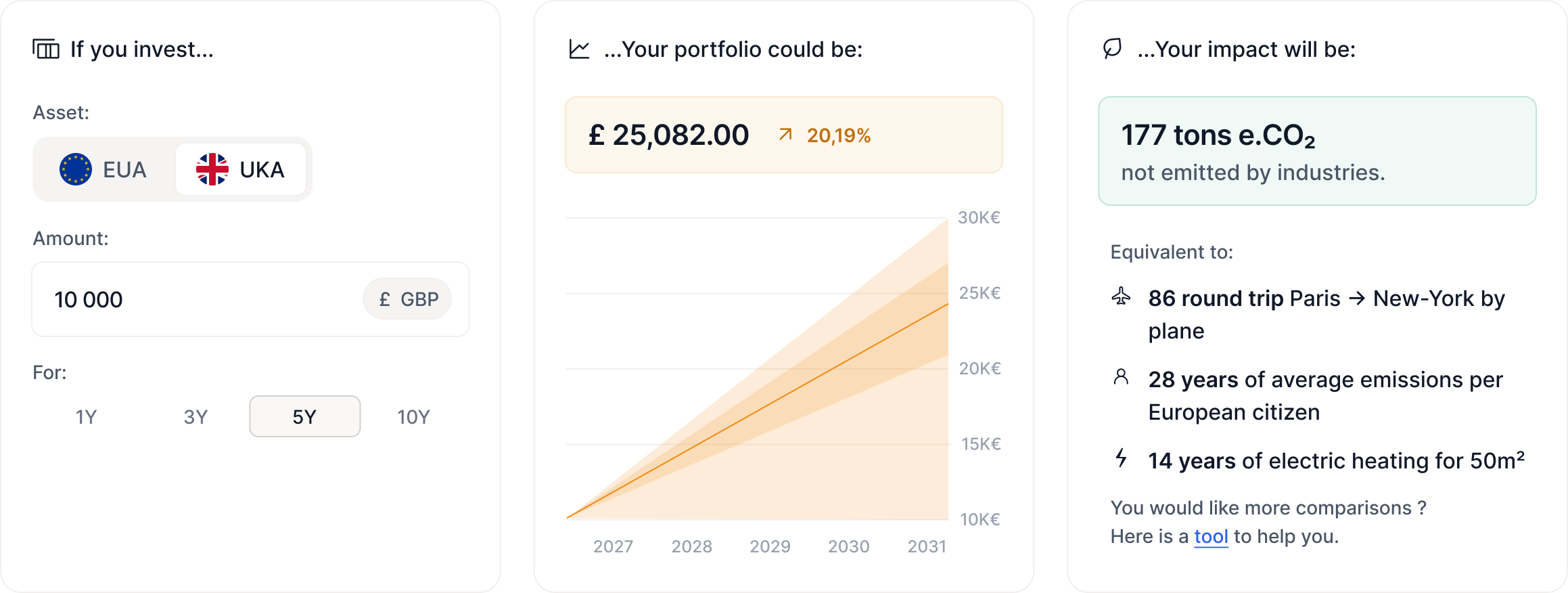
Go further: invest in the carbon market
Homaio gives you access to European carbon allowances (EUAs), an asset class that combines potential financial performance with direct climate impact. Diversify your wealth with an asset uncorrelated from traditional markets, accessible from €1,000.