Personal carbon footprint 2026 — calculation, simple actions

Do you sometimes wonder what the real impact of your daily life is on the planet? Beyond big speeches, every action, every consumption choice, every trip contributes to an invisible but very real footprint: your personal carbon footprint. Taking the time to measure it is not an exercise in guilt, but the starting point for an informed approach to becoming a tangible actor in the ecological transition.
What is a personal carbon footprint?
A carbon footprint is an indicator that measures the total greenhouse gas (GHG) emissions generated by a person over a year. It is not limited to direct emissions, such as the gasoline burned by your car, but also includes indirect emissions linked to the manufacturing and transport of the goods and services you consume.
This measure is expressed in carbon dioxide equivalent (CO₂e), a unit that makes it possible to compare the impact of different greenhouse gases on the climate.
Your personal footprint is generally broken down into four major categories:
- Housing: heating, electricity, construction.
- Transport: daily commuting, air travel, car use.
- Food: meat consumption, local products, food waste.
- Goods and services: purchases of clothing, electronic devices, leisure, public services.
Understanding this breakdown is the first step toward identifying the most relevant levers for action for you.
Why measuring your ecological footprint is an essential first step
In France, the average carbon footprint of a citizen is around 10 tonnes of CO₂e per year. Yet to meet the goals of the Paris Agreement and limit global warming to +1.5 °C, each individual would need to reduce their footprint to about 2 tonnes by 2050. The gap is considerable and highlights the urgency to act.
Becoming aware of your own impact is a powerful driver of change. Calculating your footprint is not an end in itself, but a diagnostic. It sheds light on the parts of your daily life that weigh most heavily on the climate balance and allows you to focus your efforts where they will have the greatest effect.
This individual approach is also part of a collective movement. The more informed citizens are, the more they can influence companies and public policies toward more sustainable models.
How to calculate your individual carbon footprint
No more complex spreadsheets. Today, free and accessible online tools make it possible to get a personalized estimate in about ten minutes, often without even needing to create an account.
The reference calculator in France is Nos Gestes Climat, developed by ADEME (Agence de la Transition Écologique). It takes the form of a narrative, intuitive questionnaire that guides you through different questions about your habits:
- Your housing: floor area, heating type, insulation.
- Your travel: kilometers traveled by car, train, plane.
- Your diet: frequency of meat and dairy consumption.
- Your consumption: monthly budget for purchases, types of products you prioritize.
The process is simple: the more precise your answers, the more reliable the result will be. Once the questionnaire is complete, you get your detailed footprint, often compared to the national average, along with practical action ideas.
[image alt="Dashboard of a carbon footprint calculator showing results by category: transport, housing, food and consumption."]
Interpreting your results to act effectively
The final result, expressed in tonnes of CO₂e, is only part of the information. The most important element is the breakdown of your emissions. You may discover that 40% of your footprint comes from your flights, or that your meat consumption weighs more heavily than your heating.
This analysis helps you move beyond preconceived ideas and focus on what really matters. Rather than scattering your efforts across a multitude of small gestures, you can identify 2 or 3 high-impact actions that fit your situation.
For example, for someone whose transport is the main source of emissions, reducing long-haul flights will have an infinitely greater impact than changing light bulbs. For someone else, it will be the energy renovation of their home that becomes the primary lever.
Practical actions to reduce your carbon footprint
Once your diagnosis is done, it’s time to take action. Here are ideas grouped by major emissions categories, from the simplest to the most structural.
Rethink your travel
Transport represents a significant share of households’ carbon footprint.
- Moderate-impact action: Choose walking, cycling, or public transport for short trips.
- High-impact action: Drastically reduce air travel, especially long-haul flights. A single round trip Paris–New York can represent nearly 2 tonnes of CO₂e, i.e., the annual target per person.
- Structural action: Choose a less polluting vehicle (electric, hybrid, smaller) or switch to carpooling for home-to-work commuting.
Optimize your home and your energy consumption
The building sector is a major emitter of greenhouse gases.
- Moderate-impact action: Lower the heating by 1 or 2°C, install low-flow devices on faucets to save hot water.
- High-impact action: Insulate your home (attic, walls, windows) to reduce heating needs.
- Structural action: Replace your heating system with a solution running on renewable energy (heat pump, biomass boiler).
Adopt a more sustainable diet
What we eat has considerable weight on the climate.
- Moderate-impact action: Consume local and seasonal products to limit emissions linked to transport and greenhouse cultivation.
- High-impact action: Reduce your meat consumption, especially beef, whose production is extremely emissions-intensive. Switching to a vegetarian diet can halve the carbon footprint of your diet.
- Structural action: Fight food waste by planning meals and composting your food waste.
Water footprint, the other key indicator
In addition to the carbon footprint, the water footprint measures the total amount of freshwater used to produce the goods and services we consume. It reveals the “invisible” water needed to manufacture our clothes or grow our food. Reducing meat consumption or choosing linen clothing or second-hand items helps reduce both footprints at the same time.
Consume responsibly
Manufacturing every object comes with an energy and environmental cost.
- Moderate-impact action: Sort your waste to support recycling.
- High-impact action: Buy second-hand or refurbished products, especially electronics and clothing. Extend the life of objects by having them repaired.
- Structural action: Adopt a minimalist approach by questioning the necessity of each purchase. The best energy is the energy we do not consume.
From individual action to systemic impact
Reducing your personal footprint is fundamental, but it is not enough to solve the climate equation. The ecological transition requires structural changes across our economy. Heavy industries, energy production, and freight transport are responsible for a massive share of global emissions.
This is where market mechanisms designed to accelerate decarbonization at scale come in. The main one in Europe is the EU Emissions Trading System (EU ETS), also known as the carbon market. Its principle is simple: governments set an emissions ceiling (a “cap”) for around 10 000 of the most polluting industrial sites. For every tonne of CO₂ emitted, these companies must hold and surrender a “right to pollute,” or a carbon allowance.
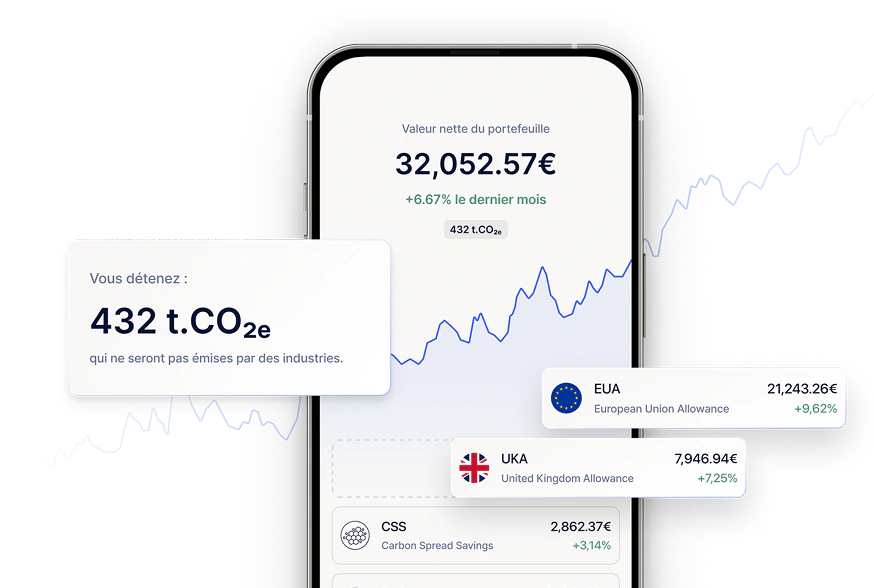
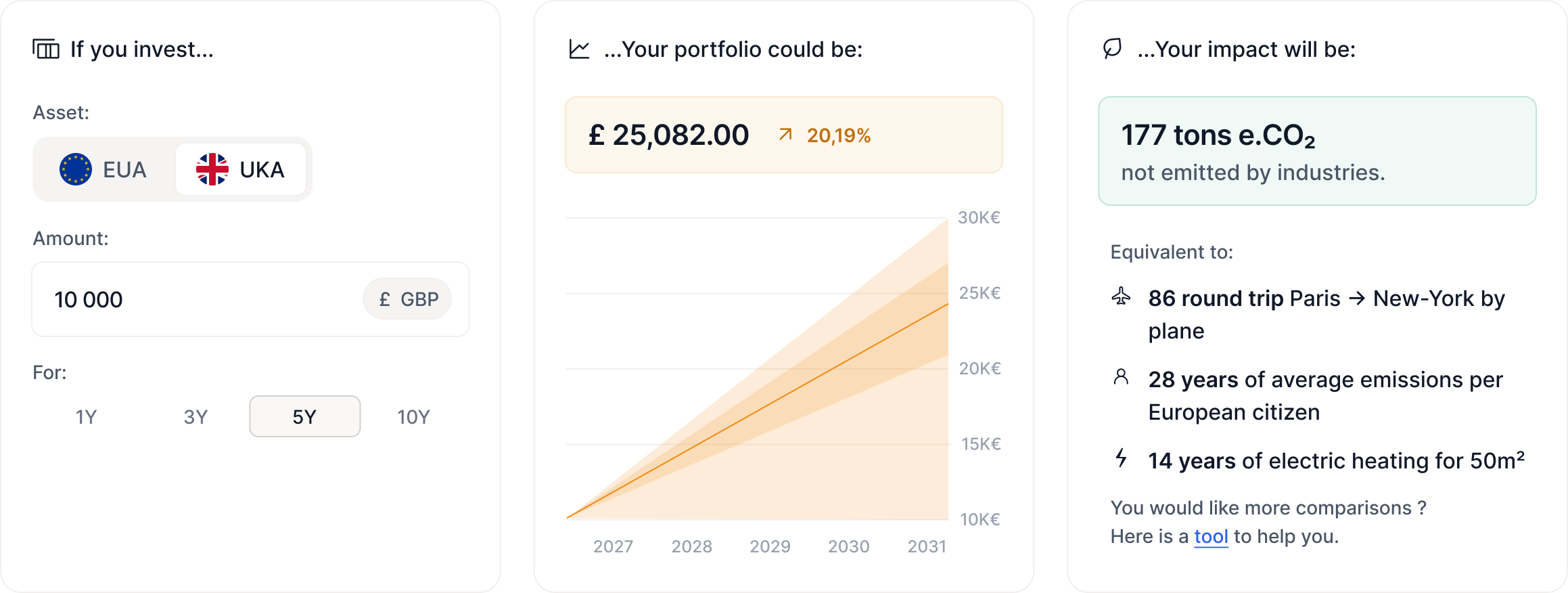
As a climate investment platform, we enable individuals to participate directly in this mechanism. By buying carbon allowances on this regulated market, our clients remove them from circulation. Fewer allowances available for industrials means that the carbon price rises, making their emissions more expensive. This creates a powerful financial incentive to invest in clean technologies and reduce emissions. It is a way to turn a financial action into a direct and measurable ecological lever, thereby complementing individual frugality efforts with pressure on the productive system.
Investment and risk
The carbon market is an asset class whose value fluctuates based on supply, demand, and political decisions. Like any financial investment, it carries a risk of capital loss, and past performance is not indicative of future performance. It is essential to invest only the money you are prepared to lose and to fully understand the mechanisms before committing.
Doing your personal carbon footprint assessment opens the door to a finer understanding of climate challenges. It turns an abstract concern into a concrete action plan, both for your own lifestyle and to participate, at another scale, in the transformation of our economy. The transition is a collective effort in which every gesture and every lever counts.
Frequently asked questions about personal carbon footprints
What data is needed for a reliable calculation?
For a precise estimate, you will need information about your home (floor area, year of construction, energy type), your energy bills, the kilometers traveled annually with your different modes of transport (car, plane, train), and an idea of your eating habits (frequency of meat and dairy consumption) as well as your monthly spending.
My score is 10 tonnes— is that bad?
Getting a score close to the French average is neither “good” nor “bad.” Above all, it is a starting point. What matters is not the initial number, but the awareness it creates and the reduction pathway you decide to begin. The goal is to understand where your main sources of emissions lie so you can act where it is most effective.
Which actions offer the best ecological return on investment?
The most impactful actions are generally linked to the following three areas: reducing or eliminating air travel, drastically cutting consumption of animal products (especially beef), and insulating your home. These three levers often have a much greater impact than a multitude of small everyday gestures.
How can I track my progress over the long term?
The best method is to recalculate your carbon footprint every year, at the same time of year. This will let you clearly see the impact of the changes you have implemented and adjust your strategy. Many calculators allow you to save your results to make year-on-year comparisons easier.
Go further: invest in the carbon market
Homaio gives you access to European carbon allowances (EUAs), an asset class that combines potential financial performance with direct climate impact. Diversify your wealth with an asset uncorrelated from traditional markets, accessible from €1,000.