Investing in Property in 2026: a Practical Guide by Budget and Risk

This article provides general information about real estate investing. It does not constitute investment advice, tax advice, or a personalized recommendation. Returns, risks, fees, credit conditions, and tax rules vary depending on products, markets, and your situation.
Investing in property means putting your money into real estate assets. This can take the form of a direct purchase (apartment, house) or an indirect investment via financial products such as SCPIs ("paper property") or shares in real estate companies. The goal is to build tangible wealth and generate income.
What does investing in property mean?
The expression "investing in property" is a metaphor that refers to the solidity and durability of real estate as an asset class. Unlike stocks or bonds, which are dematerialized financial assets, real estate is a tangible asset—that is, physical and concrete.
This savings approach is appealing because it meets a need for something material: you own something real, whether it is a home, commercial premises, or units representing a fraction of a real estate portfolio.
In practice, investing in property falls into three main categories:
- Direct real estate (or physical property): buying a property in your own name.
- Indirect real estate (or paper property): buying units in investment funds specialized in real estate (SCPI, OPCI).
- Listed real estate: buying shares of publicly traded real estate companies.
Each of these approaches has very different mechanisms, advantages, and constraints.
Why this investment attracts so many savers
Real estate investing remains one of French people’s favorite investments for several structural reasons. Understanding these motivations helps you assess whether this type of investment matches your own objectives.
- Building tangible wealth: Property offers a reassuring psychological dimension. Owning a concrete asset is perceived as security against the ups and downs of financial markets.
- Receiving regular income: Rental investing aims to generate rent, which can provide supplemental income, help repay a loan, or prepare for retirement.
- The leverage effect of borrowing: Real estate is one of the few asset classes that a bank will agree to finance with a loan for an individual. Leverage lets you acquire a property worth more than your personal contribution by using the bank’s money to build your wealth.
- Relative protection against inflation: Historically, rents and property values tend to rise over the long term, offering partial protection against monetary erosion.
- Retirement planning and wealth transfer: Over a 15-, 20-, or 25-year horizon, a real estate investment can be fully paid off, leaving capital and/or income available for retirement. It is also an asset that is easy to pass on to your heirs.
[image alt="Diagram illustrating the different forms of real estate investing: direct, paper property, and listed."]
The main ways to invest in property
There isn’t just one, but several ways to invest in real estate. The choice depends on the capital available, the time you can devote to it, and the level of risk you accept.
Buying a property directly
This is the most traditional form of investing in property. It involves buying an apartment, a house, a parking space, or commercial premises yourself in order to rent it out.
- Advantages: Full control over the property (choosing the tenant, renovations, setting the rent), direct receipt of 100% of rental income (before expenses and taxes), satisfaction of owning a concrete asset.
- Disadvantages: High entry ticket (requires a down payment and/or a significant loan), time-consuming rental management (finding tenants, dealing with unpaid rent, maintenance), high concentration of risk in a single property and a single location, significant fees (notary, agency, works), and low liquidity (selling a property can take several months).
Investing in SCPI and other pooled investments
"Paper property," mainly represented by Sociétés Civiles de Placement Immobilier (SCPI), lets you invest in a broad real estate portfolio (offices, retail, warehouses, housing) by buying units.
- Advantages: Accessible entry ticket (a few hundred or a few thousand euros), management fully delegated to professionals, immediate risk diversification across dozens or even hundreds of properties and tenants, pooling of rental risks.
- Disadvantages: Subscription and management fees that reduce net returns, no control over the investment strategy, limited liquidity (reselling units may take time and is not guaranteed), capital is not guaranteed. There are also OPCIs, which combine physical real estate and financial assets for better liquidity.
SCPI with a loan: an option to consider
As with direct real estate, it is possible to finance the purchase of SCPI units with a mortgage. This solution makes it possible to use bank leverage while benefiting from the advantages of delegated management and diversification of paper property.
Listed real estate: SIIC and other stock market vehicles
This approach involves buying on the stock exchange shares of Sociétés d’Investissement Immobilier Cotées (SIIC in France, or REITs internationally). These companies own and manage large real estate portfolios and are required to distribute a large portion of their profits in the form of dividends.
- Advantages: Very high liquidity (shares can be bought and sold in a few seconds during stock market opening hours), very low entry ticket (the price of a single share), transparency of information (regular financial disclosures).
- Disadvantages: High volatility (the share price is subject to fluctuations in financial markets, not only the value of the properties), borrowing is almost impossible for an individual, high risk of capital loss in the short term.
Investing with a small budget: fractional or gradual options
New solutions are emerging to further democratize access to property, notably for profitable small investments.
- Real estate crowdfunding: It allows you to lend money to a developer to finance a construction or renovation project, in exchange for a fixed return over a short period (12 to 36 months). The entry ticket is often € 1 000. The risk is high (capital loss in the event of the developer’s bankruptcy).
- Fractional (or tokenized) real estate: Platforms offer to buy "fractions" or "tokens" of a property. Each investor owns a small part of the property and receives a proportional share of the rents. Entry sometimes starts at € 10 or € 100. The liquidity and regulation of this market are still developing.
Return, starting capital, and borrowing: how to compare
To make things clearer, a comparison table helps summarize the key characteristics of each option. Return figures are historical orders of magnitude and do not predict future performance.
Risks to understand before investing
Investing in property, like any investment, involves risks that you must measure before committing. The perception of real estate as safe should not obscure its constraints.
- Market risk: The value of a property can fall depending on the economic context, local demographics, or changes in interest rates. Invested capital is never guaranteed.
- Rental risks: In a direct investment, two major risks exist: rental vacancy (periods without a tenant) and unpaid rent, which directly reduce profitability.
- Lack of liquidity: Real estate is an illiquid asset. Selling a property or SCPI units can take time and may force you to lower your price to find a buyer. You should only invest money you won’t need in the short term.
- Fees and taxation: Many costs reduce gross returns: notary fees at purchase (7-8%), property tax, condominium charges, agency fees, insurance... Rental income is then subject to income tax and social contributions.
- Credit-related risk: Taking on debt to invest is an opportunity, but also a risk. In case of repayment difficulties (job loss, rents not coming in), the bank may require foreclosure on the property.
[image alt="Infographic showing the main risks of real estate investing: market, liquidity, rental, and taxation."]
Watch out for the taxation of real estate income
Taxation is often the most underestimated factor by beginner investors. Rental income is added to your other income and taxed at your marginal tax rate (TMI), plus 17.2% in social contributions. With a TMI of 30%, nearly half of the rents received can go to taxes. Specific regimes (micro-foncier, LMNP) exist to optimize this burden, but they require in-depth analysis.
How to choose the right strategy for your profile
The "best" property investment does not exist in absolute terms. It depends entirely on your personal situation. To guide you, ask yourself the right questions:
- What capital do you have available and what is your borrowing capacity? If your budget is limited, paper property, listed real estate, or fractional real estate are the most realistic entry points. If you have strong borrowing capacity, direct real estate can be considered.
- What is your main objective? For regular and passive supplemental income, SCPIs are often favored. For long-term capital gains with full control, a direct purchase in a high-potential area is one path. For portfolio diversification, listed real estate is easy to add.
- How much time and energy are you willing to devote? If you have neither the time nor the desire to manage tenants and renovations, direct real estate should be set aside in favor of managed solutions (paper property, listed real estate).
- What is your investment horizon? Real estate, physical or paper, is a long-term investment (more than 10 years). If you think you will need your money within 3 or 5 years, listed real estate is the only sufficiently liquid option.
- What is your risk tolerance? Real estate crowdfunding is riskier but potentially more rewarding in the short term. SCPIs offer a more moderate risk/return trade-off. Listed real estate exposes you to stock market volatility.
Before starting to invest, it is essential to have a clear view of these five points.
Investing in property in 2025: what to look at
The context has changed in recent years. Investing in property in 2025 requires increased vigilance on certain points.
- Borrowing rates: After a decade of very low rates, their rise has increased the cost of borrowing. This weighs on the profitability of new projects and can put downward pressure on real estate prices.
- Energy performance: Regulation (via the Diagnostic de Performance Énergétique - DPE) is becoming increasingly strict, progressively banning the rental of the most energy-intensive homes ("energy sieves"). The cost of renovation works is a parameter that must be included in profitability calculations.
- New geographic dynamics: The development of remote work has reshuffled the attractiveness of regions. Demand is shifting from very large metropolitan areas to mid-sized cities offering better quality of life.
Selectivity is therefore more than ever the watchword: choosing the right location, the right type of property, and the right investment method is crucial to the success of your project.
FAQ on investing in property
Is it worth investing in property?
Yes, investing in property can be worthwhile to build wealth over the long term, generate supplemental income, and prepare for retirement. It is a tangible asset perceived as reassuring. However, you must be aware of the constraints: it is an illiquid investment, it generates significant fees and taxation, and it involves a risk of capital loss. The attractiveness therefore depends on your objectives, your time horizon, and your financial situation.
What does investing in property mean?
Investing in property means allocating part of your savings to acquiring real estate assets. This includes the direct purchase of a property (apartment, house), but also indirect forms such as buying units in real estate funds (SCPI, or "paper property") or shares in publicly traded real estate companies. The aim is to grow your capital and/or receive rental income.
What is the most profitable investment?
There is no "most profitable" investment in absolute terms. Profitability is always linked to the level of risk. Real estate crowdfunding can show high potential returns (over 8%), but with a risk of total loss of capital. SCPIs offer more moderate returns (4 to 6%) with pooled risk. The profitability of a directly owned property depends entirely on its location, its purchase price, and its management. It is essential not to rely only on the stated return and to always analyze the associated risks. Past performance does not guarantee future performance.
Can you invest in property with € 10 or € 100?
Yes, it is now possible to invest in property with a small budget. The most accessible solutions are listed real estate, where you can buy a single share of a real estate company for a few tens of euros, and fractional (or tokenized) real estate, which allows you to acquire a small part of a property for an amount sometimes under € 100. These options allow you to gain exposure to the real estate market without committing significant capital.
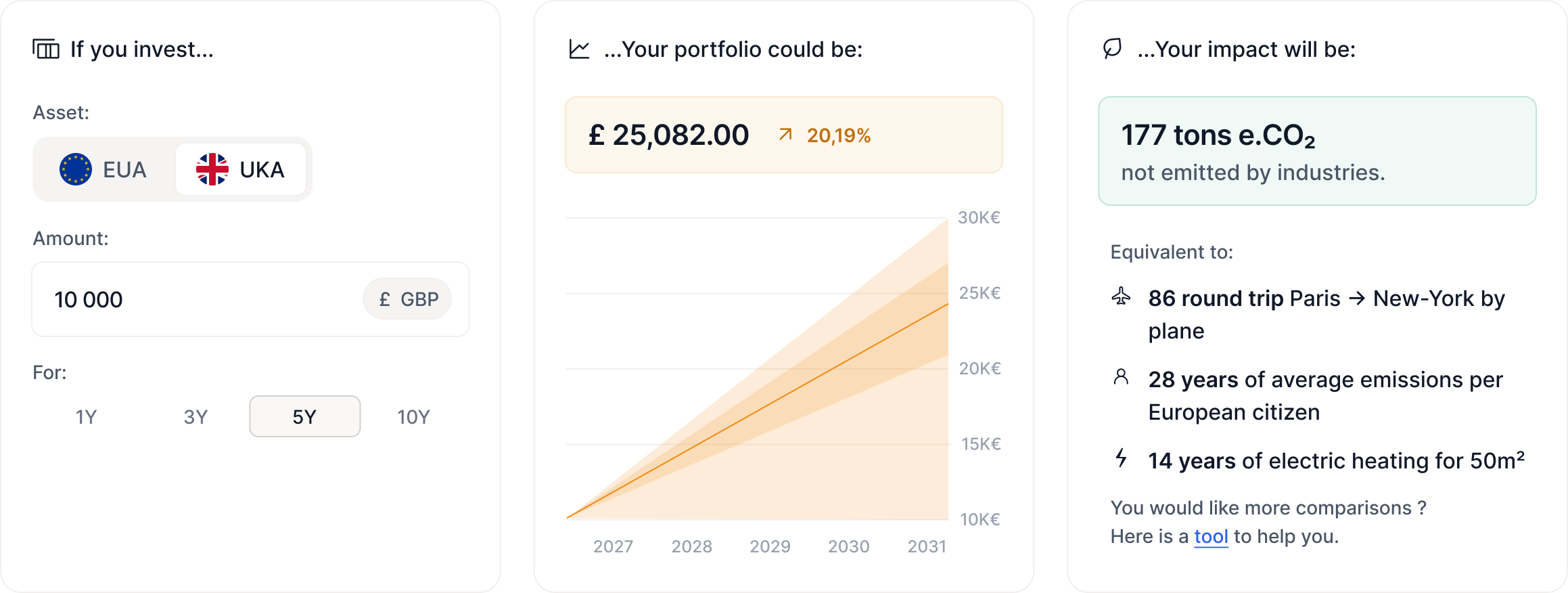
Go further: invest in the carbon market
Homaio gives you access to European carbon allowances (EUAs), an asset class that combines potential financial performance with direct climate impact. Diversify your wealth with an asset uncorrelated from traditional markets, accessible from €1,000.