Investing in Commodities in 2026: A Practical Guide to Getting Started, Comparing Options, and Limiting Risks

Investing in commodities is a diversification strategy that is attracting more and more retail investors. Oil, wheat, copper… These tangible assets, which are at the heart of the global economy, offer opportunities that differ from equities and bonds. However, how they work is complex and the risks are very real.
For an individual investor, investing is mainly done indirectly through financial products such as ETFs or by buying shares in companies in the sector. It is essential to understand that this asset class does not generate intrinsic income (such as dividends) and that its performance relies solely on price appreciation. The approach must therefore be measured and informed.
This article is for informational purposes only and does not constitute investment advice in any way. It is essential to conduct your own research and, if needed, to seek support from a professional.
What is a commodity?
Commodities are raw natural resources, extracted or grown, which are then used in the production of other goods. They are traded on global markets where prices fluctuate based on supply and demand.
They are generally classified into four main families:
- Energy commodities: oil (Brent, WTI), natural gas, coal. Their prices are highly sensitive to geopolitical tensions and OPEC decisions.
- Precious metals: gold, silver, platinum, palladium. Gold is often seen as a safe haven during periods of economic uncertainty.
- Industrial metals: copper, aluminum, zinc, nickel, lithium. Their demand is directly linked to the health of global industry and the energy transition.
- Agricultural commodities: wheat, corn, soybeans, coffee, cocoa, sugar, cotton. Their prices depend on weather conditions, harvests, and demographic trends.
What risks should you know before investing?
Before even considering the opportunities, it is crucial to understand the specific and high risks associated with commodities. This asset class is not suitable for all investor profiles.
Volatility, cycles, and geopolitical shocks
Commodity prices are extremely volatile. An unexpected drought, a political decision, or an armed conflict can cause sudden and unpredictable price movements. For example, the price of a barrel of oil can double or be cut in half within a few months.
In addition, these assets are highly cyclical, meaning they closely follow the expansion and recession cycles of the global economy.
The lack of intrinsic yield
Unlike a stock that may pay dividends or a bond that generates interest, a commodity produces no value by itself. A gold bar or a stored barrel of oil will never create more gold or oil. The only hope of profit relies on reselling at a higher price, which makes this investment closer to speculation.
Contango, backwardation, and the real performance of ETFs
Most financial products (such as ETFs) that provide exposure to commodities do not buy the physical resources. They invest in futures contracts (futures). These contracts must be rolled periodically.
- Contango: This is the situation where the price of the future contract is higher than the price of the current contract. When rolling its position, the fund sells low to buy back higher, which erodes long-term performance.
- Backwardation: This is the opposite, more favorable situation, where the future price is lower.
This complex mechanism can lead to performance for your financial product that is very different from the “spot” price (the cash price) of the commodity that you read about in newspapers.
Currency risk, fees, and concentration
Most commodities are quoted in US dollars (USD). If you invest in euros, the performance of your investment will therefore be affected by fluctuations in the EUR/USD exchange rate.
Finally, commodity investment products come with management fees that reduce final performance. Concentrating on a single commodity also significantly increases risk.
Why do some investors gain exposure to commodities?
Despite the risks, commodities interest investors for specific reasons, often as part of an overall diversification strategy.
- Portfolio diversification: Commodities tend to move in a way that is less correlated with equity and bond markets. Adding them to a portfolio can therefore potentially reduce overall volatility.
- Protection against inflation: During periods of rising prices, the value of commodities (energy, metals, agricultural products) also tends to rise. They can therefore serve as a hedge against the erosion of purchasing power.
- Benefiting from economic cycles: Strong global economic growth often translates into increased demand for industrial metals and energy, pushing their prices higher.
How to invest in commodities in practice?
Several options are available to retail investors, each with its own characteristics, advantages, and drawbacks. It is generally neither possible nor advisable for an individual to physically hold barrels of oil or tons of wheat.
ETFs, ETCs, and ETNs: the most accessible route
Exchange-traded index products are the simplest way to gain exposure to this asset class. However, be mindful of the acronyms:
- ETF (Exchange Traded Fund): An ETF that tracks a commodity index is generally invested in shares of companies in the sector (e.g., an ETF on mining companies).
- ETC (Exchange Traded Commodity): This is the most direct product. It is a debt security (a liability) that replicates the performance of a commodity (physically or via futures contracts). Counterparty risk (issuer default) exists, although it is often mitigated by collateral.
- ETN (Exchange Traded Note): Similar to an ETC, it is also a debt security, but it is generally not backed by a physical stock. Counterparty risk is therefore higher.
Buying shares in sector companies
Another approach is to invest indirectly by buying shares of companies whose core business is tied to commodities. For example:
- Energy: TotalEnergies, Shell.
- Mining: Rio Tinto, BHP Group, ArcelorMittal.
- Agriculture: Archer-Daniels-Midland, Bunge.
The advantage is that you are investing in a company that generates profits and may pay dividends. The drawback is that the share price also depends on the company’s management, its debt, and broader stock-market conditions, not only on the price of the commodity.
Funds and derivatives
- Mutual funds: Some funds specialize in commodities. They are actively managed by professionals, which implies higher fees.
- Derivatives (futures, options, CFDs): These complex instruments are reserved for expert, well-informed investors. They allow the use of leverage, which multiplies potential gains but also losses, which can exceed the initial invested capital.
Comparison table of investment solutions
Practical framework: PEA, taxation, and allocation
Can you hold commodities in a PEA?
The answer is nuanced. It is impossible to hold ETCs or ETNs within a Plan d'Épargne en Actions (PEA) (French equity savings plan), because they are not shares.
However, it is possible to invest indirectly in commodities via a PEA by buying:
- Shares of European sector companies (e.g., TotalEnergies).
- PEA-eligible ETFs that replicate an equity index of companies in the commodities sector (e.g., an ETF on European mining companies).
For direct or broader (global) exposure, you will need to use a Compte-Titres Ordinaire (CTO). To better understand how to start investing, it is crucial to choose the right tax wrapper.
What taxation applies?
In a CTO, capital gains and dividends are by default subject to the Prélèvement Forfaitaire Unique (PFU) of 30 % (12,8 % income tax + 17,2 % social contributions), or, by option, to the progressive income tax scale if that is more advantageous for you. Tax rules can change, so you should check the regulations in force.
What allocation within a portfolio?
Due to their volatility and lack of yield, commodities are considered a diversification investment. Financial advisors often suggest not exceeding 5 % to 10 % of total allocation in a portfolio. The goal is to improve the financial diversification of your portfolio without overexposing it to excessive risk.
Watch out for common mistakes
The first mistake is trying to “time” the market by buying after a strong rise, out of fear of missing an opportunity. The second is going all-in on a single commodity, exposing yourself to maximum concentration risk. A diversified and gradual approach is often more prudent.
FAQ: Investing in commodities
Which commodity should you invest in?
There is no single answer. The choice depends on your convictions and your goals.
- Gold is often used as protection against inflation and crises.
- Copper is linked to economic growth and the energy transition (electric cars, wind turbines).
- Oil is a bet on global energy demand, and is very sensitive to geopolitics.
For a beginner, gaining exposure to a broad and diversified basket of commodities via an ETC or an ETF is an approach that limits the risk of being wrong about a single resource.
What are the best commodity stocks?
It is impossible to name the “best” stocks, because their future performance is unknown. However, investors often look to the leaders in each sector for their size, geographic diversification, and financial strength.
You can cite examples such as TotalEnergies or Shell in oil, Rio Tinto or BHP in mining, or ArcelorMittal in steel. Choosing a stock should be based on an in-depth analysis of the company and should not rely solely on the price of the commodity it produces.
Is a commodity ETF suitable for a beginner?
Yes, an ETF or an ETC can be a good entry point for a beginner, provided you clearly understand its specific features. It is recommended to start with a product tracking a broad and diversified index rather than a single commodity. Above all, beginners must be aware of the risks mentioned above, notably the impact of contango on long-term performance and high volatility. They should view this investment as a small diversification sleeve.
Can you invest in commodities via a PEA?
Directly, no. Products that track the direct price of commodities, such as ETCs, are not shares and are therefore not eligible for a PEA.
Indirectly, yes. You can use your PEA to buy shares of European sector companies (mining, energy) or PEA-eligible synthetic ETFs that replicate equity indices for this sector. Diversification is then more geographically limited. For global exposure, a Compte-Titres Ordinaire (CTO) is required.
Go further: invest in the carbon market
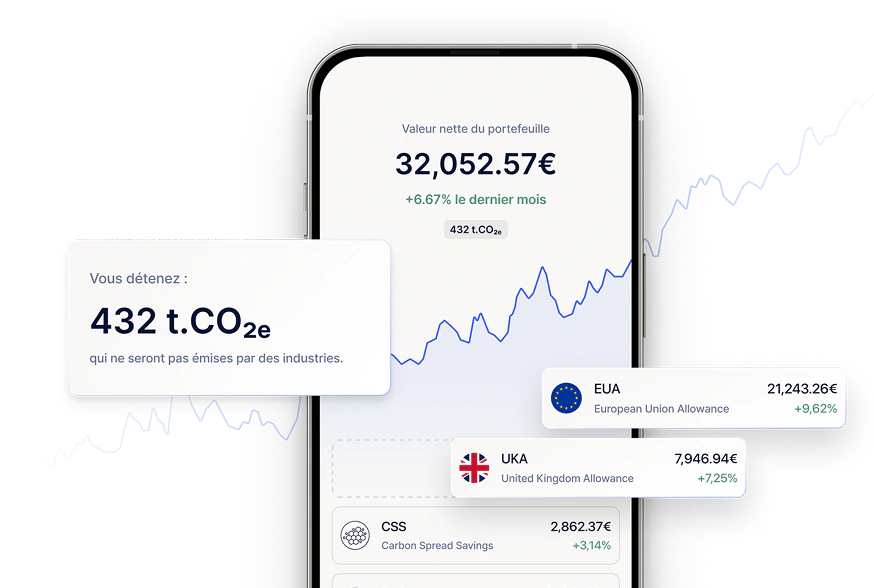
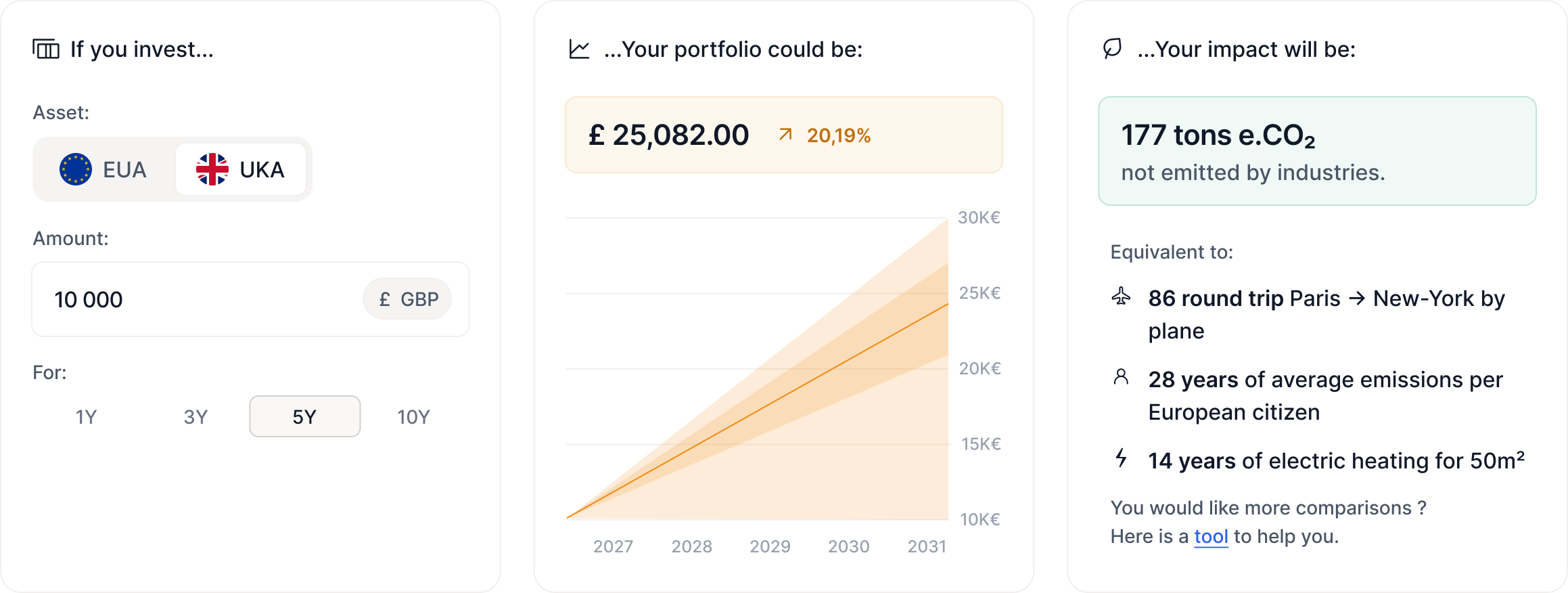
Homaio gives you access to European carbon allowances (EUAs), an asset class that combines potential financial performance with direct climate impact. Diversify your wealth with an asset uncorrelated from traditional markets, accessible from €1,000.