Investing €3,000 in 2026: a simple and safe plan

You have €3,000 set aside and you’re wondering how to grow it intelligently in 2026? With persistent inflation eroding the value of idle savings, leaving that money in a current account is a guaranteed loss.
Yet this amount, far from being trivial, is an excellent starting point.
Well managed, those €3,000 can become the first building block of a strong, sustainable investment strategy. The goal isn’t to chase miracle returns, but to build a thoughtful plan that aligns your objectives, your risk tolerance, and today’s opportunities.
The foundations: before investing the first euro
Investing without a safety net is a fundamental mistake. Before even considering an investment, it is essential to make sure the basics of your financial health are solid. The €3,000 you want to invest should not be your only savings.
It is crucial to build an emergency fund. This rainy-day fund should represent between 3 and 6 months of your regular expenses.
Its role? Cover unexpected events (car breakdown, urgent repairs, job loss) without having to liquidate your investments in a hurry, potentially at a loss. This safety cushion should be held in risk-free, immediately available vehicles, such as the Livret A or the LDDS.
Once this safety is in place, you can define your objectives. What are you investing for? Preparing a down payment for a property purchase, planning for retirement, funding a personal project? Your answer will determine your investment time horizon, i.e., how long you can keep your money invested. A long horizon allows you to take more risk in pursuit of better returns.
Secure investments: protecting your capital
For those who are starting out or have a short time horizon, protecting capital remains the priority. These options offer peace of mind, even if their returns are often moderate.
Regulated savings accounts (Livret A, LDDS)
The Livret A and the Livret de Développement Durable et Solidaire (LDDS) are the pillars of secure savings in France. Capital is guaranteed, funds are available at any time, and interest is net of income tax and social contributions.
However, their interest rate, while increased in recent years, often struggles to outpace inflation. They are therefore perfect for an emergency fund, but insufficient to build wealth over the long term.
The euro fund in life insurance
Assurance vie is a highly versatile tax wrapper. Its secure compartment, the euro fund, offers capital protection and a net return slightly higher than savings accounts, around 2.5% to 3% on average for the best contracts.
It is an excellent alternative for emergency savings or for the defensive portion of an investment portfolio. In addition, it provides access to more dynamic instruments to gradually evolve your strategy.
The long-term reflex
The stock market is volatile in the short term. The classic beginner’s mistake is to panic and sell during a downturn. Historically, markets have always risen over long periods (10 years and more). Adopting a regular investing strategy (putting in a small amount each month) helps smooth your entry point and turn volatility into an ally.
Put your money to work: options to target performance
Once your safety is secured, the objective is to generate performance above inflation. With €3,000, access to markets once reserved for experts is now a reality.
Stocks via ETFs (trackers)
Investing in the stock market no longer means having to pick stocks one by one. ETFs (Exchange-Traded Funds), or trackers, are funds that replicate the performance of an entire stock index (such as the CAC 40 or the MSCI World).
They offer instant diversification at very low cost. By buying a single unit of a global ETF, you invest in hundreds, even thousands of companies around the world.
The most suitable tax wrapper to hold ETFs is the Plan d'Épargne en Actions (PEA). It provides an income tax exemption on capital gains after 5 years of holding (only the 17.2% social contributions remain due).
Real estate crowdfunding
Crowdfunding, or real estate participatory financing, is an increasingly popular solution. The principle is simple: individuals lend money to property developers to finance a specific project.
In return, investors receive interest, with target returns generally ranging between 8% and 12% per year. The minimum investment is often low (sometimes from €100), which makes it accessible.
However, this high return comes with risk: capital is not guaranteed and depends on the success of the property project. It’s an excellent diversification tool, provided you allocate only a measured share of your portfolio to it.
An impact asset: carbon allowances
For investors looking for investments that are both ethical and high-performing, a new asset class is emerging: carbon allowances from the European regulated market (EU ETS). Historically reserved for industrial players and institutions, this market is now accessible to individuals.
The mechanism is unique: by buying carbon allowances, you remove “rights to pollute” from circulation. This increases financial pressure on the most polluting companies, encouraging them to accelerate their decarbonization.
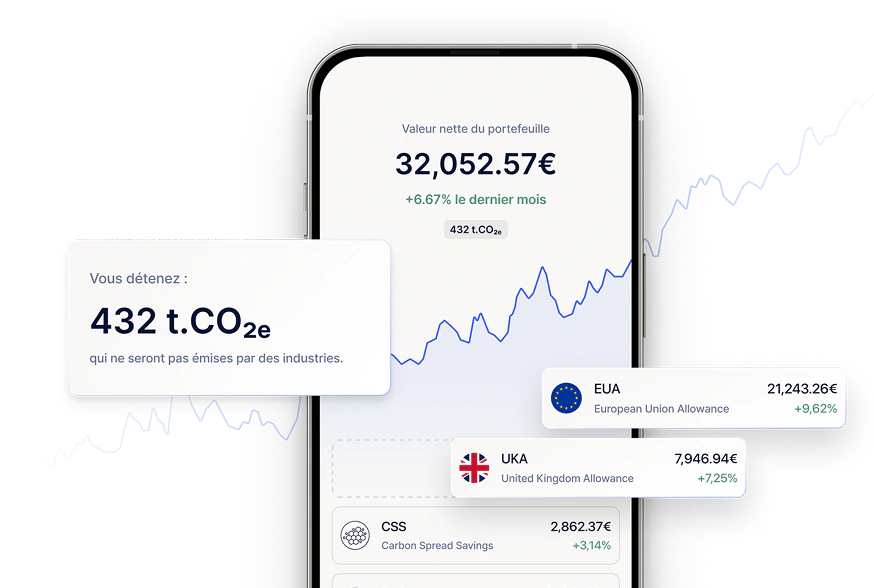
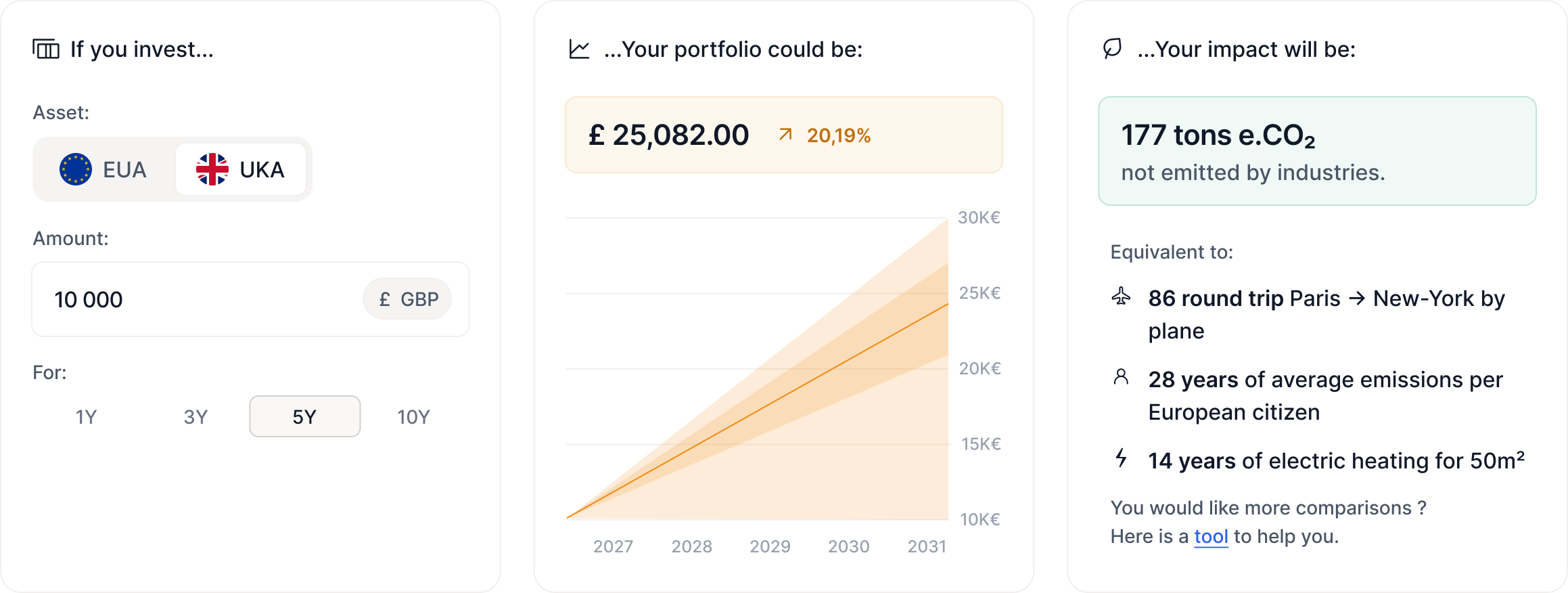
As a European pioneer, we have developed an investment product that makes it possible to gain direct exposure to the performance of the carbon price, an asset that is uncorrelated with traditional financial markets. With a minimum investment of €1,000, it is possible to add this impact asset to a €3,000 portfolio. It’s a concrete way to align your capital with your climate convictions while aiming for financial performance. The investment carries a risk of capital loss and a minimum holding period, but it offers a path to relevant and modern diversification.
Building your investment plan with €3,000
There is no perfect portfolio—only the one that fits you. Here are three allocation examples to illustrate how to spread €3,000 across different risk profiles. These are not recommendations, but ideas to consider.
[image alt="Diagram illustrating the diversification of a €3,000 investment portfolio across three profiles: conservative, balanced, and growth."]
Watch out for taxes
Each investment has its own tax treatment. The PEA and assurance vie offer advantages after a certain holding period (5 and 8 years respectively). Capital gains from other investments (crowdfunding, crypto) are generally subject to the 30% Prélèvement Forfaitaire Unique (PFU). Be sure to factor this into your net return calculations.
Mistakes to avoid with a small amount of capital
One of the most common barriers is thinking that €3,000 is “not enough to start.” This is a costly mistake because of the power of compound interest. The earlier you start, even with little, the more time your money has to work for you.
Another mistake is market timing: trying to enter and exit the market at the best moment. This is often a losing strategy, especially for beginners. Consistency and patience pay off far more.
Finally, beware of high-fee products. On small amounts, management fees of 2% or 3% per year heavily cut into performance. Favor low-cost instruments like ETFs and platforms that are transparent about their pricing.
Investing €3,000 in 2026 is above all a matter of method. It’s not about finding the deal of a lifetime, but about laying the foundations for healthy financial discipline. By combining traditional instruments with innovative solutions, you can build a diversified portfolio tailored to your ambitions and, above all, start making your money a true ally for your future projects. Digitalization has made investing more accessible than ever; it’s time to take advantage of it.
FAQ
What is the best investment for €3,000?
There is no single “best” investment in absolute terms. The ideal solution depends on your personal profile: your risk tolerance, your time horizon, and your objectives. For a conservative profile, a mix of euro funds and ETFs can be relevant. For a more dynamic profile seeking impact, an allocation including carbon allowances and real estate crowdfunding may be considered.
Should I invest my €3,000 all at once or gradually?
For volatile assets such as equities via ETFs, investing gradually is a prudent and effective strategy. This is the principle of DCA (Dollar Cost Averaging): by investing a fixed amount at regular intervals (for example, €250 per month for a year), you smooth your purchase price and reduce the impact of market fluctuations. For investments such as crowdfunding or carbon allowances, the investment is generally made in one go per project or per purchase.
Can I lose my entire investment?
The risk of capital loss is real for most investments, except for regulated savings accounts and euro funds. With equities, crowdfunding, or carbon allowances, the value of your investment can fluctuate and you could lose some or all of your capital. That’s why diversification is essential: never put all your eggs in one basket.
Go further: invest in the carbon market
Homaio gives you access to European carbon allowances (EUAs), an asset class that combines potential financial performance with direct climate impact. Diversify your wealth with an asset uncorrelated from traditional markets, accessible from €1,000.