Invest €5,000 in the Stock Market: A Simple 2026 Plan

You have €5,000 and you’re wondering whether that amount is enough to open the doors to the stock market. The answer is a clear and resounding yes.
Far from being a trivial amount, this sum represents a meaningful threshold that changes the game. It allows you not only to get familiar with how markets work, but also to build the foundations of a diversified and potentially high-performing portfolio.
Forget the misconception that investing is reserved for an elite. With €5,000, you already have access to the essentials—provided you follow a clear plan and avoid beginner mistakes.
Why investing €5,000 is an excellent starting point
Investing such an amount is a concrete and significant step. It’s the ideal sum to learn without taking disproportionate risks. You’ll discover how markets work, how to analyze investment vehicles, and above all, how to manage your emotions in the face of fluctuations.
This experience is invaluable and will serve you throughout your life as an investor, even when you manage larger amounts of capital.
Unlike smaller sums, €5,000 enables true diversification. You’re no longer forced to bet everything on one or two assets. It becomes possible to spread your capital across different asset classes, geographic areas, and sectors. This is the golden rule for diluting risk while optimizing return potential.
Finally, this amount is a solid base for building your wealth. Thanks to the magic of compound interest, even a modest starting capital can grow significantly over the long term. An annual return of 6% can turn your €5,000 into more than €8,000 in 8 years, without a single additional contribution. That’s how you kick-start wealth creation.
Essential prerequisites before allocating your capital
Before you begin, two steps are absolutely non-negotiable. Ignoring them would be like building a house without foundations.
Define your investment horizon and your risk tolerance
The stock market is not a sprint; it’s a marathon. Your investment horizon is the length of time during which you can tie up your money. For equities, a long horizon (more than 8–10 years) is strongly recommended to smooth volatility and benefit from growth potential.
Your risk tolerance is your psychological and financial ability to withstand market downturns. Be honest with yourself: would a portfolio that drops 20% in a month keep you up at night? Your strategy will depend directly on this.
Build an emergency fund
This is rule number one. Before investing a single euro, make sure you have an emergency fund. This is an amount equivalent to 3 to 6 months of your regular expenses, kept in liquid, risk-free vehicles such as the Livret A.
This safety buffer will prevent you from having to sell your investments urgently (and often at a loss) in the event of a setback (job loss, unexpected repair, etc.).
Don’t confuse saving and investing
Your emergency fund is your safety net. It must remain immediately available and guaranteed. Only invest in the stock market money you won’t need in the short or medium term.
Which tax wrapper should you choose for €5,000?
Choosing the “container” is just as important as choosing the “contents.” In France, three main wrappers stand out.
The PEA: the Swiss Army knife for the European investor
The Plan d'Épargne en Actions (PEA) (French equity savings plan) is often the preferred choice to get started. After 5 years of holding, capital gains are fully exempt from income tax (only the 17.2% social contributions remain due).
It is ideal for investing in European stocks and ETFs (index funds). With €5,000, it’s a highly efficient option.
Assurance vie: the versatile long-term solution
Assurance vie is an extremely flexible wrapper. It allows you to invest both in secure funds (euro funds) and in more dynamic instruments (Unités de Compte, which can include stocks, bonds, etc.).
Its taxation also becomes very attractive after 8 years. It’s an excellent solution for those who want to combine safety and performance within a single contract.
The Compte-Titres Ordinaire (CTO): your gateway to the world
The CTO offers no specific tax advantage, but its strength lies in total flexibility. It gives you access to all global markets, including U.S. stocks (Apple, Google, etc.) that are not eligible for the PEA.
For €5,000, it is often used as a complement to a PEA for maximum geographic diversification. Gains are subject to the 30% “flat tax.”
Strategies to grow €5,000 in the stock market
Once the wrapper is chosen, you need to fill it intelligently. Several approaches are possible.
Passive management with ETFs: simplicity in the service of performance
For 99% of investors—and especially for a first investment—ETFs (Exchange-Traded Funds) are the most rational solution. An ETF is a fund that replicates the performance of a stock index (such as the CAC 40 or the MSCI World).
By buying a single share of an MSCI World ETF, you invest simultaneously in more than 1,500 companies around the world. It’s the ultimate diversification, accessible in one click and with very low management fees.
Buying individual stocks (stock-picking): for the more experienced
Stock-picking means selecting the shares of companies you want to invest in yourself. While the idea is appealing, it is also far riskier and more time-consuming. With €5,000, it is difficult to build a sufficiently diversified portfolio (15–20 positions minimum), because the price of a single share can sometimes reach several hundred euros. This approach is best reserved for more experienced investors.
Diversification through alternative assets and impact
To optimize a portfolio, diversification doesn’t stop at stocks and bonds. New asset classes, uncorrelated with traditional markets, can reduce overall risk while adding meaning to your investment.
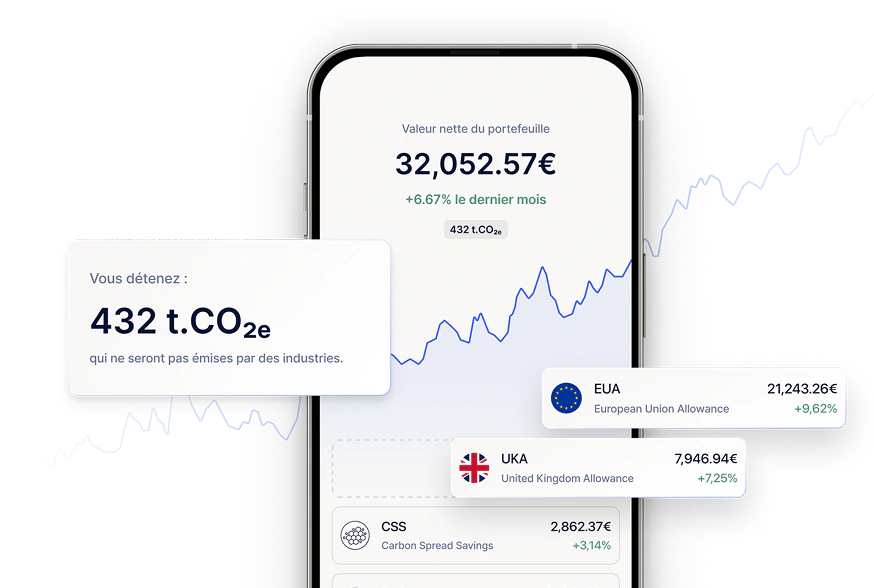
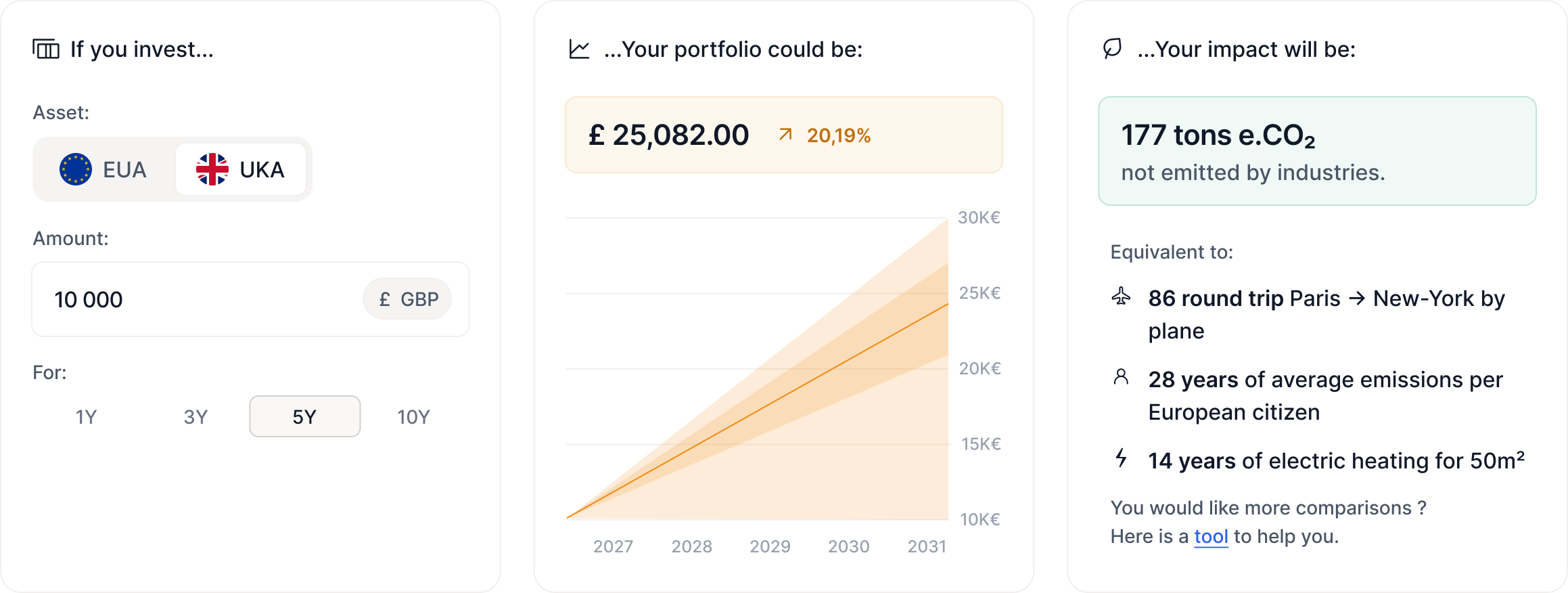
That is precisely our mission. As pioneers, we have opened access for individuals to the regulated market for European carbon allowances (EUA), a universe previously reserved for industrial players and large funds. Investing in these carbon allowances not only aims for uncorrelated financial performance, but also delivers direct climate impact. Every euro invested removes rights to pollute from the market, increasing pressure on companies to accelerate their decarbonization.
[image alt="Diagram showing the allocation of a €5,000 investment portfolio for a dynamic profile."]
3 portfolio examples to invest €5,000
Warning: The allocations below are educational examples and do not constitute investment advice. They must be adapted to your personal situation.
Cautious profile (5–8 year horizon)
The goal is capital preservation with slight exposure to market growth. Assurance vie is a suitable wrapper.
- €2,500 (50%) in euro funds: The safety sleeve, with guaranteed capital.
- €2,500 (50%) in an MSCI World ETF: The growth sleeve to capture the performance of global equities.
Balanced profile (Horizon > 8 years)
This is the classic approach for an investor targeting long-term growth with controlled risk. The PEA is the ideal wrapper.
- €4,000 (80%) in an MSCI World ETF: The core of the portfolio, diversified across developed countries.
- €1,000 (20%) in an Emerging Markets ETF: A sleeve to boost performance by gaining exposure to the growth of emerging countries.
Dynamic & Impact profile (Horizon > 10 years)
For investors with a high risk tolerance, seeking to maximize potential returns and give tangible meaning to their investment.
- €3,500 (70%) in an MSCI World ETF (via PEA): The solid, diversified base of the portfolio.
- €500 (10%) in a sector ETF (via PEA or CTO): For example, an ETF specializing in clean energy or technology, to express a strong conviction.
- €1,000 (20%) in European carbon allowances (via Homaio): The diversification and impact sleeve. It provides decorrelation relative to equity markets and directly contributes to the fight against climate change. Our minimum ticket is set at €1,000 to make this investment both accessible and meaningful.
Key watch-outs: fees and taxation
Two silent enemies can erode your performance: fees and poorly optimized taxation.
The impact of fees on your performance
On €5,000 of capital, every percentage point of fees matters. Pay attention to the different layers of costs:
- Brokerage fees: Paid on every buy or sell. Favor online brokers with competitive pricing.
- Management fees: Built into ETFs and funds. They should be as low as possible (below 0.50% for a broad ETF).
- Wrapper fees: Especially for assurance vie (entry fees, contribution fees, switching fees). Look for online contracts with 0% entry fees.
Pro tip: smooth your entry point
Rather than investing the €5,000 all at once (lump sum), the DCA (Dollar Cost Averaging) method is a calmer approach. It involves investing fixed amounts at regular intervals (e.g., €1,000 per month for 5 months). This strategy smooths your average purchase price and reduces the psychological impact of entering the market right before a downturn.
Optimize your taxation from the start
Choosing the wrapper (PEA, assurance vie) is your main lever for tax optimization. Making the right decision from the outset will save you thousands of euros over the long term. Don’t neglect this crucial step to get off to a good start investing.
Investing €5,000 in the stock market is a powerful decision. It’s the first step toward putting your money to work and actively building your financial future. The most important thing is not to chase spectacular short-term gains, but to adopt a thoughtful, diversified strategy—and stick with it over time.
With the right tools like ETFs, the right wrappers like the PEA, and innovative diversification options, this capital is more than enough to lay healthy, solid foundations. The hardest part is often taking the first step. Now, you have the plan.
Frequently asked questions about investing €5,000 in the stock market
What is the minimum budget to start investing in the stock market?
Technically, it is possible to start with a few tens of euros. However, to build a minimally diversified portfolio and offset fees, an amount like €5,000 is a much more relevant threshold. It lets you access several ETFs or instruments without fixed fees representing too large a share of the investment.
Is it risky to invest €5,000 in financial markets?
Yes, any stock market investment involves a risk of capital loss. The value of your assets can fluctuate up or down. However, this risk can be significantly reduced through proper diversification (not putting all your eggs in one basket) and a long investment horizon, which helps smooth out market turbulence.
For a first investment of €5,000, is it better to choose a PEA or an assurance vie?
That depends on your goals. The PEA is unbeatable for its taxation on capital gains from European stocks/ETFs after 5 years; it’s perfect for a 100% equity-market strategy. Assurance vie is more versatile, allowing you to mix a secure sleeve (euro funds) and dynamic sleeves (Unités de Compte), while also offering estate-planning advantages. For a young investor with a long horizon, the PEA is often the preferred choice to get started.
How long should you invest this amount for?
Equity investing is a long-term strategy. To fully benefit from the growth potential of markets and absorb downturn phases, it is advisable to plan for an investment period of at least 8 to 10 years. If you think you’ll need this money in less than 3–5 years, equity markets are probably not the most suitable option.
Go further: invest in the carbon market
Homaio gives you access to European carbon allowances (EUAs), an asset class that combines potential financial performance with direct climate impact. Diversify your wealth with an asset uncorrelated from traditional markets, accessible from €1,000.