How to invest in the stock market in 2026: a clear guide for beginners

Getting started in the stock market can feel intimidating. Between the technical jargon and the fear of losing your money, many savers hesitate to take the plunge. Yet with a clear, patient, and well-informed approach, stock market investing becomes an accessible tool to boost part of your savings.
The goal of this guide is to demystify investing for beginners. It will give you the keys to understand the basic mechanisms, choose suitable instruments, and take your first steps in a cautious and structured way.
- Define your strategy: Set your goals, time horizon, and risk tolerance.
- Choose your tools: Understand the difference between stocks and ETFs to diversify easily.
- Select your account: Compare the PEA (French equity savings plan), the securities account, and life insurance.
- Take concrete action: Follow the steps to open an account and place a first order.
- Manage risk: Apply the principles of diversification and regular investing.
Warning: Investing in financial markets involves a risk of capital loss. Past performance is not indicative of future performance. This article is for informational purposes only and in no way constitutes investment advice.
Understanding what it means to invest in the stock market
The stock market is, above all, a large marketplace. Instead of trading fruit and vegetables, people buy and sell financial securities there—mainly "stocks". A stock represents a small portion of a company’s equity.
By buying a stock, an investor therefore becomes the owner of a fraction of that company. They are betting on its future growth, hoping the value of the stock will rise over time. For companies, the stock market is a way to raise funds to finance their development: research, innovation, new factories, etc.
Why the stock market is best considered for the long term
One of the main barriers to investing is volatility: stock prices rise and fall every day, sometimes dramatically. That’s why a stock market investment strategy is generally considered over a long period (several years, even decades).
Over the long term, this volatility tends to smooth out. Historically, major stock indices have shown an upward trend over periods of 10, 20, or 30 years, despite crises and recessions. The goal is to allow your savings to grow enough to potentially outpace inflation, which erodes the value of money left in a current account.
The basics to know before you start
Before you even think about buying your first security, three notions are fundamental to building a sound investment strategy.
Goal, investment horizon, and risk tolerance
- Your goal: Why do you want to invest? Prepare for retirement, fund your children’s education, buy a property in 15 years? A clear goal defines your horizon.
- Your investment horizon: This is the length of time you can leave your money invested. For the stock market, a 5-year horizon is a minimum, and more than 10 years is often recommended. Never invest money you may need in the short term.
- Your risk tolerance: What maximum loss would you be willing to accept without panicking? Be honest with yourself. Better a lower potential return than taking on risk that keeps you up at night.
Capital loss, volatility, and diversification
These three concepts are at the heart of risk management for investors.
- The risk of capital loss: This is the golden rule. The value of your investment can fall, and you can lose part or all of the amount invested. There is no stock market investment without risk.
- Volatility: This is the magnitude of price fluctuations in an asset. High volatility means the price can rise or fall very quickly.
- Diversification: This is the best response to volatility. The principle is simple: "don’t put all your eggs in one basket." By spreading your investment across many companies, sectors, and geographic areas, you reduce the impact of the poor performance of a single security on your overall investment portfolio.
Choosing what to buy when you’re starting out
For a beginner, the choice of investment instruments can seem endless. Two options stand out in particular.
Individual stocks: potential and limitations
Buying shares in a single company (such as LVMH, Apple, or TotalEnergies) can offer high return potential if the company performs very well.
However, this approach requires a lot of time to analyze companies and involves a high concentration risk. If that company runs into trouble, your entire investment is affected.
ETFs (exchange-traded index funds): a simple solution to diversify
An ETF (Exchange Traded Fund), also called a "tracker," is an investment fund that replicates the performance of a stock index (such as the CAC 40 for France or the S&P 500 for the United States).
Buying a single unit of an "MSCI World" ETF, for example, is equivalent to investing simultaneously in more than 1,500 large companies around the world. It’s the simplest and most effective way to instantly diversify your portfolio with very low fees. For this reason, ETF shares are often recommended to start investing.
[image alt="Simple diagram comparing an individual stock to an ETF representing a basket of multiple stocks."]
Choosing the right investment wrapper
In France, to invest in the stock market, you must use a "tax wrapper": a specific account that holds your securities and sets the tax rules for your gains. Here are the three main ones.
PEA: to invest in stocks and ETFs within a dedicated framework
The Plan d'Épargne en Actions (PEA) is often the preferred wrapper for getting started.
- Main advantage: Very attractive taxation. After 5 years of holding, capital gains are exempt from income tax (only social contributions of 17.2 % remain due).
- Limit: It is mainly reserved for stocks and ETFs of European companies. The contribution ceiling is 150 000 €.
Standard securities account (CTO): more flexible but taxed differently
The securities account is the most flexible wrapper.
- Main advantage: It allows you to invest in all types of securities worldwide (U.S. stocks, Asian stocks, etc.) with no ceiling.
- Limit: Taxation is less advantageous. Gains are, by default, subject to the prélèvement forfaitaire unique (PFU) of 30 % ("flat tax").
Life insurance: when it can complement a stock market strategy
Although it is primarily a savings product, a multi-support assurance vie contract lets you allocate part of your capital to financial markets via "unit-linked" investments (which can be funds or ETFs).
- Main advantage: Ideal for estate planning thanks to favorable taxation on transfers. Taxation on withdrawals also becomes attractive after 8 years.
- Limit: Management fees are often higher than with a PEA or a CTO, and the selection of securities is more limited.
Watch out for the risk of capital loss
Whatever wrapper you choose, the risk of capital loss remains the same. The favorable taxation of a PEA or life insurance does not protect you in any way against market fluctuations.
How to invest in the stock market step by step
Once the theory is understood, taking action is fairly simple.
1. Open an account with a bank or broker
You can open a PEA or a securities account with your traditional bank or, more often, with an online broker. Specialized brokers often offer much lower transaction (brokerage) fees, an essential criterion for optimizing performance.
2. Fund your account and define your investment amount
Once the account is approved, you simply make a bank transfer to fund it. Set an initial investment amount you are comfortable with, keeping in mind that this is money you can potentially afford to lose.
3. Place a buy order easily
To buy your first security (stock or ETF), log in to your client area and look for the securities search engine.
- Find the security: Type its name or its ISIN code (its unique identifier).
- Enter the quantity: Choose the number of units you want to buy.
- Choose the order type: To get started, a "market order" is the simplest. It executes immediately at the best available price.
- Confirm: After confirmation, the order is placed and the securities appear in your portfolio within moments.
Investing with a small budget: what to do with 100 €?
There is no minimum amount to invest in the stock market. It is entirely possible to start with 100 €, 50 €, or even less.
With a small budget, the objective is twofold: diversify as much as possible and minimize fees. To do this, the best approach is often to buy one or two units of a broad ETF (such as an MSCI World or S&P 500 ETF) via a PEA opened with a low-fee broker.
With 100 €, you can become a "co-owner" of a global portfolio of hundreds of companies. This approach is much more prudent than betting everything on a single stock.
The power of scheduled contributions
Rather than trying to guess the "right time" to invest, an effective strategy is to invest a fixed amount at regular intervals (for example, 100 € each month). This method, called DCA (Dollar Cost Averaging), helps smooth your entry price and reduce the impact of volatility over the long term.
Which fees and which risks to watch
Your investment performance also depends on costs and your discipline.
- Brokerage fees: Charged on each buy or sell. Favor brokers offering orders at 0 € or under 2 €.
- Annual management fees: Specific to ETFs and funds. For an ETF, they are very low (often between 0.10 % and 0.40 %).
- Custody fees: Fees for holding securities. Most online brokers no longer charge them.
- Emotional risk: The biggest risk for a beginner investor is reacting out of fear. Selling in panic during a market downturn is often the best way to lock in a loss.
[image alt="Chart illustrating the potential growth of a long-term investment despite short-term volatility."]
Common beginner mistakes to avoid
- Wanting to get rich quickly: The stock market is a marathon, not a sprint. Beware of promises of quick gains.
- Investing everything on a "hot tip": It’s the best way to concentrate risk and suffer significant losses. Diversification is key.
- Neglecting fees: An extra 1 % in fees per year may not seem like much, but over 30 years it represents a considerable share of your final performance.
- Investing money you need: Make sure you have solid emergency savings before investing in the stock market.
- Checking your portfolio every day: It generates stress and encourages impulsive decisions. Adopt a long-term view.
Getting started with investing is above all a learning process. By starting small, favoring simple tools like ETFs, and keeping a long-term perspective, you maximize your chances of making the stock market an ally for your savings.
FAQ: common questions for getting started in the stock market
How do you invest in the stock market as a beginner?
- Define a goal and a long time horizon (more than 5 years).
- Open a Plan d'Épargne en Actions (PEA) for its favorable tax treatment.
- Invest regular amounts in broad ETFs (like an MSCI World) to diversify immediately at low cost.
- Don’t panic during market downturns and stick to your long-term strategy.
How do you invest 100 € in the stock market?
With 100 €, the ideal approach is to open a PEA with an online broker with no inactivity fees and very low brokerage fees. Use that amount to buy one or more units of an ETF that tracks a global index. This allows you to be diversified across hundreds of companies with a single purchase.
What is the minimum price to invest in the stock market?
Technically, there is no minimum amount. The entry price corresponds to the price of one share of stock or an ETF unit, which can range from a few euros to several thousand. So it’s possible to start with 20 € or 50 €. However, you should always take transaction fees into account, as they can represent a high percentage on very small amounts.
How do you invest in the stock market yourself while limiting risk?
It is impossible to eliminate risk entirely in the stock market, but you can manage it. The three pillars for limiting risk are:
- Diversification: Don’t put all your eggs in one basket. ETFs are an excellent tool for that.
- Time: Adopt a long investment horizon (10 years and more) to smooth market volatility.
- Consistency: Invest fixed amounts at regular intervals (each month or quarter) to avoid buying at a market peak.
Go further: invest in the carbon market
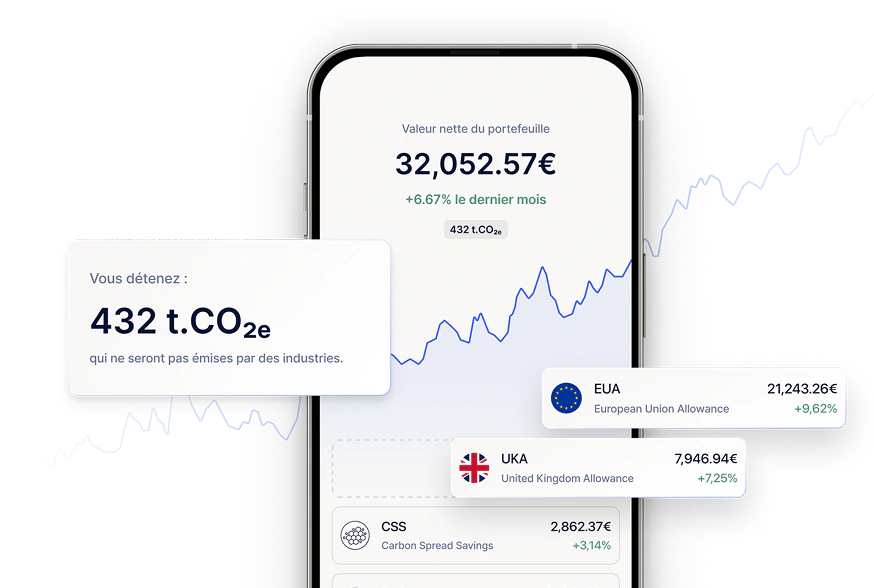
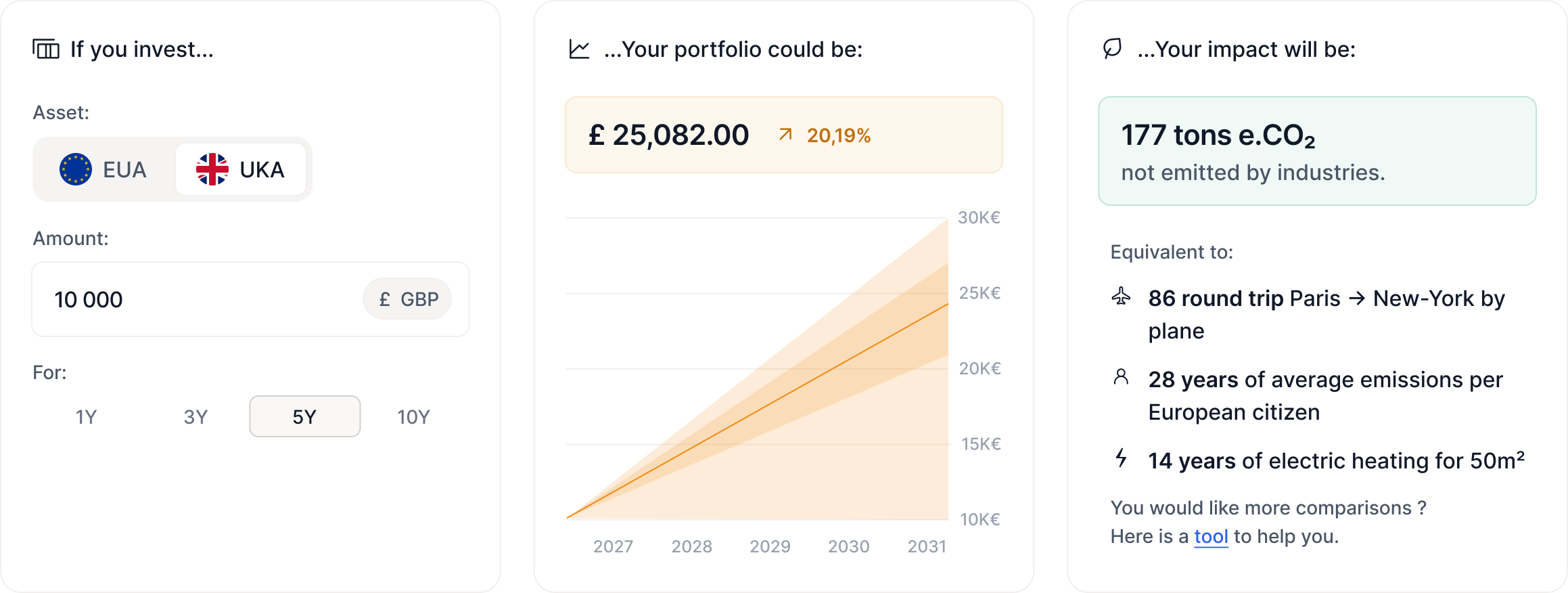
Homaio gives you access to European carbon allowances (EUAs), an asset class that combines potential financial performance with direct climate impact. Diversify your wealth with an asset uncorrelated from traditional markets, accessible from €1,000.