How to invest €500 in 2026: an actionable guide

You have €500 set aside and you’re wondering how to make it grow instead of letting it sit idle in a current account? That’s an excellent question. Investing such an amount may seem modest, but it’s a decisive first step to build good financial habits and lay the foundations for future wealth.
Far from being anecdotal, this sum opens the door to many concrete opportunities. It allows you to get familiar with how markets work, test your risk tolerance, and turn a small amount of capital into a solid base—without the pressure that comes with larger sums.
Essential prerequisites before investing your €500
Before chasing the best return, it’s crucial to make sure your financial foundations are solid. Jumping into investing without a safety net is the beginner’s first mistake.
Build your emergency fund: the golden rule
An emergency fund is money set aside to deal with the unexpected: a car repair, a healthcare expense, a temporary loss of income. It must be immediately available and with no risk of capital loss.
It’s widely recommended to have at least 3 months of day-to-day expenses in a liquid account. If you don’t yet have this reserve, your €500 will be best placed there.
The ideal vehicles for this savings are:
- Livret A or LDDS (Livret de Développement Durable et Solidaire): guaranteed capital, instant access to funds, and tax-exempt interest.
- LEP (Livret d'Épargne Populaire): if you’re eligible, its rate is indexed to inflation, making it the best shield against monetary erosion for safety savings.
Investing comes after safety
Never invest money you might need in the short term. Financial markets are volatile, and being forced to sell at the wrong time to cover an emergency is the best way to lock in losses.
Define your goals and time horizon
Once your emergency fund is in place, ask yourself what the goal is for these €500. The answer will determine the most suitable investments.
- Short-term horizon (under 3 years): You’re planning a trip or a specific purchase. The priority is preserving capital. Risky investments should be avoided.
- Medium-term horizon (3 to 8 years): You’re aiming to buy a car or build a down payment for a real-estate project. Moderate risk may be considered to seek better returns.
- Long-term horizon (over 8 years): You’re preparing for retirement or simply want to grow your capital over time. It’s over this horizon that more dynamic investments, such as equities, reveal their full potential thanks to compound interest.
Lump sum or recurring investments: which strategy to start with?
Should you invest your €500 all at once or spread it over time? Both approaches have their merits and reflect different rationales.
A lump-sum investment exposes your entire capital to the market immediately. If markets rise, you benefit fully. However, you also take the risk of investing right before a downturn.
Recurring investments (for example, €50 per month for 10 months) correspond to a strategy called Dollar Cost Averaging (DCA). This method involves investing a fixed amount at regular intervals.
- When markets fall, your €50 buys more units.
- When markets rise, it buys fewer.
This approach smooths your average entry price and reduces the impact of volatility. For a beginner, it’s often more comfortable psychologically and helps establish a disciplined, regular saving habit.
The best options for investing €500 in 2026
With €500, you can access many products—provided you choose carefully to keep fees under control and enable good diversification.
Safety first: capital-guaranteed placements
If your profile is very cautious or your horizon is short, these solutions should be prioritized.
- Regulated savings accounts (Livret A, LDDS): As seen earlier, they’re perfect for an emergency fund, but their real return (after inflation) is often negative. They don’t build wealth; they preserve it.
- The euro fund of life insurance (assurance-vie): This is the secure core of many contracts. The capital is guaranteed by the insurer, and the return, while modest, is generally higher than Livret A. It’s an excellent option to “start the clock” on an assurance-vie contract and benefit from its advantageous tax treatment after 8 years.
Target performance: equity investments
For a long investment horizon, exposure to equity markets is essential if you want meaningful capital growth.
- PEA (Plan d'Épargne en Actions): This is the most attractive tax wrapper for investing in European equities. After 5 years of holding, capital gains are exempt from income tax (only social contributions of 17,2 % remain due).
- ETFs (trackers): These are funds that passively replicate the performance of a stock market index (such as the CAC 40 or the S&P 500). Their advantages are huge for a beginner:
- Instant diversification: With a single ETF unit, you invest in hundreds or even thousands of companies.
- Very low fees: They are 5 to 10 times cheaper than traditional mutual funds.
- Accessibility: Many ETFs are eligible for the PEA and can be accessed for a few dozen euros.
- Assurance-vie in Unités de Compte (UC): In addition to the euro fund, assurance-vie allows you to invest in a wide range of assets (equities, real estate, bonds) called Unités de Compte. Capital is not guaranteed, but the performance potential is higher. It’s a very flexible wrapper.
Diversify with alternative investments
To go further, innovative solutions provide access to other asset classes.
- Real-estate crowdfunding: Also called “fractional rental investment,” it lets you lend money to real-estate developers to finance their projects in exchange for an attractive annual return (often between 8 % and 12 %). The minimum investment is sometimes accessible from €100, but the risk is real (delays, developer defaults) and capital is not guaranteed. It’s a solution to consider for a small portion of your portfolio.
- SCPI (Sociétés Civiles de Placement Immobilier): Investing in “paper” real estate lets you earn rental income without management constraints. While an SCPI unit often costs more than €500, it is possible to invest via certain assurance-vie contracts or specialized platforms that offer the purchase of fractional units.
Building your first portfolio: 3 concrete examples
There isn’t a single portfolio, but allocations tailored to each profile. Here are three simulations to illustrate how to allocate €500. This is not investment advice, but educational examples.
The power of compound interest
Albert Einstein is said to have called compound interest the “eighth wonder of the world.” By systematically reinvesting your gains, your capital grows exponentially. With an average return of 5% per year, your initial €500, supplemented by €100 per month, can turn into nearly €15 000 in 10 years.
What next? Think further with impact investing
Once you’ve set up your first strategy and you’re comfortable with the basics, you can look to diversify your portfolio with innovative assets that combine performance potential and positive impact.
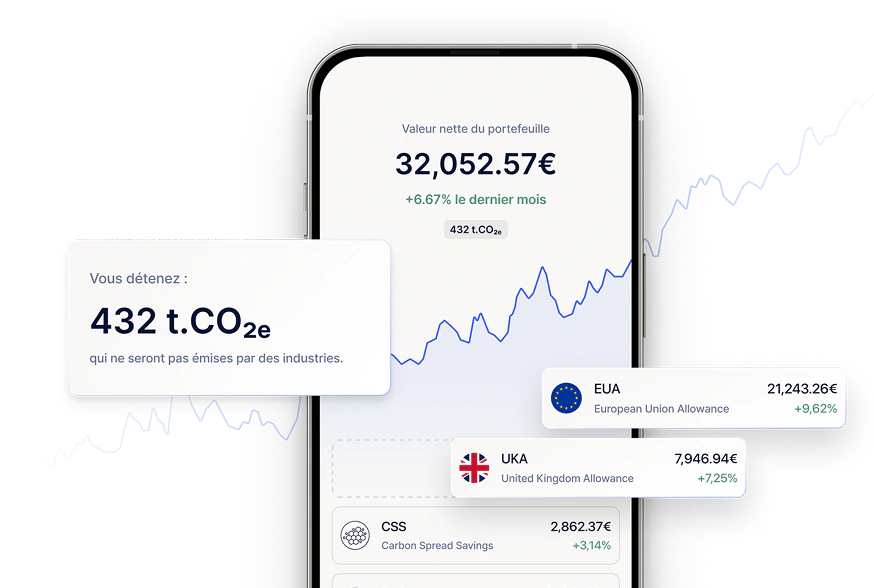
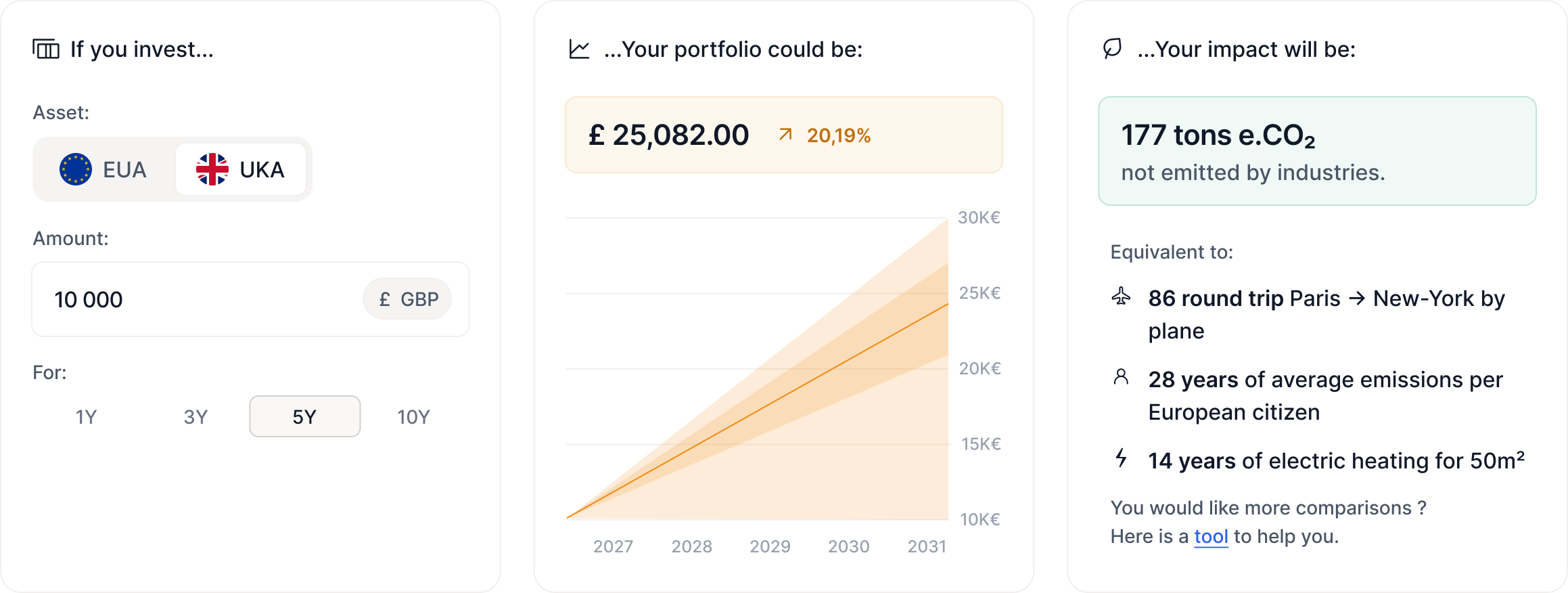
This is where solutions like investing in climate assets come in. The market for carbon emission allowances (EU ETS), for example, was long reserved for large industrial players and institutional investors. Its principle is simple: polluting companies must buy “rights to pollute” to offset their emissions.
Today, pioneering platforms are democratizing access to this market. By investing there (generally with a higher minimum ticket, around €1 000), you buy these allowances and remove them from circulation. Mechanically, this reduces the number of permits available, pushes up their price, and financially incentivizes industries to accelerate decarbonization. It’s a way to make investing a direct lever for climate action, while gaining exposure to an asset class that is uncorrelated with traditional markets. It’s an interesting avenue for responsible investors.
Mistakes to avoid so you don’t lose your initial capital
Investing with a small amount doesn’t mean you’re protected from mistakes. Here are the most common pitfalls to avoid.
- Ignoring fees: With €500, a 2% entry fee already represents €10. On small amounts, fixed fees are particularly punitive. Favor products with no entry fees and the lowest possible annual management fees (such as ETFs).
- Putting all your eggs in one basket: Putting your entire €500 into a single “trendy” stock or a cryptocurrency is extremely risky. Diversification is the only protection against an asset’s idiosyncratic risk.
- Panicking and selling at the first dip: Financial markets fluctuate—that’s their nature. Selling after a 10% drop only crystallizes your losses. A long-term investment strategy means staying the course and trusting time.
- Forgetting taxes: Capital gains on your investments are generally taxed. Wrappers like the PEA or assurance-vie offer very advantageous tax frameworks that you should use to optimize your net return.
Investing €500 in 2026 is far more than a simple financial transaction. It’s the beginning of a learning journey that will build your confidence and give you the right reflexes for the future. By starting small, staying disciplined, and continuing to learn, you set in motion a virtuous circle that will gradually turn this first building block into solid, lasting wealth.
FAQ
Can you really invest with only €500?
Absolutely. It’s even an excellent starting point. Many platforms and financial products, such as ETFs via a PEA or an assurance-vie, don’t have a high minimum ticket. What matters isn’t the starting amount, but consistency and discipline over the long term.
What is the safest investment for €500?
For maximum safety, regulated savings accounts (Livret A, LDDS) and euro funds in assurance-vie contracts are hard to beat, because capital is guaranteed. However, their return is low and doesn’t always protect against inflation. “Safety” also depends on your time horizon: over 10 years, a diversified equity portfolio has historically performed better and can be considered “safe” for achieving growth goals.
Should you invest your €500 all at once?
For a beginner, it’s often recommended to spread the investment over time (for example, €100 per month over 5 months). This recurring-investment strategy (DCA) reduces the risk of investing at the top and eases the stress linked to market volatility.
How long does it take to see results?
Investing is a marathon, not a sprint. In equity markets, it’s recommended to have a time horizon of at least 5 years, and ideally 8 years or more, to smooth out fluctuations and fully benefit from growth potential. In the short term, results can be random, but over time, the markets’ historical trend is upward.
Go further: invest in the carbon market
Homaio gives you access to European carbon allowances (EUAs), an asset class that combines potential financial performance with direct climate impact. Diversify your wealth with an asset uncorrelated from traditional markets, accessible from €1,000.