
How can EUAs improve your socially responsible investment portfolio?
Socially Responsible Investing (SRI) combines financial returns with positive social and environmental impacts, offering diversification and risk mitigation. Investing in EU Allowances (EUAs) through the EU Emissions Trading Scheme (EU ETS) supports environmental goals and provides financial returns, with strong historical performance and promising future forecasts. EU labels like France's SRI and Green Fin guide investors in building sustainable and ethical portfolios.

Socially Responsible Investing (SRI) combines financial returns with positive social and environmental impacts. Basically, it is directing funds towards ethical and sustainable practices. In the EU, labels like France's SRI and Green Fin, Belgium's Towards Sustainability, Luxembourg's LuxFLAG, and Germany's FNG-SIEGEL help investors align their investments with their climate values. SRI portfolios offer financial gains and risk mitigation through diversification. Possible strategies include investments in environmental sustainability, social justice, and ethical governance. The EU Emissions Trading Scheme (EU ETS) and investing in EUAs is an impactful SRI, generating significant auction revenues for EU member states to fund climate initiatives that promote economic growth and resilience. With promising historical performance and future forecasts, EU Allowances (EUAs) in an SRI portfolio support environmental goals and offer strong financial returns.
- What is socially responsible investing?
- How to Build a Socially Responsible Investment Portfolio?
- What are some examples of Socially Responsible Investment strategies?
- What is the social and environmental impact of investing in carbon allowances (EUAs)?
- How do EUAs bring good financial returns to a socially responsible portfolio?
What is socially responsible investing?
Defining Socially Responsible Investment (SRI)
Socially Responsible Investment (SRI) is an approach that considers both financial returns and social impact. SRI focuses on investing in companies and projects that demonstrate ethical, sustainable, and responsible practices.This is crucial because, when aggregated, our individual investment decisions shape the world we live in. We direct our money towards our priorities and what we want to contribute to.
What are the Socially Responsible Investing labels in the EU?
In the European Union (EU), there is a growing emphasis on sustainability and corporate responsibility. With increasing awareness of environmental and social issues, investors are seeking ways to align their investments with their values. For example,
- France has 2 labels in this domain: the SRI label, endorsed by the French State under the Ministry of Economy and Finance, and the Green Fin label, focusing on green finance, managed by the Ministry of Ecological Transition;
- Belgium offers the Towards Sustainability label;
- Luxembourg provides the LuxFLAG label;
- Germany presents the FNG-SIEGEL label, among others.
Why do investors like Socially Responsible portfolios?
Investing in socially responsible assets offers various benefits. Beyond financial returns, SRI can enhance reputational value and mitigate risk. By supporting companies with strong ESG practices, investors can diversify their portfolio, hedge against inflation, as usually socially responsible investment and climate assets like carbon allowances have low levels of correlation with traditional financial instruments.
How to Build a Socially Responsible Investment Portfolio?
Identifying Your Social and Environmental Goals
Before constructing an SRI portfolio, it's essential to clarify your values and investment objectives. As mentioned in an exclusive interview for Homaio, the professional impact investor Arnaud Giraudon shared that there is a scale of green investments and one can decide whether they want to build a “light” or “dark” green portfolio for positive impact on both society and the environment. Arnaud said that climate and finance can go hand in hand, so one’s social and environmental goals do not threaten their financial aspirations.
Researching Socially Responsible Investment Options
Determine which social and environmental-related assets most align your investment strategy. Some options are:
- Green real estate and REITS
- Shares through sustainable funds
- Fixed income products with investments sensitive to ecological issues
- European Union Carbon Allowances.
Diversifying Your Portfolio with Socially Responsible Funds
Diversification is crucial in any investment strategy, and this is too often ignored by investors. Even a portfolio built to be 100% socially responsible can have at least 5% of diversification assets. Spreading investments across various asset classes, regions, and sectors aims to minimize risk and maximize returns.
What are some examples of Socially Responsible Investment strategies?
Environmental Sustainability
Investing in companies that prioritize environmental sustainability can contribute to positive change. This may include
- renewable energy firms,
- clean technology companies,
- businesses focused on waste reduction and resource conservation.
Social Justice and Human Rights
Supporting organizations that promote social justice and human rights can be well in line with the social ambition of a portfolio. It can be a good idea to look for companies committed to:
- Fair labor practices,
- Diversity,
- Inclusion,
- Community development initiatives.
Ethical Governance and Corporate Responsibility
Investing in companies with ethical governance structures and strong corporate responsibility practices fosters transparency, accountability, and long-term sustainability. Seek out businesses with robust
- governance frameworks,
- ethical leadership,
- a commitment to stakeholder engagement.
What is the social and environmental impact of investing in carbon allowances (EUAs)?
How much are the auction revenues from the EU ETS?
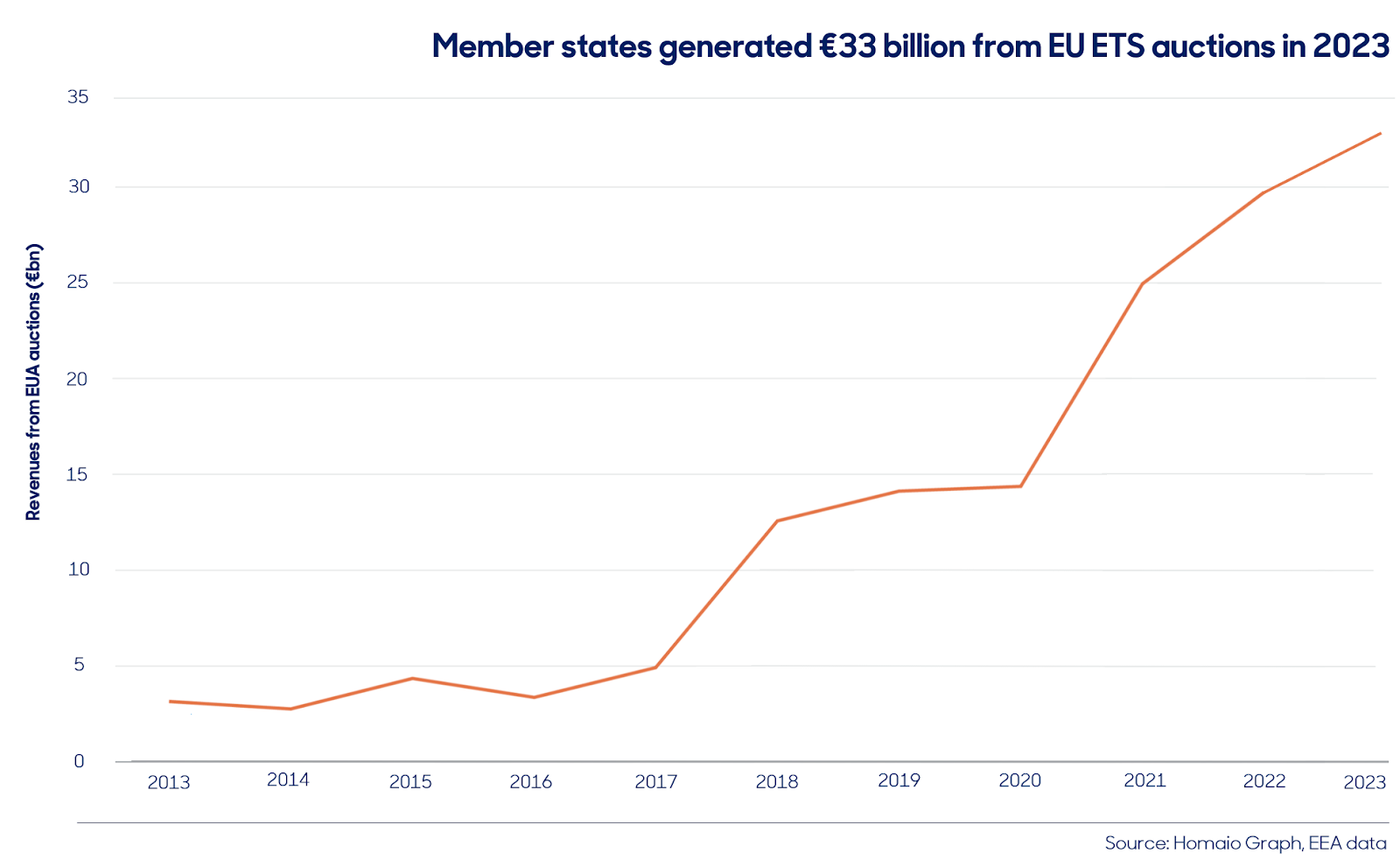
The European Union Emissions Trading Scheme (EU ETS) generates auction revenues from the sale of carbon allowances. These revenues are used to finance various climate-related projects and initiatives aimed at reducing greenhouse gas emissions and promoting sustainability. Member States generated EUR 33 billion from EU ETS auctions in 2023.
What is the positive social impact of the projects funded by the EU ETS?
Projects financed by EU ETS auction revenues have a positive social impact by supporting initiatives such as renewable energy development, energy efficiency improvements, and climate adaptation measures. These projects create jobs, stimulate economic growth, and enhance community resilience to climate change.
How do EUAs bring good financial returns to a socially responsible portfolio?
What is the historical price of EUAs?
EU Allowance (EUA) prices have exhibited strong historical performance, with a compound annual growth rate for the past 10 years of 26.7%. Carbon allowance prices have remained low in the first stages of the scheme, wandering below EUR 30 approximately until 2020. At the time, the market got more stable under the effect of the Market Stability Reserve that contributed to the tightening of demand and supply, bringing prices up.
What is the EUA price forecast for 2024 and beyond?
Expert analysts project an average EUA price of EUR 64.65 for the end of 2024, with forecasts ranging from EUR 50.6 EUR to EUR 75. Looking ahead to 2030, analysts are bullish when it comes to carbon price levels, with an average forecast of EUR 140.65 - this represents a 120% increase from present levels. This surge is anticipated due to a projected recovery in industrial demand for EUAs, the elimination of the supply surplus, (with the end the of RepowerEU sales), a faster tightening of the cap, and the increased buying demand from the new sectors like aviation and maritime shipping.
Key Takeaways
- Socially Responsible Investing (SRI) combines financial returns with positive social and environmental impacts.
- Labels like France's SRI, Green Fin, Belgium's Towards Sustainability, Luxembourg's LuxFLAG, and Germany's FNG-SIEGEL guide investors in their portfolio construction.
- Diversification thanks to SRI portfolios mitigates financial risks.
- The EU Emissions Trading Scheme (EU ETS) generates significant auction revenues for climate initiatives.
- EU Allowances (EUAs) have strong historical performance and promising future forecasts.
- EUAs in an SRI portfolio support environmental goals and offer financial returns.