Where to invest €100,000 in 2026 based on your profile and time horizon

Having €100,000 is a key milestone in building wealth. Whether this sum comes from a sale, an inheritance, or years of saving, the question of how to invest it becomes central. Far from searching for a miracle product, the best approach is to build a tailor-made allocation aligned with your life plans.
Where to invest €100,000: the short answer
There is no single “best” investment for €100,000. The optimal solution is to spread (allocate) this amount across several vehicles, chosen according to your risk tolerance, your investment horizon (the length of time you can lock your money away), and your personal goals (prepare for retirement, generate additional income, buy real estate).
Diversification remains the fundamental principle for optimizing return potential while keeping risk under control.
Before investing €100,000: the 5 criteria to define
Taking the time to think before investing is the most profitable step. Five simple questions will help you shape your personal strategy.
1. What is your investment horizon?
Will you need this money in 2 years, 5 years, or more than 10 years?
- Short term (less than 3 years): The absolute priority is safety and access to funds. Risk-free investments should be favored.
- Medium term (3 to 8 years): A balance between safety and performance is possible, by accepting a share of moderate risk.
- Long term (more than 8 years): This is the ideal horizon to gain exposure to financial markets (stocks, etc.). Time helps smooth out fluctuations and aim for potentially higher returns.
Watch the return/risk trade-off
A fundamental rule in finance is that there is no high return without high risk. Be wary of promises of quick, guaranteed gains. Any investment offering a potential return significantly higher than that of risk-free savings accounts comes with a trade-off: the risk of capital loss.
2. What is your risk tolerance?
Risk is inseparable from return potential. Would you accept seeing the value of your capital temporarily fall by 10%, 20% or more in exchange for a higher upside? Your answer will determine the share of volatile assets (such as equities) in your portfolio.
3. How much liquidity do you need?
Liquidity refers to how easily and quickly you can get your money back without loss of value. A Livret A is very liquid (immediate withdrawal), while a real estate investment is far less so (several months to sell a property).
4. What is your main objective?
- Grow capital: The objective is long-term growth (compounding).
- Generate additional income: You are looking to receive regular income (dividends, rents, interest).
- Prepare for a specific project: Property purchase, children’s education, retirement.
- Pass on wealth: Inheritance taxation becomes a key criterion (assurance vie is often favored for this).
5. What tax wrappers do you have?
France offers “wrappers” that provide tax advantages: PEA (French equity savings plan), assurance vie, PER (retirement savings plan)... Using them wisely helps optimize the net return of your investment.
Comparison table of the main investments for €100,000
This table summarizes the major families of investments available in France. Past performance is not indicative of future results.
Where to invest €100,000 with no risk or limited risk?
For savers who prioritize capital security, several solutions exist. Their potential return is logically lower.
Regulated savings accounts
The Livret A and the Livret de Développement Durable et Solidaire (LDDS) are the basic solutions for emergency savings.
- Advantages: Capital 100% guaranteed by the state, money available at any time, no taxation.
- Limits: Their caps are reached quickly (€22 950 for the Livret A, €12 000 for the LDDS). You can therefore only place part of your €100,000 there.
Fixed-term accounts (CAT)
Offered by banks, fixed-term accounts involve locking away a sum of money for a defined period (from a few months to several years) in exchange for an interest rate known in advance. The longer the lock-up period, the more attractive the rate generally is.
The euro fund of assurance vie
The euro fund is an investment vehicle available within an assurance vie contract. Its capital is guaranteed by the insurance company (excluding entry fees). It is mainly invested in government bonds, offering high security. It is a very popular solution for securing a significant share of one’s wealth over the medium or long term while benefiting from the advantageous tax framework of assurance vie.
Investments to target a potentially higher return
To hope for a return above inflation, you need exposure to riskier assets whose value can fluctuate.
ETFs and stocks on the stock market (PEA or brokerage account)
Investing in the stock market means buying shares in companies (stocks). For a beginner, the simplest and most diversified way is to use ETFs (Exchange Traded Funds), also called “trackers”. These are funds that replicate the performance of an entire stock index (such as the CAC 40 or the MSCI World), allowing you to invest in hundreds of companies in one click and at lower fees.
The PEA (Plan d'Épargne en Actions) is the tax wrapper to prioritize for investing in European equities. After 5 years of holding, capital gains are exempt from income tax.
Assurance vie in unit-linked funds (UC)
In addition to the euro fund, assurance vie allows you to invest in unit-linked funds (UC). These can be equity funds, bond funds, or real estate vehicles (SCPI, OPCI). Unlike the euro fund, the capital in UC is not guaranteed and moves with financial markets.
Bonds
A bond is a debt security issued by a government or a company. By buying a bond, you lend money in exchange for interest (coupon) paid regularly and repayment of principal on a set date (maturity). Risk is generally more moderate than for stocks, but it exists (notably the issuer default risk).
Investing €100,000 in real estate
With €100,000, real estate becomes a tangible option, whether directly or through pooled investments.
SCPI (sociétés civiles de placement immobilier)
SCPI, often called “paper real estate”, is a simple solution for investing in commercial real estate (offices, retail, warehouses...). You buy shares in a company that manages a real estate portfolio, and in return you receive a portion of the rents, proportional to your investment.
- Advantages: Accessible entry ticket (a few thousand euros), delegated management, risk pooling across many properties and tenants.
- Disadvantages: High entry fees (around 10%), low liquidity, taxation of rental income.
Down payment for a rental investment
€100,000 can be a very solid down payment to obtain a bank loan and buy a property to rent out. The leverage effect of credit makes it possible to acquire a higher-value property and target an attractive return. However, this requires active management (finding tenants, renovations, handling unpaid rent...).
How much do €100,000 invested earn?
This is the most common question, but the answer depends entirely on the investment chosen. Here are a few simulations for purely indicative purposes, based on assumptions of annual gross return before fees and taxes.
Think about net returns
The displayed return is always “gross”. To calculate your real gain, you must subtract fees (management, entry fees...) and taxation (social contributions of 17.2% and income tax or flat tax). A gross return of 5% can easily turn into a net return of 3% to 3.5% in your pocket.
How to target an income of €500 per month?
Getting an income of €500 per month, i.e., €6 000 per year, with a capital of €100,000 requires a net return of 6% per year.
- Is it realistic? Achieving such a return in a stable and secure way is very difficult. Risk-free investments are excluded. You would need to move toward riskier solutions such as rental property (with a good yield), high-performing SCPI, or a dividend stock portfolio.
- Conclusion: This is an ambitious goal that implies taking significant risk and pursuing a long-term strategy. There is no guarantee of achieving it every year.
3 allocation examples for €100,000
Here are sample allocations to illustrate diversification by risk profile. They do not constitute investment advice.
Allocation 1: conservative profile
Objective: preserve capital while seeking a return slightly above inflation. Horizon: 3 to 5 years.
- €50 000 (50%) in euro fund (Assurance Vie): The secured core.
- €30 000 (30%) in SCPI: For steady rental-type income and lower correlation to financial markets.
- €10 000 (10%) in bond ETF: For diversification and controlled risk.
- €10 000 (10%) in savings accounts (A, LDDS): Emergency savings, immediately available.
Allocation 2: balanced profile
Objective: a good compromise between capital growth and risk control. Horizon: 5 to 10 years.
- €30 000 (30%) in euro fund (Assurance Vie): The safety pocket.
- €40 000 (40%) in global equity ETFs (via PEA): The long-term performance engine.
- €20 000 (20%) in SCPI: For passive income and real estate diversification.
- €10 000 (10%) in savings accounts (A, LDDS): For unexpected expenses.
Allocation 3: growth profile
Objective: maximize capital growth by accepting high volatility. Horizon: more than 10 years.
- €65 000 (65%) in equity ETFs (global, thematic...) via PEA and brokerage account: High market exposure.
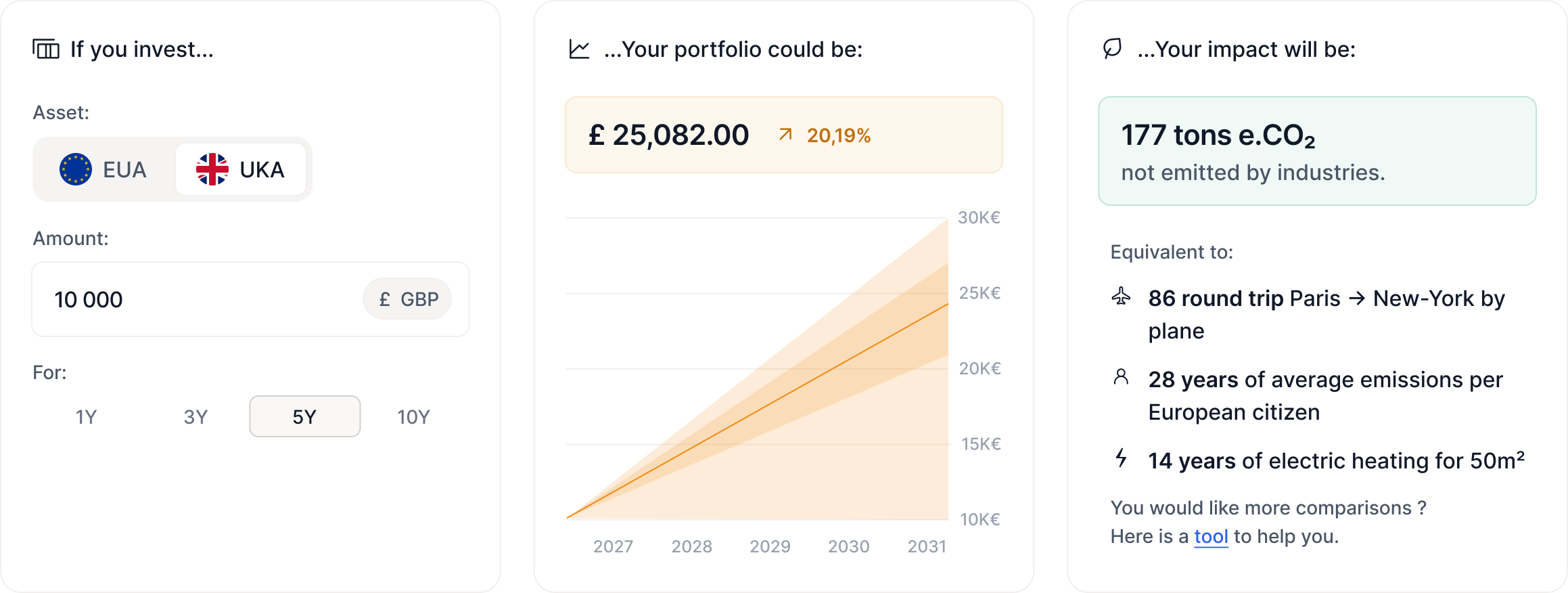
- €15 000 (15%) in diversification assets (for example, investments in carbon markets and finance or other alternative asset classes): To seek uncorrelated sources of performance.
- €10 000 (10%) in SCPI: A touch of real estate for stability.
- €10 000 (10%) in euro fund or savings accounts: The essential safety base.
FAQ: Investing €100,000
How much do €100,000 invested earn per month?
Monthly gains depend entirely on the vehicle. They can range from €0 (in case markets fall) to several hundred euros. On a secure investment with a net return of 3% per year, that represents about €250 per month. On a growth allocation targeting 6% net, the theoretical average gain would be €500 per month, but with large variations.
How much do €100,000 invested in a bank earn?
“Investing in a bank” can mean many things. In a standard bank savings account (non-regulated), the return is often very low (less than 1%). In a fixed-term account, it can rise to 3% or more depending on offers. Stock market investments offered by the bank (via a PEA for example) have much higher potential returns but with a risk of loss.
Which savings account to invest €100,000?
No single regulated savings account allows you to invest €100,000. You will need to combine the Livret A (cap €22 950) and the LDDS (cap €12 000). For the remainder, you can use a Livret d'Épargne Populaire (LEP) if you are eligible (cap €10 000) or turn to taxable bank savings accounts, fixed-term accounts, or a euro fund within assurance vie.
Investing €100,000 in assurance vie: good or bad idea?
It is an excellent idea if the allocation is well designed. Assurance vie is a very versatile wrapper. You can invest your €100,000 by mixing the safety of the euro fund and the potential of unit-linked funds (stocks, real estate...). Its taxation on withdrawals and wealth transfer makes it a key tool.
How to invest €100,000 in 2026?
The fundamental principles will remain the same in 2026: diversify, define your horizon and your risk tolerance. Market conditions (interest rates, inflation, economic growth) will evolve, which may make certain asset classes more or less attractive. A good strategy defined today will remain relevant, provided you reassess it periodically.
Go further: invest in the carbon market
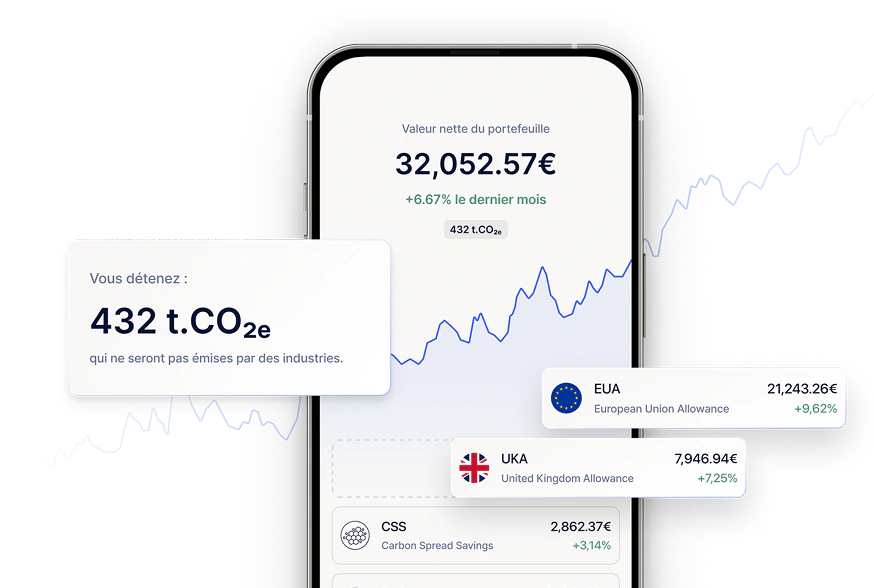
Homaio gives you access to European carbon allowances (EUAs), an asset class that combines potential financial performance with direct climate impact. Diversify your wealth with an asset uncorrelated from traditional markets, accessible from €1,000.