Where to invest €10,000 in 2026: a guide by time horizon and risk

You’ve managed to set aside €10,000 and you’re wondering how to grow that amount? That’s an excellent step. But faced with a multitude of options, from the Livret A to stock markets, it’s easy to feel lost. The first thing to know is that there is no universal "best investment." The ideal solution is the one that perfectly matches your plans, your time horizon, and your sensitivity to risk.
This guide is designed to help you see things clearly in a simple and neutral way, so you can build a consistent investment strategy for your €10,000.
Disclaimer: This article is for informational and educational purposes only. It does not constitute personalized investment advice under any circumstances. All investments involve risks, including a loss of capital. Before making a decision, it is recommended that you do your own research and, if necessary, consult a professional financial advisor.
What can I do with €10,000? The 3 key questions before you start
Before choosing a product, it is essential to define your own requirements. A good allocation of your €10,000 depends on three fundamental pillars.
1. What is your investment time horizon?
This is the most important question. For how long can you lock this money away?
- Short term (less than 3 years): You are preparing for a major purchase (car, down payment for a property), a trip, or you simply want to keep the money available. The absolute priority is safety and liquidity.
- Medium term (3 to 8 years): You have a more distant project, such as funding a child’s education or renovation work. You can accept a small amount of risk to aim for potentially higher returns.
- Long term (more than 8 years): You are preparing for retirement, want to pass on capital, or simply grow your wealth. Over this time frame, more dynamic investments can fully express their potential by smoothing out market fluctuations.
2. Do you already have an emergency fund?
An emergency fund is an essential safety cushion, equivalent to 3 to 6 months of your regular expenses. It should be held in a risk-free vehicle and be immediately available (such as a Livret A or an LDDS). If your €10,000 represents all of your savings, a large portion should be allocated to this emergency fund before considering any other investment.
3. What level of risk do you accept?
The return/risk trade-off is inseparable: higher potential gains always come with a higher risk of loss. Be honest with yourself. Would you be comfortable if the value of your investment fell by 10% or 20% in just a few months?
- Conservative profile: Preserving capital is your priority. You prefer a modest but guaranteed return.
- Balanced profile: You are willing to accept a measured share of risk to boost your savings, while keeping a secure base.
- Dynamic profile: You aim for maximum performance over the long term and understand that this means accepting significant volatility, with possible drawdown phases.
Comparison table of solutions to invest €10,000
To help you see more clearly, here is an overview of the main investment options available.
Investing €10,000 for the short term: safety above all
If you need this money in less than 3 years, the objective is simple: protect your capital from monetary erosion without taking risks.
Regulated savings accounts: the essential foundation
The Livret A and the Livret de Développement Durable et Solidaire (LDDS) are the leading solutions for an emergency fund.
- Advantages: 100% capital guarantee, money available at any time, and interest fully exempt from income tax and social contributions. Their rates are set by the government.
- Limits: Their caps are limited (€22,950 for the Livret A, €12,000 for the LDDS) and their real return may be negative if inflation is higher than their rate.
With €10,000, you can easily fill part or all of your LDDS if your Livret A is already well funded.
The fixed-term account (CAT): a locked alternative
A CAT is an account where you deposit a sum for a fixed period (from a few months to several years). In exchange for locking your money, the bank offers a guaranteed interest rate, often higher than passbook accounts.
- Advantages: Rate known in advance, capital guaranteed.
- Limits: The money is locked. An early withdrawal generally triggers penalties that reduce, or even cancel, the interest earned.
Where to invest your money when all your passbooks are full?
If your emergency fund is already in place and your Livret A and LDDS are maxed out, it’s time to explore medium- and long-term solutions. With €10,000, you can start diversifying.
Assurance-vie: the all-purpose wrapper
Assurance-vie is often described as the "Swiss army knife" of savings. It provides access to two types of holdings:
- The euro fund: Similar to passbooks, it offers a capital guarantee. Its return has fallen in recent years, but it remains a core safety pillar for a conservative profile.
- Unit-linked funds (UC): These are holdings invested in financial markets (stocks, bonds, real estate...). Their value fluctuates up and down: there is a risk of capital loss. In return, their long-term performance potential is much higher.
With €10,000, you can open a policy and split the amount between the euro fund and unit-linked funds depending on your risk profile.
The Plan d'Épargne en Actions (PEA) (French equity savings plan): to invest in the stock market
The PEA is a tax-advantaged wrapper for investing in shares of European companies. It is an excellent tool for long-term investors.
- Advantages: After 5 years, gains are exempt from income tax (but still subject to social contributions). Ideal for investing via ETFs (trackers), which are diversified baskets of stocks with low fees.
- Limits: The risk of capital loss is real and swings can be significant. It is limited to European equities.
What is an ETF?
An ETF (Exchange Traded Fund), or tracker, is an investment fund that replicates the performance of a stock market index (such as the CAC 40 or the S&P 500). Buying an ETF share means investing simultaneously in hundreds or even thousands of companies, offering instant diversification at a lower cost.
SCPIs: "paper" real estate
Sociétés Civiles de Placement Immobilier (SCPI) let you invest in a portfolio of commercial real estate (offices, retail, warehouses) by buying shares. You then receive a portion of the rent collected, generally paid quarterly.
- Advantages: Access to real estate with a low entry ticket (a few thousand euros), management delegated to professionals.
- Limits: Entry fees are high (around 10%), liquidity is low (you need to find a buyer to resell your shares), and capital is not guaranteed. This is an investment to consider over at least 8 to 10 years.
Concrete examples: 4 ways to allocate €10,000
These allocations are simplified illustrations. They must be adapted to your personal situation.
1. Short-term project (buying a car in 2 years)
- Goal: 100% safety and availability.
- Allocation:
- €10,000 (100%) in a Livret A or an LDDS.
2. Conservative profile (5+ year horizon)
- Goal: Protect capital while seeking a small additional return.
- Allocation:
- €7,000 (70%) in the euro fund (via an Assurance vie).
- €3,000 (30%) in SCPI for regular rental income.
3. Balanced profile (8+ year horizon)
- Goal: A good compromise between safety and the search for performance.
- Allocation:
- €4,000 (40%) in the euro fund (Assurance vie).
- €4,000 (40%) in a global ETF (via a PEA or an Assurance vie).
- €2,000 (20%) in SCPI.
4. Dynamic profile (10+ year horizon)
- Goal: Maximize capital growth by accepting high volatility.
- Allocation:
- €1,000 (10%) in the euro fund (safety base).
- €7,000 (70%) in ETFs (global, S&P 500, etc.) via a PEA.
- €2,000 (20%) in conviction-based or alternative investments (thematic stocks, private equity, climate assets, etc.).
Be careful with alternative investments
Investments such as crowdfunding, crypto-assets, or climate assets can offer interesting diversification prospects, but they come with specific and high risks (illiquidity, lack of regulation, total loss of capital). They should only represent a small portion of an already well-diversified portfolio.
What are the 5 traps to avoid to protect your savings?
- Neglecting your emergency fund: Never invest money you might need in case of an unexpected event.
- Putting all your eggs in one basket: Diversification is the golden rule. Spreading your €10,000 across different asset classes (passbooks, real estate, stocks) reduces overall risk.
- Believing in miracle return promises: A very high return always hides a very high risk. Be wary of offers that seem too good to be true.
- Underestimating fees: Entry, management, exit fees... They can significantly reduce the net performance of your investments. Compare them carefully.
- Panicking and selling at the wrong time: Financial markets fluctuate. If you have invested for the long term, it is crucial to keep a cool head during downturns and not sell under the influence of emotion.
The checklist before investing your €10,000
Investing €10,000 is an important step. It is the start of building or consolidating your wealth. There is no miracle solution, but there is a simple method: start with you.
Before you begin, check these points:
- [ ] Is my emergency fund sufficient?
- [ ] What is the precise goal of this investment? (Purchase, retirement, etc.)
- [ ] When will I need this money? (My horizon)
- [ ] Am I ready to see the value of my investment temporarily fall? (My risk profile)
- [ ] Have I fully understood the characteristics of the product I’m considering? (Risks, fees, taxation)
- [ ] Is the allocation I’m considering sufficiently diversified?
By answering these questions, you will turn a sum of money into a real plan for the future, aligned with who you are.
FAQ: Your questions about investing €10,000
What is the best investment for €10,000?
There is no single answer. The "best" investment depends entirely on your project. For an emergency fund, it’s the Livret A. To prepare for retirement in 20 years, it’s probably a PEA invested in ETFs. The first step is to define your goal.
Where to invest €10,000 in the short term?
For a horizon of less than 3 years, prioritize risk-free and liquid options: Livret A, LDDS, or possibly a fixed-term account if you are certain you won’t need the funds before maturity.
Is it a good idea to put €10,000 in a Livret A?
Yes, if this money is your emergency fund or if you have a very short-term project. If you already have a safety buffer and a longer horizon, it can be wise to look for potentially higher-performing investments for part of that amount to counter inflation.
Where to invest €10,000 in 2025 and 2026?
The fundamental principles of investing remain the same from one year to the next. A strategy based on your horizon, your risk tolerance, and good diversification will always be more relevant than trying to predict markets. Focus on building a strong portfolio tailored to your personal goals, one that will withstand different economic conditions.
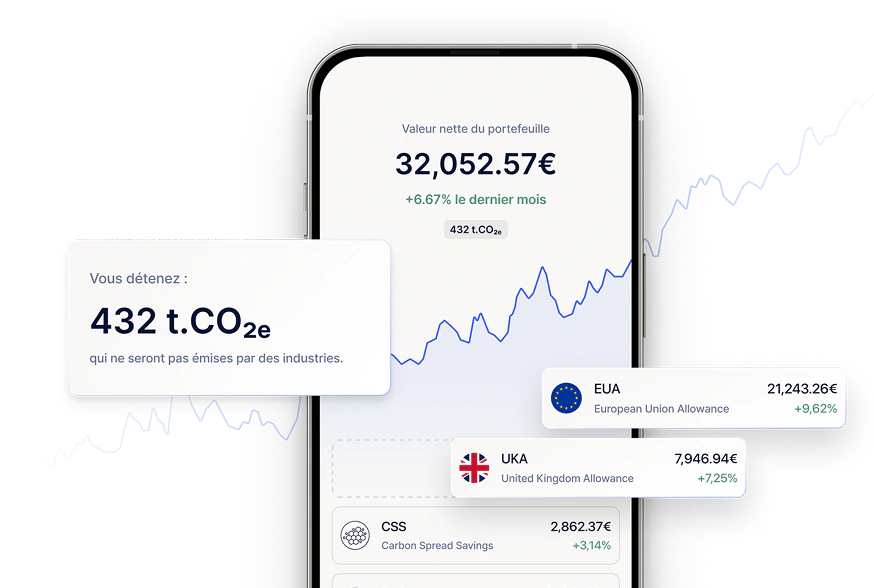
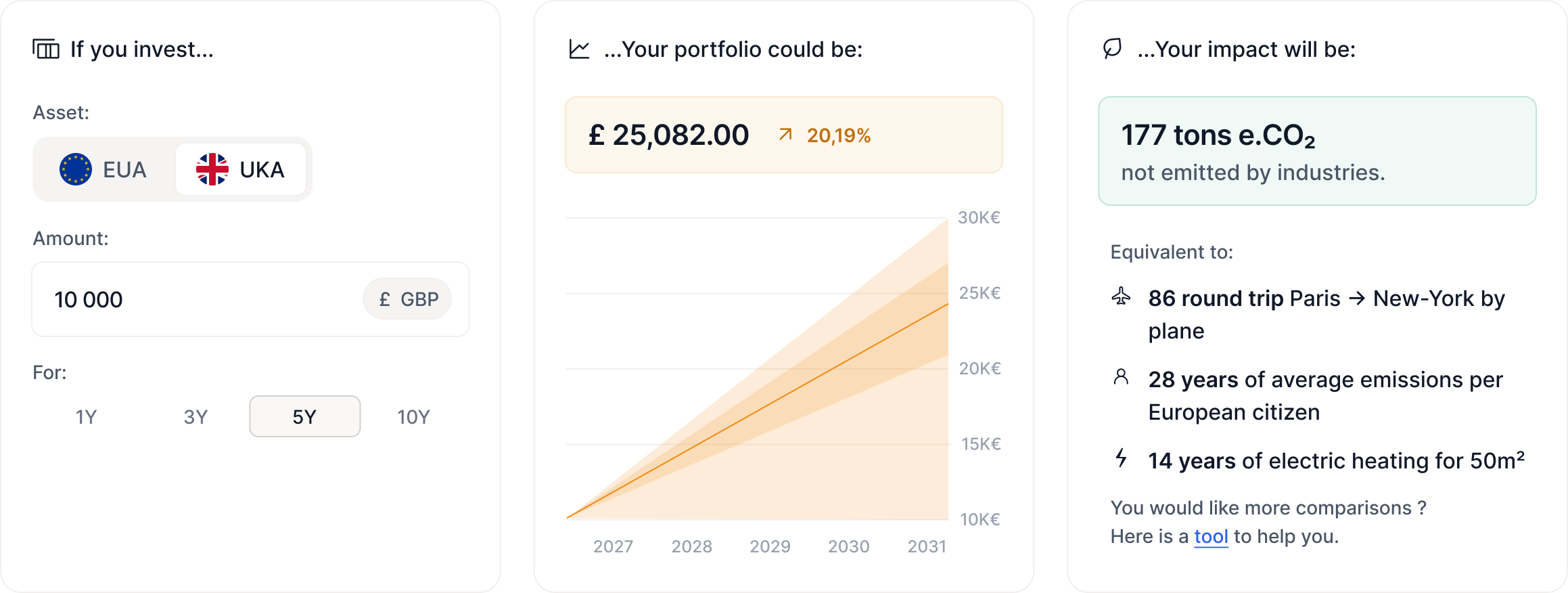
Go further: invest in the carbon market
Homaio gives you access to European carbon allowances (EUAs), an asset class that combines potential financial performance with direct climate impact. Diversify your wealth with an asset uncorrelated from traditional markets, accessible from €1,000.