The UKA-EUA Convergence Play: Anatomy of a Catch-Up in Motion

May 2025: when the pendulum swung
19 May 2025, London. Keir Starmer welcomes Ursula von der Leyen for the first UK-EU summit since Brexit. The official agenda: fisheries, youth mobility, defence. The real agenda: the gradual reintegration of the United Kingdom into the European regulatory ecosystem.
At the heart of that reintegration sits a technical but consequential file: the linkage of the UK ETS with the European Emissions Trading System (EU ETS).
For the first time since Brexit, the two governments have officially announced their intention to connect their emissions trading systems (carbon markets). This is a key point: it provides a concrete basis for the "Convergence Play" (the idea that quota prices will converge), which until now was mere speculation, and which now becomes an officially validated political orientation.
To read this moment properly, it helps to place it inside the short history of the UKA market. Since 2021, the UKA price has gone through four phases: (1) mirror trading: UKA tracking EUA almost perfectly, (2) political decoupling: post-Brexit uncertainty opens the gap, (3) discounted tracking: UKA still correlated to EUA but with a persistent spread, and now (4) the convergence phase: the one opening since May 2025.
The "spread": a discount that has already partially closed
As of July 2026, a tonne of CO₂ trades at around £55 in the UK vs. roughly €79 in the eurozone. At current FX rates, that's a ~20% discount for the UKA. A discount that has already partially closed since May 2025: it stood at ~30% earlier this year, before UK-EU negotiations took shape.
Carbon traders call this the "spread". And every serious investor asks the same question: why is this gap there?
The answer is plain: there is no structural economic reason for the discount. Both markets cover equivalent sectors (power, heavy industry, aviation), aim at the same goal (Net Zero 2050), and run on the same mechanics (Cap and Trade). Comparable fundamentals should produce comparable prices: the same right to emit one tonne of CO₂ should cost roughly the same.
The gap is purely political. It opened up between 2022 and 2024, during a period of uncertainty on the UK's Net Zero agenda under the Sunak government and the pre-election Starmer years. The more uncertainty grew, the more the market doubted, the further UKA drifted from EUA.
May 2025 reversed the trend. The trajectory is now clear: toward linkage.
The Swiss precedent: what history tells us
Linking two ETSs is not new. Switzerland did it with the EU, and the experience holds rich lessons for UKA investors.
2011: Switzerland opens negotiations with the EU to link its carbon market with the European one. 2020: the agreement formally enters into force. Nearly 10 years between decision and operationalisation. Long, but not infinite.
More importantly: a large share of the price convergence happened before the final signature. As soon as the trajectory became credible (around 2017-2018), Swiss prices started moving mechanically toward European levels, well before all technical agreements were finalised.
What this tells us about the UK ETS: formal linkage probably won't happen before 2028-2030. But the price catch-up can trigger as soon as the market judges the trajectory credible enough. And given the spring 2025 announcements, that moment looks close.
The residual catch-up potential
Since the political signal of May 2025, part of the convergence has already been priced in. The residual potential is now measured differently.
If UKA sits at £55 and EUA at around £68 (the GBP equivalent of €79), full convergence brings the UKA to £68. That's a (68 - 55) / 55 = +24%* rise in a perfect-convergence scenario.
But perfect convergence is rarely achieved (even Switzerland keeps a mild spread). Analysts typically use a two-stage scenario: the residual spread closes by +15 to +20% within 12-18 months, then structural drivers (engineered scarcity, Net Zero 2050) take over beyond that horizon.
The residual mechanical potential, in the order of +20%, remains meaningful, particularly as it adds to the long-term structural drivers. The delivered part validates the thesis; the remaining part is still up for the taking.
The three conditions of the Convergence Play
For the catch-up to materialise, three conditions must be met. Good news: they are.
Condition 1: a strong political signal. ✅ The May 2025 summit and the joint Starmer/von der Leyen announcement ticked that box.
Condition 2: a credible Cap reduction trajectory. ✅ The UK ETS is enshrined in UK law, the Climate Change Committee has published its Seventh Carbon Budget, and the Cap continues to shrink in line with the 2050 Net Zero trajectory.
Condition 3: no major regulatory friction. 🟡 This is the watch point. Technical linkage still has to be negotiated (CJEU jurisdiction, governance, auction coordination). This is where timing slips can happen, and where the exact catch-up tempo will be decided.
How to position on the Convergence Play
For an investor, positioning on the Convergence Play means buying UKAs today in anticipation of the catch-up. Several options:
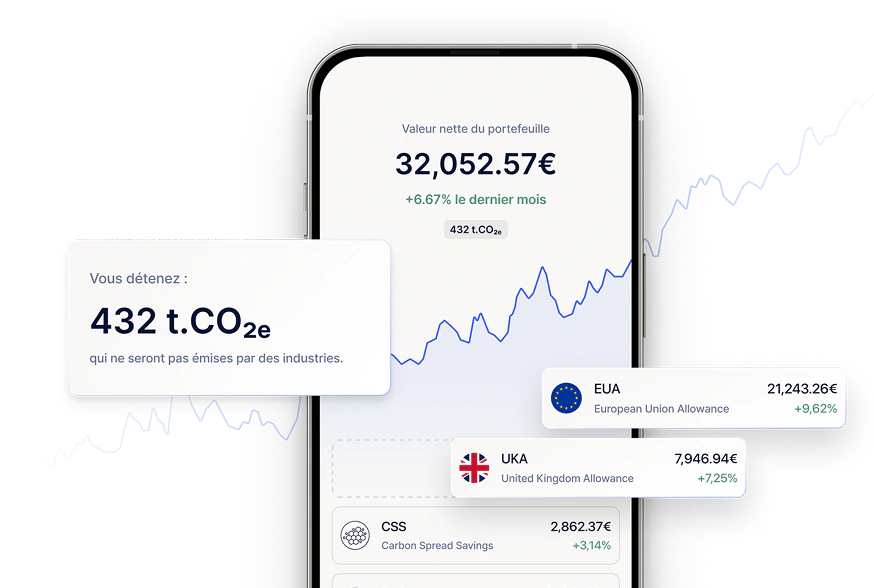
- Direct holding via Homaio which opens access to retail investors,
- Carbon ETFs exposed to a basket of allowances (mostly EUA-dominated, but some include UKAs),
- Futures contracts on ICE Futures Europe (for qualified investors).
Each approach has its own profile in terms of liquidity, taxation and complexity. But the underlying logic is the same: take position before the market has digested the linkage information.
What if linkage doesn't happen?
That's the legitimate question. The honest answer: even without formal linkage, UKA keeps a bullish trajectory.
Why? Because the UK ETS remains a Cap and Trade market with shrinking annual supply, regardless of any European negotiation. Engineered scarcity does its job, the 2050 Net Zero target stays in law, and industrial demand remains structurally present.
Linkage is the accelerator of the catch-up. But it is not the only condition for an upward trajectory. That's what makes the thesis robust: even in the worst case (linkage pushed to 2032+), UKA remains a structurally deflationary asset.
June 2026 Update: Three scenarios for UKA-EUA convergence
The convergence timeline hinges primarily on one factor: the signing of a formal linkage agreement between the UK ETS and the EU ETS. Leading carbon research houses, including Energy Aspects, model three distinct scenarios to year-end 2026.
Scenario 1: linkage signed in summer 2026 (base case)
If the agreement is signed in the coming months, roughly 90% of the convergence would be priced in upon signature. The UKA could average £71 (€82) over H2 2026, climbing toward £100 (€115) by 2030. The discount to the EUA closes within weeks, as the Swiss-EU precedent demonstrated in 2020.
Scenario 2: linkage delayed to late 2026
If the leadership transition in Westminster pushes back the diplomatic calendar, uncertainty lingers. Energy Aspects projects a UKA average of £57 (€66) in H2 2026. Convergence is delayed but not cancelled, with the gap narrowing gradually as the market regains visibility.
Scenario 3: collapse of negotiations
In the worst-case scenario, a complete breakdown of the linkage talks would bring the UKA down to around £32 (€37) by year-end 2026. But this scenario carries a paradox: in the long run, without linkage, the structural constraints inherent to the UK ETS (smaller market, tighter cap, rising power demand) could push the UKA to £140 (€162) by 2030, above the £100 (€115) anticipated under linkage. Convergence through the downside is the exception, not the rule.
What it means for investors
Whatever the short-term political arbitrage, the underlying UKA trajectory remains bullish. The current discount constitutes a tactical window: the closer linkage approaches, the more the political risk premium compresses. Conversely, a delay does not break the thesis, it simply shifts the value capture further in time.
Sources: Energy Aspects, June 2026 projections. Carbon Risk, "Britain's green credibility gap", 23 June 2026.
The takeaway
The UKA-EUA Convergence Play is the anatomy of a mechanical catch-up between two markets that share everything except a political discount that, since May 2025, has already begun to close. The London summit started the clock; the first deliveries of value are already visible. The Swiss precedent tells us that price convergence happens before the formal signature, as soon as the trajectory becomes credible.
The residual mechanical potential is in the order of +20 to +25%. The base scenario is solid, the risks are identified and bounded. It's rare to find an investment thesis this readable: a regulated asset, a clear political signal, a portion of the catch-up already validated by the market, and a historical precedent to calibrate orders of magnitude.
The Convergence Play is exactly that: a macro-political trade where the risk-reward leans the right way.