What is the Climate Impact of a UKA? One Tonne of CO₂ Pulled Off the Market, Measured and Verifiable
A mechanic that's almost brutally simple
Most "individual climate contribution" tools rely on a complex chain: plant trees, fund a project, buy a voluntary credit, hope the carbon really gets captured, trust the certifier, wait for audit reports. Many steps, many uncertainties.
The UK ETS works differently. There's no project to fund, no methodology to validate, no rebound effect to fear. There's a government-set emissions cap, and a number of allowances in circulation that materialises that cap.
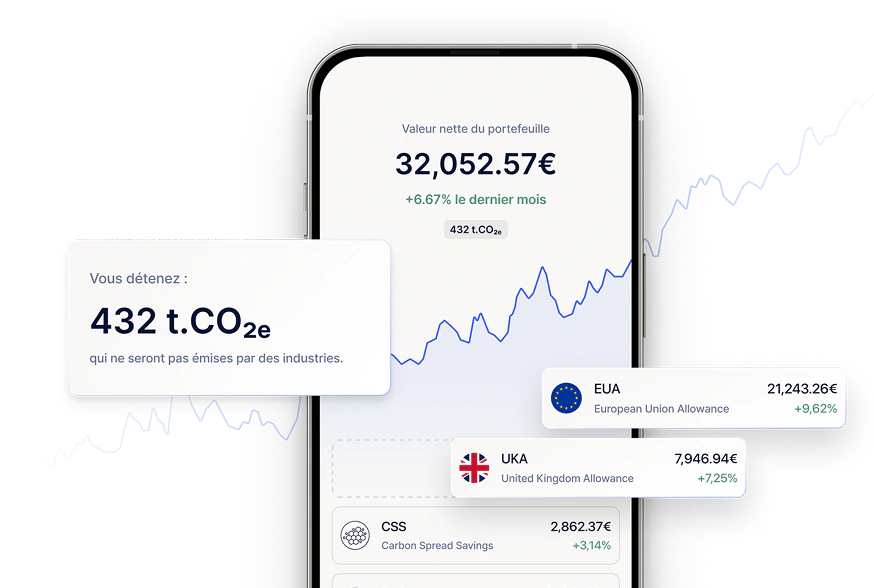
If you hold a UKA off-perimeter (i.e. as a retail investor, not as a regulated emitter), that allowance cannot be used to cover a real emission. It exits the pool of allowances available to compliance buyers.
Fewer allowances in circulation for regulated emitters translate into practical results: increased pressure to cut emissions and a greater incentive to invest in decarbonization. Ultimately, this means one less tonne of CO₂ will be emitted.
Why this isn't an "offset"
UKAs are not voluntary carbon credits. The distinction matters.
A voluntary carbon credit is a certificate issued by a project (reforestation, capture, renewable energy) that claims to have avoided or captured a tonne of CO₂. The voluntary market has its uses, but it has weathered serious scandals: ghost projects, double counting, contested methodologies, debatable additionality.
A UKA is different. It's a regulatory instrument of the UK government, created under parliamentary control, publicly accounted for, and used under strict legal framing. When a UK industrial emitter wants to release a tonne of CO₂, it must surrender a UKA. No fuzzy methodology. No greenwashing. Direct accounting.
That's the fundamental difference between acting on the cause (the scarcity of the right to emit) and acting on the consequence (offsetting an emission after the fact). The UK ETS acts on the cause.
Real additionality
The central test for any climate action is additionality: "did my action actually change something, or would the outcome have happened anyway?"
For UKAs, the answer is mechanical. If you hold 1 UKA, the market has 1 fewer allowance available to compliance buyers. If you hold 1,000 UKAs, it has 1,000 fewer. The effective emissions ceiling shrinks accordingly.
This is the opposite of symbolic offsetting: here, the impact does not depend on the quality of a project, the integrity of a certifier, or the survival of a forest that might burn in ten years. It depends only on the legal fact that this allowance is no longer available to cover a real emission.
That's what makes UKAs one of the most robust climate-impact vehicles on the market, well ahead of most "ESG" solutions available to retail investors today.
How much impact, exactly?
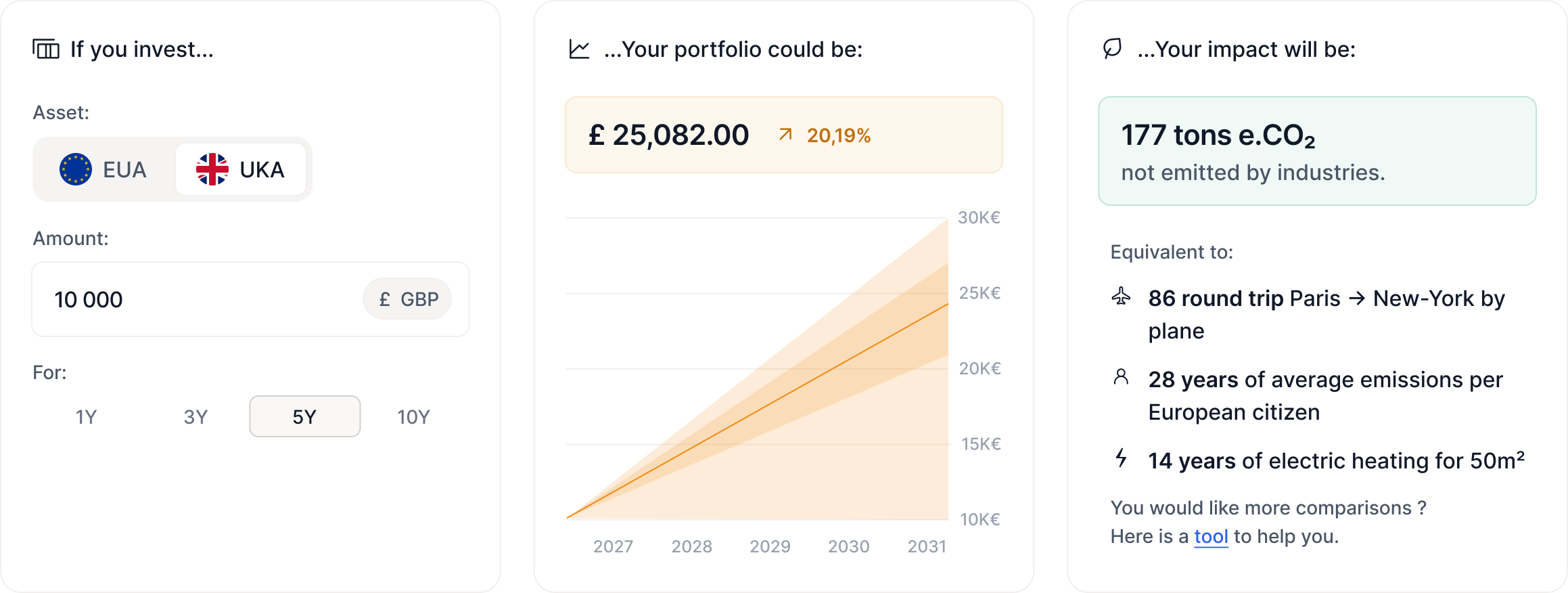
One tonne of CO₂ pulled off the market is roughly equivalent to:
- 5,000 km in an average internal-combustion car (about a Paris-Athens round trip),
- one Paris-New York economy flight,
- 5 months of gas heating for an average UK household,
- about 6 months of average personal emissions for a European.
These are orders of magnitude. They give an intuition for the physical weight of the unit, but they're not the point. The point is: for every UKA you hold, it's one tonne that won't be emitted by a UK industrial player, because they won't have the allowance to cover that emission.
What about leakage? Won't emitters just emit elsewhere?
That's the classic objection. The answer comes in two layers.
Layer 1: inside the UK ETS, there's no leakage. The system is closed: covered emitters must surrender a UKA for every tonne they emit. If they can't access a UKA, they have to either reduce emissions or buy another one, which pushes the price up and accelerates decarbonisation. The emission either doesn't happen, or it happens at a higher cost.
Layer 2: cross-border leakage is known and actively countered. The EU rolled out the CBAM (Carbon Border Adjustment Mechanism): a border-tax mechanism that taxes imports based on their carbon footprint. The UK announced its own UK-CBAM starting in 2027. Carbon leakage is structurally discouraged.
And the auction revenue, where does it go?
That's the other dimension of impact. UKAs are first sold at government auctions, and the UK Treasury collects the proceeds. What is that money used for?
According to the March 2026 update from the UK Climate Change Committee, reaching Net Zero by 2050 would cost the UK around £4 billion per year (≈ £100 billion cumulative by 2050), for an estimated return of £2 to £4 per £1 invested. A clearly positive cost-benefit equation, which makes the agenda fiscally sustainable regardless of which government is in office.
In practice, these funds support the pillars of the UK transition: carbon capture and storage (CCS) in the Teesside and Humber industrial clusters, low-carbon hydrogen development, and thermal retrofit programmes for public and residential buildings.
A useful caveat though: unlike the European system, where a share of EU ETS revenues is legally earmarked for the Innovation Fund and the Modernisation Fund, UK ETS revenues are not formally ring-fenced by law for decarbonisation. They flow into general government resources, and their allocation depends on successive budget choices. This is a watch point: not a flaw in the mechanism, but a transparency feature worth knowing.
An asset that decarbonises while it appreciates
That's what makes the UK ETS especially interesting for a clear-eyed investor: you don't have to choose between financial return and climate impact.
The asset is designed to appreciate over time (engineered scarcity, structural demand, 2050 Net Zero alignment). And every UKA held is, simultaneously, one tonne of CO₂ that won't be emitted.
A case where financial arithmetic and climate arithmetic point in the same direction. For a long-term investor seeking to align capital with conviction, that's a rare set-up. It's also part of why the UK-EU Convergence Play is drawing attention right now: it offers a potential alignment between a strong macro-political thesis and a measurable climate impact.
And the systemic dimension?
Beyond the individual tonne, holding UKAs strengthens the carbon price signal itself.
The more demand there is for allowances, the higher the price, the more economically rational decarbonisation becomes for emitters. That's the price-signal effect: a high carbon price drives investment in low-carbon energy, energy efficiency, capture technologies.
Holding UKAs therefore acts at two levels: a micro level (one tonne pulled out of circulation) and a macro level (a contribution to a carbon price that weighs on the entire economic system).
The takeaway
Holding a UKA is a measurable, verifiable, additional, legally-framed climate action. Not a voluntary credit, not an offset, not a promise. An allowance that exits the market and won't be used to cover a real emission.
At a time when individual "climate contribution" tools are under scrutiny (and often criticised) for their lack of robustness, the UK ETS provides one of the most solid frameworks available: backed by UK law, supervised by the State, publicly accounted for.
One tonne per UKA, no middleman, no debatable methodology, no dependency on the long-term survival of a project. It's one of the rare forms of climate impact that combines regulatory rigour with clarity of reading.