Stock market forecasts for 2026: methods and reliability

Facing a 2026 horizon filled with uncertainty—between blazing-fast technological innovations like AI, persistent geopolitical tensions, and monetary policies being reshaped—how can an investor hope to navigate with peace of mind?
Every day, a constant flow of analyses, advice, and predictions pours in, promising to anticipate the next moves of the CAC 40 or the Nasdaq.
But can we really rely on these financial prophecies?
Rather than looking for a definitive answer, it is wiser to understand how these expectations are built, what their strengths are, and above all, their inevitable limits.
Understanding stock market forecasts: more than a crystal ball
A stock market forecast is not a certainty. It is a reasoned estimate of the future movement of the price of an asset, an index, or a market, based on a set of data and a specific methodology.
Its goal is not to predict the future with perfect accuracy, which is impossible, but to provide an analytical framework to make more informed decisions.
It helps identify potential opportunities, better assess risks, and build a coherent investment strategy. To be useful, a forecast must always be put into context based on its time horizon:
- Short term (a few days to a few weeks): Often dominated by the news, macroeconomic releases (such as inflation figures or unemployment benefit claims) and market sentiment.
- Medium term (a few months to two years): Influenced by economic cycles, company earnings, and central bank policies.
- Long term (several years): Driven by deep structural trends such as demographic, technological, or energy transitions.
The four main approaches to stock market forecasting
To try to read the future of markets, analysts mainly rely on four families of methods, often complementary.
Fundamental analysis: the health of the economy and companies
Fundamental analysis is based on the principle that the price of a financial asset should ultimately reflect its intrinsic value. For a stock, this value depends on the company’s financial health and its growth prospects.
Analysts pore over balance sheets and income statements, and assess the quality of management and competitive positioning.
At the macroeconomic level, this approach focuses on the major indicators that shape the overall environment:
- Economic growth (GDP): A key driver for corporate profits.
- Inflation and interest rates: Their trajectory directly influences the cost of capital and the relative attractiveness of equities versus bonds.
- Household confidence and business sentiment: Leading indicators for future consumption and investment.
- Geopolitical tensions: A war in Iran, for example, has a direct impact on oil prices, supply chains, and investors’ risk aversion.
This method is particularly suited to long-term investment strategies, as it focuses on the foundations of value.
Technical analysis: crowd psychology in charts
Conversely, technical analysis is not concerned with the economic “why,” but focuses on the market “how.” It assumes that all available information is already priced in and that price history, studied through charts, makes it possible to identify trends and recurring patterns.
Technical analysts use tools such as moving averages, support and resistance levels, or momentum indicators (RSI) to anticipate future movements.
This is an approach highly valued by short-term traders looking to capture fast moves. However, its reliability is often debated, with some critics comparing it to a self-fulfilling prophecy in which signals work simply because a large number of participants believe in them and act accordingly.
Quantitative analysis: trading robots at the controls
Quantitative analysis takes mathematical logic even further. It relies on complex algorithmic models to identify correlations and statistical probabilities in massive volumes of data.
Some services now offer forecasts generated by “trading robots” that can, for example, indicate a “73% probability of a rise over a 20-day horizon” for a stock such as Sanofi.
The major advantage of this method is that it eliminates human emotional biases. The robot executes its strategy without fear or greed. The risk, however, is trusting a model blindly which, by definition, is based on past data and can be completely blindsided by a novel event.
Market sentiment analysis: measuring investors’ mood
This last approach attempts to quantify the market’s collective emotion. Is it euphoric, neutral, or in full panic?
To do this, analysts track indicators such as the VIX (often called the “fear index”), call and put option volumes, and even the content of news and social networks using artificial intelligence.
The idea is that sentiment extremes often signal a trend reversal. Unbridled euphoria can precede a correction, while abyssal pessimism can signal a bottom and a buying opportunity.
A hybrid approach is often the most relevant
The most experienced investors never rely on just one method. They often combine fundamental analysis to choose what to buy (a solid company in a promising sector) and technical analysis to decide when to buy (at an entry point deemed attractive).
The limits of reliability: why forecasts often get it wrong
Accepting that a forecast is fallible is the first step toward using it intelligently. Several reasons explain why even the brightest analysts are regularly wrong.
Financial markets are complex systems, influenced by millions of human decisions, often irrational. A totally unpredictable event, a “black swan” such as a global pandemic or the sudden outbreak of a conflict, can render all analyses obsolete within a few hours.
In addition, investors are subject to many cognitive biases. Confirmation bias pushes us to retain only information that validates our initial beliefs, while herding behavior encourages us to follow the crowd—sometimes right to the cliff. A forecast, even if correct at the outset, can be invalidated by collective psychology.
Finally, the world changes. A model that worked perfectly in a low-rate environment and an era of smooth globalization can prove completely ineffective in today’s context of geopolitical fragmentation and the energy transition.
No forecast is a guarantee
Never forget that any forecast, whatever its source, carries a degree of uncertainty. Basing an investment decision on a single analysis, without critical thinking, is the shortest path to disappointment. Past performance is never a guarantee of future performance.
[image alt="Diagram illustrating the four types of stock market analysis (fundamental, technical, quantitative, sentiment) converging toward an investment decision."]
Integrating forecasts into a prudent investment strategy
Rather than following them blindly, forecasts should be used as a tool to support reflection and refine your own strategy.
Diversify so you don’t bet everything on a single card
It is the oldest advice, but it remains the most relevant. Diversification is the only effective protection against the unexpected. It involves spreading your investments across different asset classes (equities, bonds, real estate...), geographic areas, and business sectors.
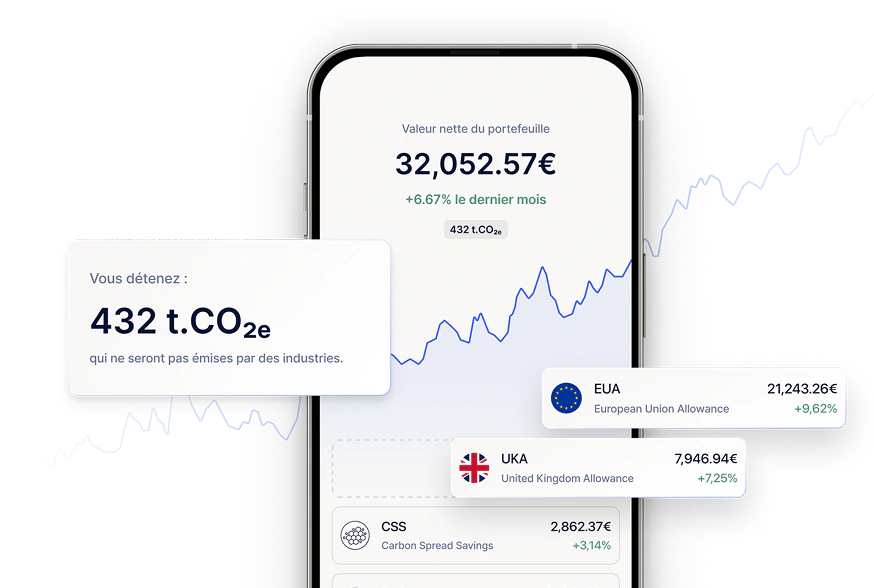
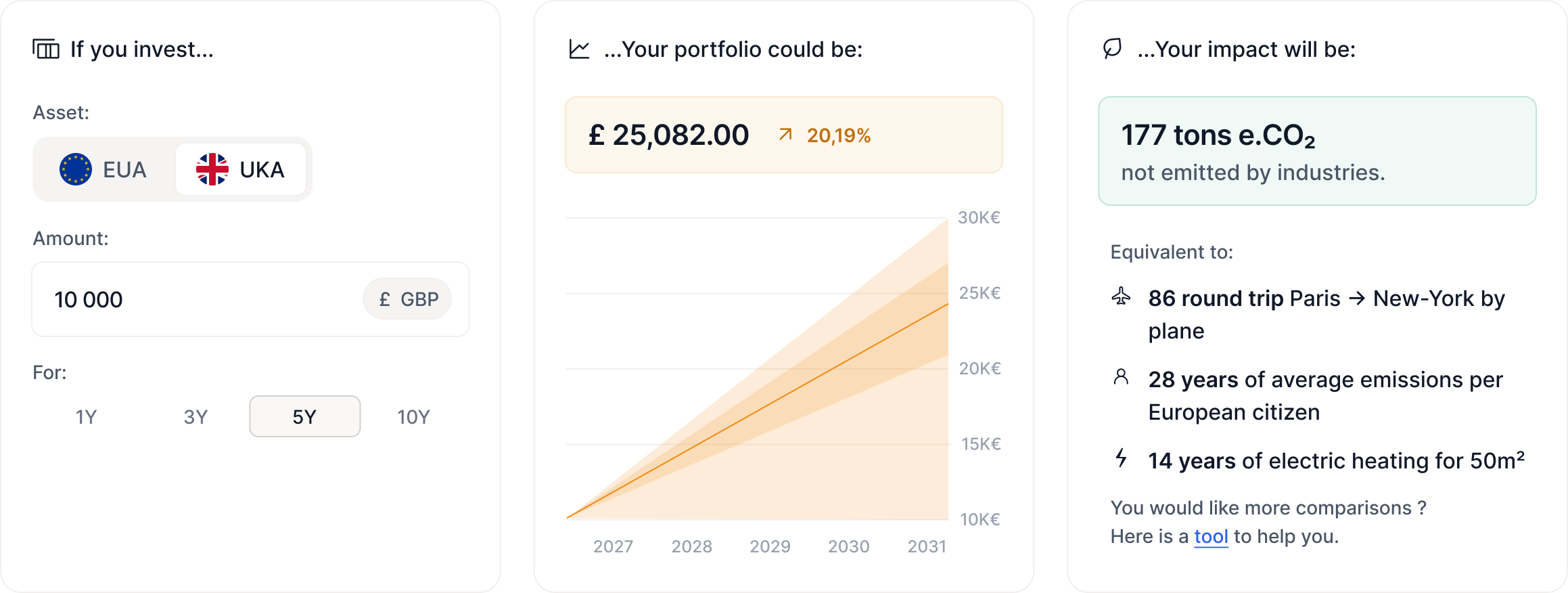
Modern diversification can also include less traditional assets that are uncorrelated with mainstream markets. At Homaio, we focus on one of these assets: European carbon emission allowances (EUA). The value of these permits to pollute is mainly driven by European Union climate policies and industrial activity—factors that are quite distinct from those that drive the CAC 40. Our approach aims to make this market, historically reserved for institutional investors, accessible to individuals who want to combine performance potential with direct environmental impact.
Define your own time horizon and risk profile
A 2-day trading forecast has no relevance for an investor preparing for retirement in 20 years.
Before acting on an analysis, it is essential to ensure it matches your own investment horizon and your risk tolerance. That is why an investor profile assessment process, compliant with regulations, is a must-have step to ensure the products offered are suited to your knowledge and objectives.
Cross-check sources and keep a critical mindset
Never rely on a single source of information. Compare analyses, including those that contradict each other. A high-quality forecast should always be transparent about its methodology, assumptions, and limitations.
Ask yourself the right questions:
- Who is the author of the forecast? Do they have a conflict of interest?
- What data and assumptions does the analysis rely on? Are they realistic?
- When was the analysis published? Is it already outdated?
- What alternative scenarios are considered?
An expert tip
Remember the bursting of the dot-com bubble in 2000. The most optimistic forecasts were based on metrics like the “number of clicks,” ignoring the most basic fundamentals such as profitability. It is a powerful historical reminder: a forecast must always keep its feet on the ground. Use analyses to challenge your own ideas, not to confirm them unthinkingly.
Stock market forecasts are useful instruments for understanding market dynamics and the forces at play. They provide perspectives, inform debate, and can help structure strategic thinking.
However, they should never replace your own judgment. The best investment strategy is the one you understand, that is aligned with your long-term goals, and that is built on solid principles like diversification and patience, rather than chasing the latest fashionable prediction.
FAQ on stock market forecasts
What is the most reliable forecasting method?
There is no single foolproof method. Reliability depends on the time horizon and the market context. Fundamental analysis is often preferred for long-term strategies, while technical and quantitative analyses are more used for the short term. The most robust approach is often to combine several methods to obtain a more complete view.
How can a beginner use stock market analysis?
A beginner should use stock market analysis mainly for educational purposes: to understand the factors that influence prices, learn financial vocabulary, and become familiar with different sectors. It is crucial to start with reputable, educational sources, and to always cross-check information before considering any investment decision.
Are AI-based forecasts better?
Artificial intelligence can analyze far larger quantities of data than a human and identify complex correlations, which is an advantage for quantitative analysis. However, AI still depends on the quality of the data it is trained on and can also be caught off guard by events with no historical precedent. It is a powerful tool, but not a miracle solution.
What is an uncorrelated asset and why is it important?
An asset is said to be “uncorrelated” when its price movements are not directly linked to those of another asset class, such as equities. For example, gold, certain commodities, or carbon allowances. Integrating uncorrelated assets into a portfolio is a pillar of diversification, because they can potentially perform well when equity markets fall, and vice versa, which helps smooth overall performance and reduce risk.
Go further: invest in the carbon market
Homaio gives you access to European carbon allowances (EUAs), an asset class that combines potential financial performance with direct climate impact. Diversify your wealth with an asset uncorrelated from traditional markets, accessible from €1,000.