Negative externality: simple definition 2026

Have you ever thought about the real cost of some of our economic activities? Beyond the listed price, many production or consumption actions generate unwanted side effects, borne by the whole community. These consequences, often invisible in companies’ accounting statements, lie at the heart of a fundamental economic concept: the negative externality.
Understanding this phenomenon is not just a theoretical exercise. It is an essential key to decoding the biggest challenges of our time, from climate change to the deterioration of our quality of life, and to identifying the levers for action available to us.
What is a negative externality? (Simple definition)
A negative externality occurs when an economic activity, carried out by an individual or a company, imposes a cost on a third party without that agent paying compensation. It is an unintentional, unbilled side effect that represents a real market failure.
In simple terms, a negative externality is a social cost that is not included in the private cost of production or consumption. The economic agent behind the nuisance does not financially bear the damage they cause to society or the environment.
This concept, popularized by economist Arthur Pigou in the early 20th century, highlights the gap between private interest and collective well-being. The industrialist who pollutes a river to minimize production costs does not pay for water decontamination, biodiversity loss, or local residents’ health problems. The cost is “externalized” to society.
It is important to distinguish this phenomenon from its opposite, the positive externality. This occurs when an action benefits third parties without them having to pay for it. A beekeeper whose bees pollinate neighboring orchards creates a positive externality for farmers, just as a company that innovates and whose discoveries benefit the entire sector. The challenge for public policy is therefore twofold: reduce negative effects and encourage positive effects.
Everyday real-life examples of negative externalities
Negative side effects are everywhere, often hidden in our most entrenched habits. Identifying them is the first step toward realizing their scale.
Pollution: the classic example
- Air pollution: Factories, coal power plants, or road traffic emit fine particles and greenhouse gases. These releases have a direct cost for society: more respiratory diseases, public healthcare spending, building deterioration, and contribution to global warming.
- Water pollution: Discharges of industrial chemicals or intensive pesticide use in agriculture contaminate groundwater and rivers. Consequences include the destruction of aquatic ecosystems, scarcity of drinking water, and high treatment costs for municipalities.
- Noise pollution: Noise generated by airports, highways, or construction sites disrupts residents’ peace and quiet. This externality has measurable impacts on health (stress, sleep disorders) and the property value of nearby homes.
The impacts of our consumption
Every day, our consumption choices can create hidden costs for the planet and its inhabitants.
- Single-use plastic: The production and massive consumption of plastic packaging leads to long-lasting pollution of soils and oceans, threatening marine wildlife and entering the food chain. The cost of recycling (when it happens) and cleanup is borne by the community.
- Long-distance imports: An avocado from South America or a smartphone assembled in Asia has a considerable carbon footprint due to transport. This CO2 emission is a global negative externality, whose effects (climate change) are shared by all humanity.
- Electronics and mining extraction: Demand for electronic products fuels a mining industry that, in many regions, causes irreversible environmental damage and comes with precarious working conditions.
Climate change, an externality on a global scale
Climate change is probably the greatest negative externality in history. It is the sum of billions of individual and industrial actions (burning fossil fuels, deforesting) whose cost—sea-level rise, extreme weather events, biodiversity loss—is borne by the entire world population, and especially by future generations and the most vulnerable countries.
How do you fix a market failure?
Since the market alone cannot incorporate these hidden costs, intervention is needed to “internalize the externality.” This means ensuring that the polluter pays for the damage they cause. Several tools exist to achieve this.
Public intervention: taxes and regulations
The most traditional approach relies on government action, which can work through two main levers:
- Regulation: The state can set strict standards and bans. For example, imposing limits on vehicle pollutant emissions, banning certain chemicals, or requiring industries to install filters. Failure to comply is punished with deterrent fines.
- Taxation (Pigouvian tax): The idea is to apply a tax whose amount equals the cost of the damage caused by the externality. A carbon tax, for example, aims to make CO2 emitters pay for their contribution to climate change. The principle is simple: the more you pollute, the more you pay. This creates a financial incentive to adopt more virtuous behaviors.
Market mechanisms: the emissions quota system
Another approach, complementary to the first, is to use market tools to solve the market’s own failures. The emissions trading system (ETS), also called the “carbon market” or “cap and trade,” is a perfect illustration.
It works as follows:
- Capping (Cap): Public authorities set an overall cap on allowed emissions for an economic sector (e.g., industry, electricity generation) over a given period. This cap gradually decreases over time to meet climate targets.
- Allocation of allowances (Trade): “Permits to pollute” (or allowances), each equivalent to one tonne of CO2, are distributed to the companies concerned, either for free or via auctions.
- Trading: Companies that emit less than their allowances can sell their surplus on a market. Those that exceed their allocation must buy the permits they lack.
This system creates a price for carbon. Polluting is no longer free. This innovation makes investments in clean technologies and decarbonization financially more attractive than buying the right to pollute. The European carbon market (EU ETS) is the largest in the world, covering more than 10,000 industrial installations.
Expert tip
The idea of a market to regulate pollution is not new. In the 1990s, the United States set up a “cap and trade” system to combat acid rain caused by sulfur dioxide (SO2) emissions. The program was a huge success, reducing emissions much faster and at a much lower cost than expected. This shows that, when well designed, a market mechanism can be an extraordinarily effective tool for internalizing an environmental externality.
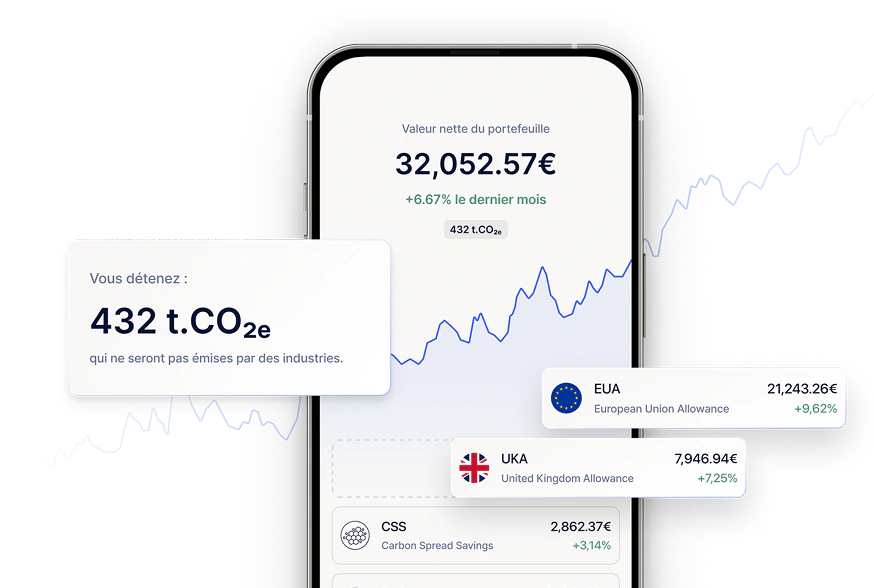
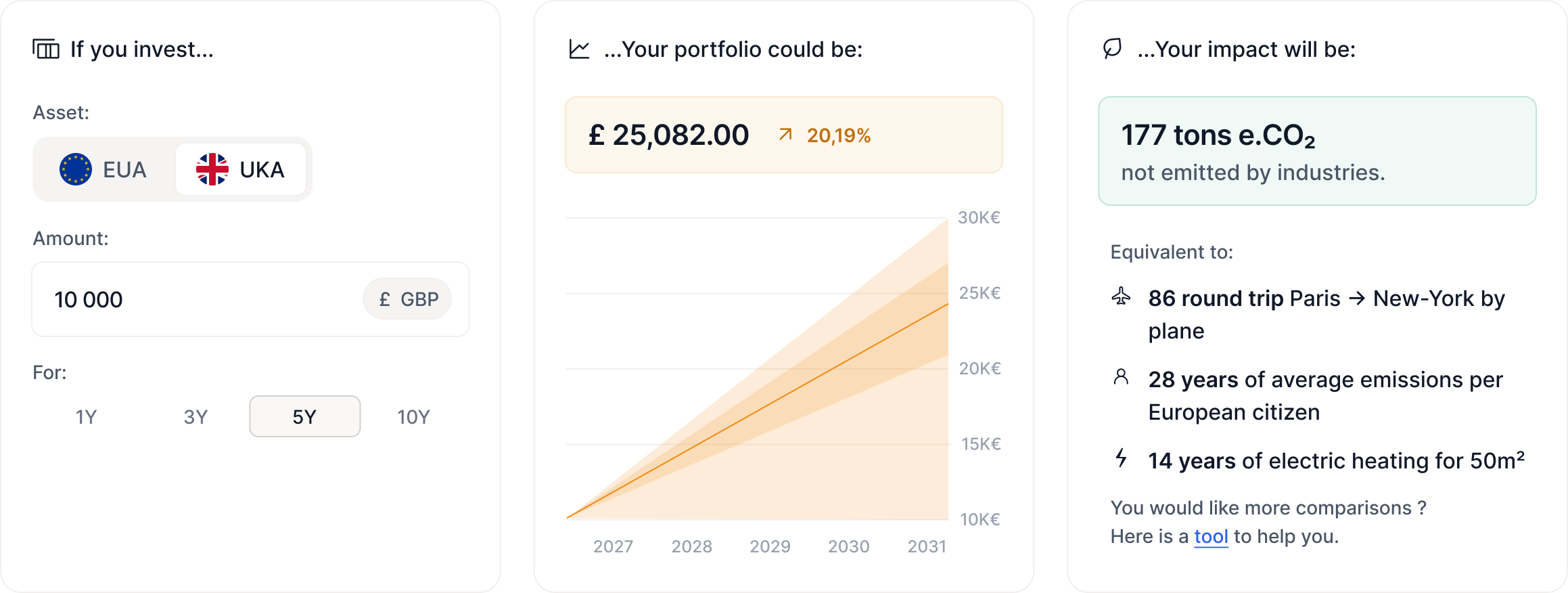
Historically reserved for industrial companies and institutional investors, this market is gradually opening up. Platforms like Homaio now allow retail investors to buy European carbon allowances (EUA). By acquiring these permits and withdrawing them from circulation, the number of rights to pollute available to industrials mechanically decreases, which helps push up the carbon price and accelerates their ecological transition.
What is our role as citizens and investors?
Faced with the scale of negative externalities, individual action can seem insignificant. Yet our everyday choices, whether related to consumption or savings, have very real power.
Adopt more responsible consumption
Changing our habits is a powerful lever to reduce demand for nuisance-generating activities. Several avenues are possible:
- Prioritize short supply chains to limit the carbon footprint linked to transport.
- Reduce consumption of single-use products, especially plastic.
- Favor repair and second-hand to fight planned obsolescence and resource waste.
- Choose soft modes of transport (walking, cycling, public transport) when possible.
Direct your savings toward impact
Beyond our shopping baskets, our money can become a powerful tool for change. Impact finance aims precisely to allocate capital to projects that generate measurable social or environmental benefits, in addition to a financial return.
This can be done through investment funds specialized in renewable energy, sustainable agriculture, or social innovation. But there are also more direct approaches. Investing in carbon allowances, for example, makes it possible to act directly on Europe’s main climate regulation mechanism. By choosing to invest in assets that force the internalization of environmental costs, the investor actively helps correct a major market failure. In doing so, they align their financial objectives with direct, tangible ecological impact.
Risk warning
Investing in carbon markets, like any financial investment, involves a risk of capital loss. The value of allowances fluctuates based on many economic and political factors. It is essential to fully understand the product and ensure it matches your risk profile before committing.
Ultimately, becoming aware of negative externalities pushes us to rethink the notion of “value.” The true wealth of an economic activity can no longer be measured solely by its financial profit, but must include its impacts on society and the planet.
As citizens, consumers, and investors, we have the power to influence this paradigm shift—by demanding greater transparency and steering our choices toward solutions that build a future where hidden costs are finally revealed and taken on.
FAQ on negative externalities
What is a negative externality in one sentence?
A negative externality is a cost imposed on a third party by an economic activity, without the person or company responsible for that cost paying compensation.
Is noise pollution a negative externality?
Yes, absolutely. Excessive noise from an airport or a highway is a perfect example of a negative externality, because it reduces local residents’ quality of life and property values without them being compensated by those responsible for the nuisance (airlines, drivers).
What is the difference between a carbon tax and a quota market?
Both aim to put a price on carbon, but through different means. The carbon tax directly sets the price of pollution (e.g., 40 € per tonne of CO2), but the total volume of emissions remains uncertain. The quota market, on the other hand, sets the total volume of allowed emissions (the “cap”) and lets the market determine the quota price through supply and demand.
How can an individual take concrete action?
An individual can act on two fronts: as a consumer, by adopting more sustainable habits (short supply chains, waste reduction, soft mobility); and as an investor, by directing their savings toward impact solutions that finance the ecological transition or directly participate in mechanisms that correct externalities, such as carbon markets.
Go further: invest in the carbon market
Homaio gives you access to European carbon allowances (EUAs), an asset class that combines potential financial performance with direct climate impact. Diversify your wealth with an asset uncorrelated from traditional markets, accessible from €1,000.