Loi NRE Explained: Obligations and 2026 Developments

How could a single line in an annual report mark the beginning of a revolution in how French companies think about responsibility? Before 2001, a company’s performance was measured almost exclusively by its financial results. Yet a law came and changed everything, forcing listed giants to look beyond their balance sheets.
The law on Nouvelles Régulations Économiques, or Loi NRE, was that historic turning point. It laid the first stones of a transparency that will seem obvious to you today, by requiring companies to talk about their impacts on society and on the planet. It was the first step toward an era in which non-financial performance would become a major strategic issue.
What is the Loi NRE? Definition and objectives
Enacted on 15 May 2001 and effective from 1 January 2003, Law No. 2001-420 on Nouvelles Régulations Économiques (NRE) is a foundational piece of French legislation. It was the first to require listed companies to publish information on the social and environmental consequences of their activities in their annual management report.
For the first time in France, the Loi NRE introduced a requirement for non-financial reporting for listed companies. Article 116 compelled them to include in their annual report detailed information on how they take into account the social and environmental impacts of their activities, marking the birth of CSR transparency in French law.
Initially designed to modernize the legal and economic framework after the crises of the 1990s, the Loi NRE pursued three main objectives:
- Financial regulation: Strengthen market transparency and corporate governance.
- Competition regulation: Adapt French law to new economic dynamics.
- Corporate regulation: Introduce the concept of social and environmental responsibility.
It was this third component that represented the real innovation, making France the first country in the European Union to enshrine non-financial reporting and the notion of “stakeholders” in its legislation.
Historical context: why such a law in 2001?
The adoption of the Loi NRE did not happen in a vacuum. It responded to a series of financial crises and economic scandals that shook the end of the 20th century, revealing deep flaws in corporate governance and market regulation. The need to strengthen transparency and more rigorously oversee the practices of major multinationals was becoming urgent.
At the same time, a global awareness was emerging about the imbalances created by globalization and the growing impact of industrial activities on the environment and society. The Loi NRE was therefore a strong political act, aimed at rebalancing power by giving more information to investors, employees, and civil society.
Article 53, for example, also reformed invoicing rules and payment terms between companies, seeking to improve business relationships. But it is indeed Article 116 that has gone down in history as the catalyst for change.
Obligations imposed by the Loi NRE: non-financial reporting
Article 116 of this legislation amended the Commercial Code to introduce an unprecedented transparency obligation. The 700 French companies listed on a regulated market now had to account for their non-financial performance.
An implementing decree of 20 February 2002 clarified the nature of the expected information, organizing it around three fundamental pillars.
The social pillar
Companies had to provide concrete, and where possible quantified, data on topics such as:
- Employment (headcount, hiring, layoffs, use of subcontracting).
- Work organization (hours, arrangements).
- Labor relations (dialogue with employee representatives).
- Health and safety at work (accidents, occupational illnesses).
- Training.
- Equal treatment and the fight against discrimination.
The environmental pillar
This component required information on how the company managed its ecological impact:
- Consumption of water, raw materials, and energy.
- Land-use conditions.
- Emissions of pollutants into air, water, and soil.
- Noise and odor nuisance.
- Waste production and recycling measures.
- Measures taken to ensure environmental compliance.
The societal and territorial pillar
This final axis focused on the company’s integration into its ecosystem:
- The impact of the activity on regional development and local populations.
- Relations with stakeholders (suppliers, subcontractors, associations).
- Compliance with the International Labour Organization (ILO) conventions in foreign subsidiaries.
A double-edged methodological freedom
The Loi NRE did not impose a strict methodology or verification by an independent third party. Each company was free to present the information as it saw fit. While this flexibility allowed gradual adoption, it was also the system’s main weakness, often leading to reports that were more marketing than factual.
From NRE to CSRD: the evolution of sustainability reporting
The Loi NRE was only the beginning. It paved the way for a series of increasingly demanding regulations, both in France and at the European level. You can see its legacy in all the legislation that followed.
The Grenelle 1 (2009) and Grenelle 2 (2010) laws considerably strengthened the framework. They extended the reporting obligation to certain large unlisted companies, clarified the list of 42 indicators to be published and, above all, introduced the obligation to have this information verified by an Organisme Tiers Indépendant (OTI).
Later, the 2017 ordinance transposing a European directive replaced this reporting with the Déclaration de Performance Extra-Financière (DPEF). The shift in philosophy was major: moving from a logic of simple “reporting” (accounting) to a logic of “performance,” asking companies to explain their business model, sustainability-related risks, and the policies put in place to address them.
Today, the framework is moving into a new era with the CSRD (Corporate Sustainability Reporting Directive), which will gradually apply to nearly 50,000 companies in Europe. The CSRD imposes standardized European reporting standards (the ESRS), a single digital format, and a much higher level of assurance.
This rapid evolution shows that the pioneering idea of the Loi NRE has become an unavoidable standard. Non-financial reporting is no longer an appendix, but a central element of corporate strategy and competitiveness. It directly influences access to financing and investor confidence.
The law’s tangible impact: a silent revolution
The legacy of the Loi NRE is considerable, even though its immediate effects were mixed. Certainly, studies have shown that it did not lead to a deep and immediate overhaul of business models. However, its impact proved more profound over the long term.
First, it forced top management to take ownership of topics previously relegated to technical or communications departments. Collecting social and environmental data forced companies to measure what they were not looking at—an essential first step to any improvement.
Second, it encouraged the emergence of a new ecosystem of experts: non-financial rating agencies, specialized auditors, CSR consultants. This expertise market helped professionalize the approach and make it more credible.
Finally—and perhaps most importantly—it embedded in French corporate culture the idea that performance must be assessed holistically. It popularized the acronyms CSR and ESG (Environmental, Social, and Governance) and prepared the ground for far more binding mechanisms.
An expert tip for decoding transparency
The Loi NRE taught a crucial lesson: reporting without a sanction mechanism or market mechanism remains declarative. Analysis of the first NRE reports showed a huge gap between words and actions. That is why modern regulatory frameworks, such as the European carbon market (EU ETS), are much more effective. They do not merely ask for a report on CO2 emissions; they require polluters to buy allowances for every ton emitted. Reporting thus becomes a direct financial issue, no longer a simple communications exercise.
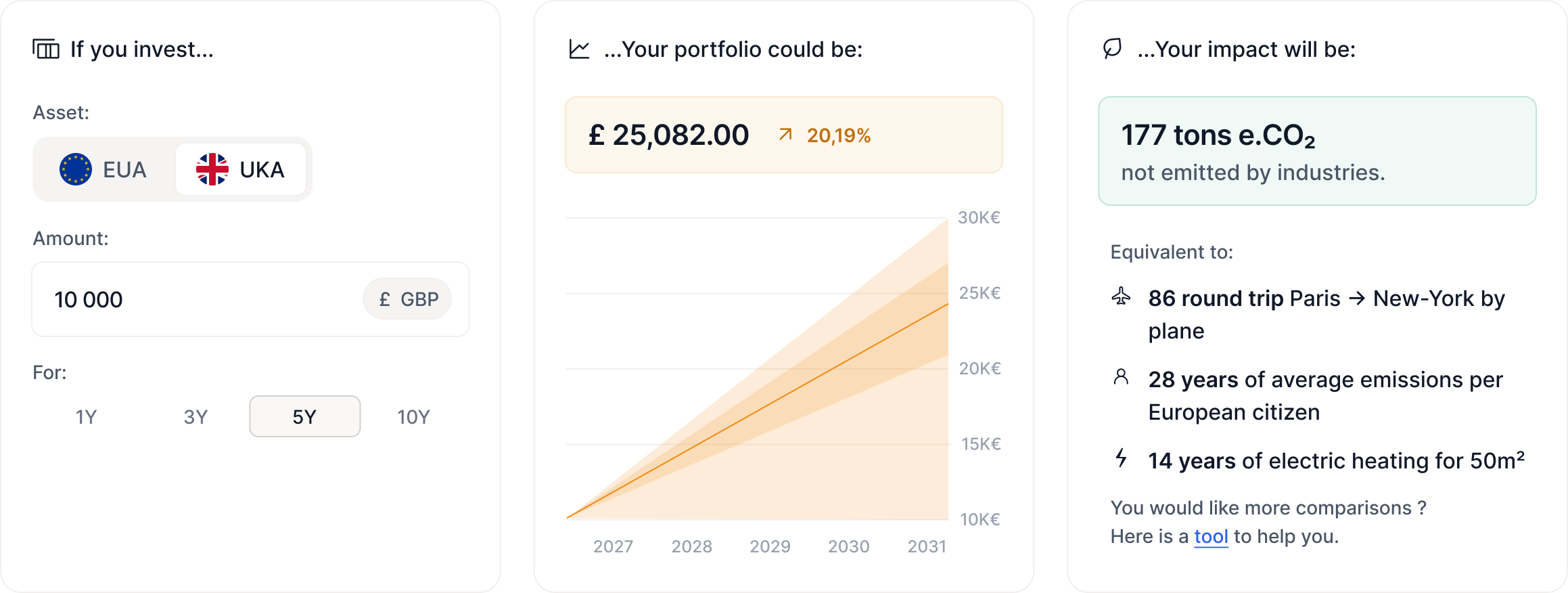
This transition from reporting to financial accountability is the key. Where the Loi NRE encouraged transparency, systems like the carbon compliance market create real economic pressure for decarbonization. It is with this logic that we designed Homaio: enabling investors to participate directly in this market mechanism, by buying and retiring carbon allowances to accelerate the transition. The goal is to transform information into action—to move from declarative impact finance to measurable impact.
The Loi NRE was the seed of a growing awareness. More than twenty years later, its fruits are visible in regulations that shape an economy where sustainability is no longer an option, but a condition of performance. It initiated a movement that today is redefining the rules of capitalism by integrating planetary boundaries and social imperatives.
FAQ: Loi NRE questions
What is a simple definition of the Loi NRE?
The 2001 Loi NRE (Nouvelles Régulations Économiques) is the first French law that required listed companies to publish in their annual report information on the social and environmental consequences of their activities. It is considered the founding act of non-financial reporting in France.
Which companies were covered by the Loi NRE?
When it came into force in 2003, the Loi NRE applied exclusively to French companies whose securities were admitted to trading on a regulated market (listed companies). This represented around 700 companies at the time.
Is the Loi NRE still in force?
No, the Loi NRE as such has been replaced and expanded by successive texts. Its reporting obligations were first strengthened by the Grenelle laws, then replaced by the Déclaration de Performance Extra-Financière (DPEF) in 2017. Today, the European reference framework is the Corporate Sustainability Reporting Directive (CSRD), which represents the culmination of more than twenty years of evolution since the NRE.
What did the social and environmental section of NRE reporting contain?
NRE reporting had to cover a broad range of information. On the social side, it included data on employment, working conditions, training, and equality. On the environmental side, it addressed resource consumption (water, energy), pollution, waste management, and greenhouse gas emissions.
Go further: invest in the carbon market
Homaio gives you access to European carbon allowances (EUAs), an asset class that combines potential financial performance with direct climate impact. Diversify your wealth with an asset uncorrelated from traditional markets, accessible from €1,000.