Livret Bleu 2026: understand, compare, and choose

Livret Bleu is a familiar name in the French savings landscape, often mentioned alongside its famous counterpart, the Livret A. Yet questions remain: is it the same product? How does it work, and what is its real value for your savings? This comprehensive guide provides clear, factual, and practical answers to help you understand this regulated savings product.
Livret Bleu: simple definition and key points to remember
Livret Bleu is an interest-bearing savings account whose funds are available at any time. It is marketed exclusively through the Crédit Mutuel banking network.
Historically, Livret Bleu had its own specific features, but it was gradually aligned with the Livret A. Today, in practice, it is considered its “twin”, sharing the same operating rules, interest rate, and deposit cap set by the public authorities. It is a secure savings product, with no risk of capital loss, and whose interest is fully exempt from tax and social contributions.
In short, if you are a Crédit Mutuel customer, Livret Bleu is simply the name used for the Livret A at this bank.
What is the difference between a Livret Bleu and a Livret A?
This is the most common question, and today the answer is very simple: there is virtually no difference for savers anymore. Their features have been harmonized to offer the same benefits and the same constraints.
The essential similarities
For an individual, Livret Bleu and Livret A are identical on all fundamental points. Here are the characteristics they share:
- Interest rate: The rate is strictly the same, set by the State and potentially revised twice a year.
- Deposit cap: The maximum amount you can deposit into a Livret Bleu is identical to that of the Livret A. Beyond this cap, additional deposits are no longer possible.
- Taxation: The interest earned is fully tax-exempt. It is subject to neither income tax nor social contributions.
- Eligibility conditions: Any natural person, adult or minor, can hold a Livret Bleu, with no income or age conditions.
- Availability of funds: The money deposited is available at any time, with no fees or penalty in case of withdrawal.
- Interest calculation: Interest is calculated by fortnight (from the 1st to the 15th and from the 16th to the end of the month) and paid annually on December 31.
Differences to know depending on the institution and how it is offered
The only real difference is commercial:
- The distributing institution: Livret Bleu is a controlled name and distributed only by Crédit Mutuel. Livret A, on the other hand, is offered by almost all French banks.
As a result, if you open a regulated savings account at Crédit Mutuel, it will be a Livret Bleu. At another bank, it will be a Livret A. Otherwise, the experience and benefits for the saver are the same.
What is Livret Bleu for, and who is it useful for?
What is the point of Livret Bleu? Its main purpose is building an emergency fund. It is designed to set money aside safely to handle unexpected expenses or to finance short-term projects.
This product is particularly suitable for:
- Building an emergency fund: This is its primary purpose. The money remains immediately accessible to cover an unexpected expense (car breakdown, urgent repair, healthcare costs). Experts often recommend keeping the equivalent of 3 to 6 months of regular expenses there. You can learn more about building your emergency fund in our dedicated guide.
- Financing a short-term project: Planning a vacation, a move, buying a household appliance, or a down payment for a larger project. The capital is guaranteed, so you can be sure you will have the amount you saved when you need it.
- Saving without taking risk: For savers who do not want any exposure to financial market fluctuations, Livret Bleu is a simple and fully secure solution.
Livret Bleu is suitable for all profiles, from young professionals just starting to save to retirees seeking to protect their capital.
Rate, cap, interest, and access to funds: how does it work?
The practical operation of Livret Bleu is simple and transparent, because it is governed by regulation.
- The interest rate: The Livret Bleu interest rate is set by the State. It is currently 3 % net per year. This rate was frozen until January 2025. It is important to verify this information with official sources because it may change.
- The deposit cap: The maximum amount of deposits into a Livret Bleu is set at 22 950 € for an individual. Once this cap is reached, you can no longer make new deposits. However, the interest generated each year can continue to be added and push the balance above this amount.
- Interest calculation: Interest is calculated according to the “fortnight rule”. Money deposited starts earning interest on the 1st or the 16th of the month following the deposit. Money withdrawn stops earning interest on the 1st or the 16th of the month preceding the withdrawal.
Expert tip to optimize your interest
To get the most out of the fortnight rule, try to make deposits just before the 16th or the end of the month (for example, the 15th or the 30th). Conversely, if you need to make a withdrawal, do it preferably just after the start of a fortnight (the 1st or the 16th of the month). It is a small detail, but on large amounts, it helps you avoid “losing” a fortnight of interest.
Availability of funds: Money deposited into a Livret Bleu is never locked in. You can withdraw at any time, by transfer or at the counter, with no fees and without losing interest already earned in previous years.
Can you have a Livret A and a Livret Bleu at the same time?
The answer is unequivocal: no.
French regulation is very clear on this point: the same person can hold only one product in this category. Since Livret Bleu and Livret A are considered one and the same type of regulated savings account, it is forbidden to combine them.
When opening a Livret Bleu (or a Livret A), the bank has a legal obligation to check that you do not already hold one at another institution. This check is done via a query to the tax authorities. If you already have a Livret A, your request to open a Livret Bleu will be refused, and vice versa.
Is Livret Bleu taxable?
No, and this is one of its most significant advantages. The interest you receive each year on your Livret Bleu is fully exempt from taxation.
This means it is subject to:
- Neither income tax: You do not need to report it in your annual income tax return.
- Nor social contributions (CSG, CRDS, etc.).
The displayed 3 % rate is therefore a “net” rate. What you earn is what you keep, unlike many other investments whose gross return is reduced by taxes. This feature makes it a very effective tool for an emergency fund, where simplicity and predictability are essential. To explore alternatives, you can consult our comparison of the best savings accounts.
Opening for an adult, a child, or a baby: what you need to know
Opening a Livret Bleu is available to everyone, with no age, nationality, or French tax residency requirement.
- For an adult: The process is simple. You just need to go to a Crédit Mutuel branch with an ID document and proof of address. An initial deposit, generally a small amount (10 € for example), is required to activate the account.
- For a child or a baby: A Livret Bleu can be opened in the name of a minor from birth. The legal representatives (generally the parents) complete the opening steps and manage the account until the child reaches adulthood. It is an excellent way to start building savings for future projects (studies, driving license). The funds deposited belong to the child, but the parents manage them.
Livret Bleu is often used as a “birth savings book”, a practical and lasting gift to welcome a newborn.
Note
The features of regulated savings products (rate, cap, taxation) may change with legislation. It is always recommended to check the conditions in force with official sources such as the Banque de France website or directly with the relevant banking institution before making any decision.
FAQ about Livret Bleu
Which savings account is going to go to 6 %?
The rumor about a savings account moving to 6 % concerns the Livret d'Épargne Populaire (LEP), not Livret Bleu or Livret A. The LEP rate is directly indexed to inflation and did indeed reach 6 % in 2023 before coming back down. Opening an LEP is subject to income conditions. It is a different product, intended for low-income households. The Livret Bleu rate is currently 3 %.
What is the cap for Livret Bleu?
The deposit cap for Livret Bleu is currently 22 950 € for individuals. This amount is identical to that of the Livret A. It is essential to verify this figure, as it may be updated by the public authorities.
Is a Livret Bleu for a newborn or baby a good idea?
Yes, it is a very common and relevant option. Opening a Livret Bleu for a newborn is a good idea because it combines several advantages: total capital security, no fees, tax-free net interest, and the ability for the family to add money over the years. It is a simple and effective way to start building a first pool of capital for the child’s future.
How can you check the Livret Bleu rate in 2026?
To find the official Livret Bleu rate in 2026 or at any other date, it is essential to rely on trustworthy sources. The best options are:
- The official website of the French administration (service-public.fr).
- The Banque de France website (banque-france.fr).
- The Crédit Mutuel website or official communications (creditmutuel.fr).
Avoid relying on unsourced information, as the rates of regulated savings accounts are sensitive and changing data.
Go further: invest in the carbon market
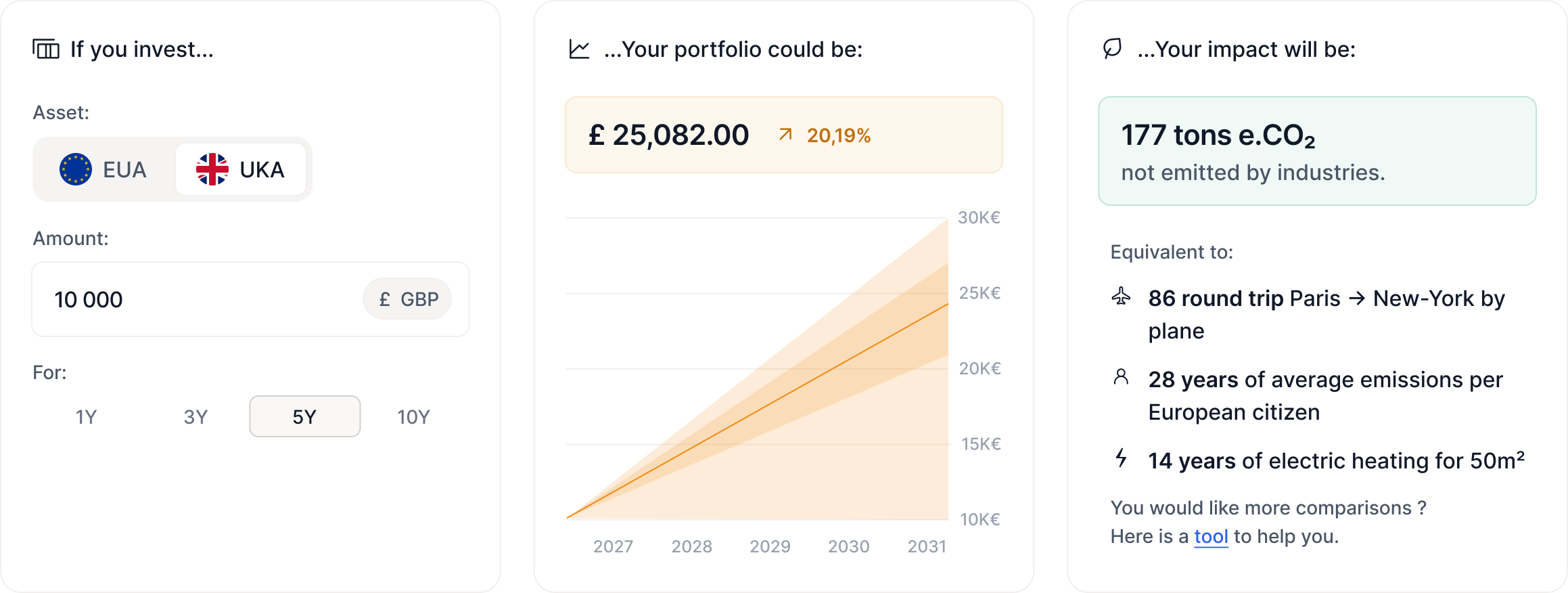
Homaio gives you access to European carbon allowances (EUAs), an asset class that combines potential financial performance with direct climate impact. Diversify your wealth with an asset uncorrelated from traditional markets, accessible from €1,000.