Livret B cap in 2026: does it exist?

You’ve just received a large sum of money following a property sale or an inheritance and you’re wondering where to place it temporarily and safely, without being blocked by a deposit limit? The question of the Livret B cap then naturally arises.
This passbook savings account, often little known, has a feature that radically sets it apart from its regulated cousins. But does that make it the miracle solution for your excess savings? Let’s explore together the rules that frame it and the concrete implications for your wealth.
Livret B, a savings solution with no regulatory limit
Livret B is an interest-bearing savings account, but it belongs to the category of unregulated banking products.
This distinction is fundamental. Unlike the Livret A, the LDDS or the LEP, whose features (rate, cap, opening conditions) are set by the public authorities, Livret B is an in-house product. Each bank defines its own rules contractually.
Whether it is marketed under the name “Livret B” at Caisse d'Épargne, “Compte sur Livret” at Crédit Agricole, or otherwise, the principle remains the same: it is a savings product whose terms are freely determined by the institution offering it. It is accessible to a broad customer base: adult and minor individuals, tax residents or not, and even certain legal entities such as associations.
Livret B cap: the myth of the limit
The central question is simple: is there a deposit limit on Livret B? The answer is its main advantage: no, there is no regulatory deposit cap on a Livret B.
This is its major technical feature. While the Livret A is strictly capped at 22 950 €, the Livret B allows you to credit theoretically unlimited amounts. This lack of a cap makes it an ideal cash “airlock” to hold very large sums that cannot remain in a non-interest-bearing current account.
However, although banks rarely set a contractual limit, another limit—far more important—should command your full attention: the guarantee limit.
Watch out for the deposit guarantee
If the deposit cap is unlimited, the protection of your capital is not. Funds deposited in a Livret B are covered by the Fonds de Garantie des Dépôts et de Résolution (FGDR).
The guarantee is capped, not the deposits
The FGDR guarantees your deposits up to 100 000 € per customer per banking institution. If you deposit 500 000 € into a Livret B at a single bank and that bank goes bankrupt, only 100 000 € will be covered. To secure amounts above that, you must spread your cash across several separate banks to multiply the guarantees.
This nuance is crucial. Livret B is an excellent tool for large amounts—provided you understand and follow this prudential rule by diversifying banking institutions.
How does a Livret B work?
How Livret B works is based on the bank’s contractual freedom, which directly influences its return and its appeal to savers.
An interest rate freely set by banks
The Livret B interest rate is set at each bank’s discretion. It is not indexed to any legal formula, unlike the Livret A. As a result, it is often much less attractive.
Currently, base rates on taxable bank passbooks generally fall within a range of 0,10 % to 1,00 % gross per year. Some banks may offer “super passbooks” with boosted promotional rates for a short period, but the base rate remains low.
Taxation that weighs on returns
This is Livret B’s main drawback. While interest from the Livret A is fully exempt from income tax and social contributions, Livret B interest is taxable. By default, it is subject to the Prélèvement Forfaitaire Unique (PFU), also called the “flat tax,” of 30 %.
This levy breaks down as follows:
- 12,8 % for income tax.
- 17,2 % for social contributions.
It is crucial to distinguish the gross rate (communicated by the bank) from the net rate (what you actually receive). For example, a Livret B with a gross rate of 1,00 % will in reality yield only 0,70 % net after applying the flat tax. For low-tax households, it is possible to opt for taxation under the progressive income tax scale, but the 17,2 % social contributions still apply.
Availability and interest calculation
As with the Livret A, funds placed in a Livret B are fully liquid. You can make withdrawals at any time, without fees or penalties, which makes it an excellent solution for an emergency fund or cash awaiting investment.
Interest is calculated according to the “bi-monthly rule”:
- Amounts deposited between the 1st and the 15th of the month start earning interest on the 16th.
- Amounts deposited between the 16th and the end of the month start earning interest on the 1st of the following month.
- The interest generated is paid into the passbook at year-end and added to the principal, itself earning interest the following year (interest compounding).
Pros and cons of Livret B: the bottom line
To make things clearer, let’s compare Livret B with its main competitor, the Livret A.
The verdict is clear: Livret B shines thanks to its lack of a cap, but falls short due to its low net return because of taxation.
When should you use a Livret B?
Livret B is not a performance product but a tactical cash-management tool. Its usefulness becomes clear in very specific situations:
- As a safety buffer: After the sale of a business, a property sale, or a substantial inheritance, Livret B allows you to immediately secure several hundred thousand euros while you define a long-term investment strategy. It’s a remunerated and secure “parking” solution (by respecting the 100 000 € per bank rule).
- As a complement to regulated passbooks: Once the Livret A cap and the LDDS cap are reached, Livret B is a simple solution for excess savings that must remain available.
- For the cash holdings of legal entities: Associations or works councils, often excluded from regulated passbooks, can use Livret B to at least grow their day-to-day cash without locking it up.
It should therefore not be seen as a long-term investment, but rather as a flexible waiting solution with no amount limit.
Beyond Livret B: diversify your savings to combine returns and impact
Once your emergency fund is built and your liquidity is secured in vehicles like Livret B, the question of diversification arises. Letting large amounts of capital sit in low-yield passbooks means accepting an erosion of value due to inflation.
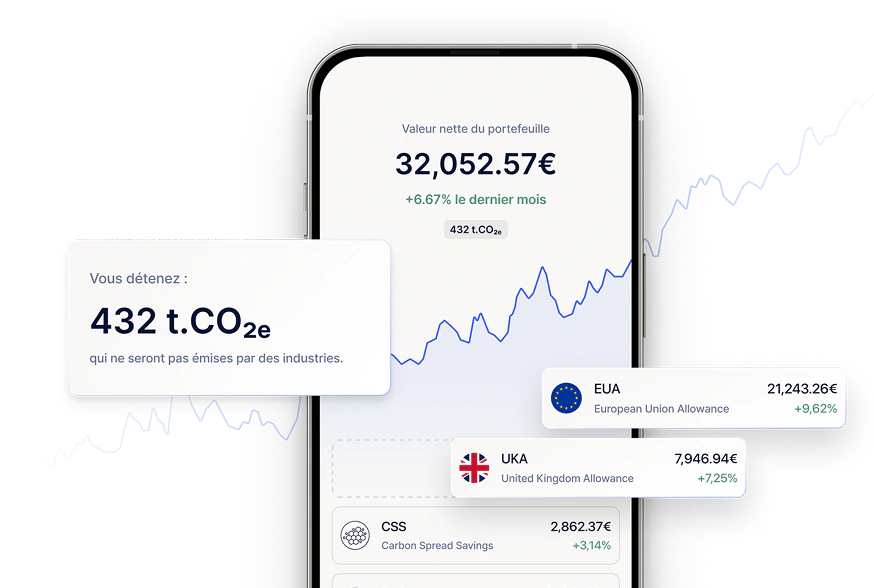
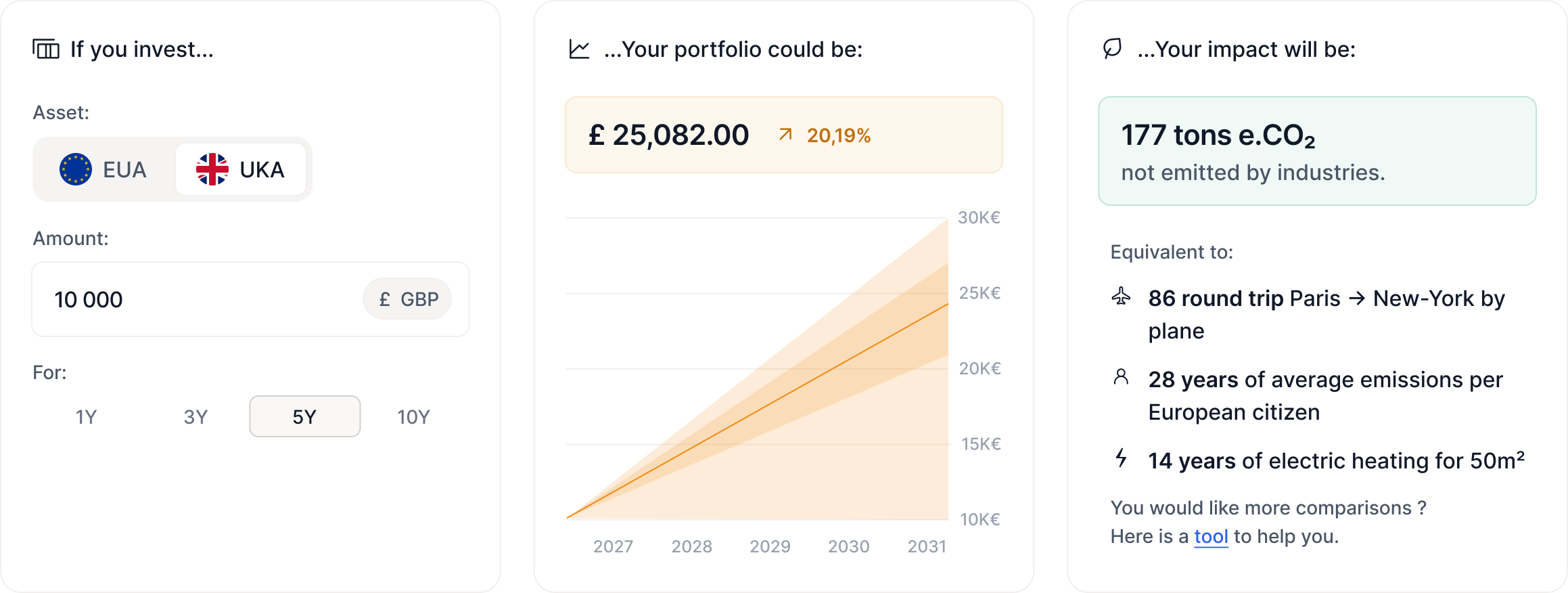
For investors looking to give meaning to their savings while aiming for potentially higher performance, new solutions are emerging. Investing in climate assets, such as European carbon emission allowances (EUA), is a relevant example.
Historically reserved for institutions, this market is now accessible to individuals via innovative platforms. By investing in carbon allowances, you’re not only seeking a financial return; you actively contribute to the ecological transition. Each allowance bought and withdrawn from the market increases the cost of pollution for industrials, encouraging them to accelerate their decarbonization.
This asset has the advantage of being uncorrelated with traditional financial markets, making it an excellent portfolio diversification tool. Of course, like any investment with higher return potential, it carries a risk of capital loss and fits into a longer-term wealth strategy, far from Livret B’s simple storage objective.
An expert opinion
Don’t confuse a liquidity bucket with an investment bucket. Livret B excels for the former, but it is counterproductive for the latter. Historically, the mistake many savers have made is keeping too much cash in low-yield vehicles out of fear of risk, taking the full hit from inflation. Once your safety cushion is secured, daring to allocate part of your capital to high-conviction assets—whether real estate, equities, or climate assets—is the only way to build solid long-term wealth.
Livret B is therefore a gateway, an essential tool for managing large cash flows. But it should only be a step before a more ambitious and thoughtful allocation of your capital.
In summary, Livret B is a double-edged wealth-management tool. Its lack of a cap makes it the only liquid receptacle capable of holding very large amounts of capital, which makes it essential for managing wealth transitions (sales, inheritances). However, its low gross return, reduced by 30 % taxation, makes it a very poor long-term investment.
It should therefore be considered for what it is: an excellent secure and flexible “waiting account,” but in no way a high-performing savings solution. Its use should be temporary, while you intelligently reallocate the funds toward investments better suited to your long-term goals.
FAQ
Does Livret B really have a cap?
No, there is no deposit cap set by law. Each bank can theoretically define one in its contractual terms, but that is extremely rare. The only real limit to consider is the FGDR guarantee, set at 100 000 € per depositor per bank.
What exactly is the taxation on Livret B interest?
Interest generated by a Livret B is by default subject to the 30 % Prélèvement Forfaitaire Unique (PFU), which consists of 12,8 % income tax and 17,2 % social contributions. Taxpayers for whom this option is more favorable can choose to include this interest in their tax return to be taxed under the progressive scale.
Can I hold a Livret B alongside a Livret A?
Yes, absolutely. Since Livret B is an unregulated product, you can hold one or more, in different banks, in addition to all your other savings accounts (Livret A, LDDS, LEP, etc.).
Is Livret B a good investment?
That depends entirely on your objective. To secure large sums of money over a short period while keeping full availability, it’s an excellent solution. On the other hand, if you are looking for a return to grow your wealth over the medium or long term, Livret B is not a good investment due to its low rate and taxation. It is then preferable to look for alternatives to the Livret A and other traditional savings products.
Go further: invest in the carbon market
Homaio gives you access to European carbon allowances (EUAs), an asset class that combines potential financial performance with direct climate impact. Diversify your wealth with an asset uncorrelated from traditional markets, accessible from €1,000.