Investing in Art in 2026: A Complete Guide to Getting Started and Limiting Risk

Investing in art is often seen as an investment reserved for an elite. Yet it is an asset class that is attracting more and more interest for its ability to decouple a portfolio from traditional financial markets. Above all, it is a long-term investment that blends aesthetic pleasure with wealth strategy.
There is no return guarantee. The art market is complex, opaque, and less liquid than the stock market or real estate. A successful approach relies on good information, patience, and ideally a genuine interest in the works you buy.
Why some works gain value
Unlike a company share whose value is based on financial statements and growth prospects, the value of a work of art is built on a set of far more subjective criteria. Understanding these mechanisms is the first step toward investing rather than simply buying.
The role of the artist, rarity, and provenance
A work’s value is a complex alchemy. At the heart of the equation is the artist. Their reputation, track record (exhibitions in recognized galleries, presence in museums or prestigious collections) and critical recognition are the foundations of their market value.
Next comes rarity. A unique painting will never have the same value as a lithograph published in 200 copies. For editions, a small print run (under 50) signed and numbered by the artist is a mark of value.
Finally, provenance—the work’s ownership history—is crucial. A work that belonged to a famous collector or was exhibited in a renowned institution will see its value increase. It is a guarantee of authenticity and historical relevance.
The importance of the certificate of authenticity
Never buy a work without a proper certificate of authenticity, issued by the artist or their recognized rightful holder. This is the document that proves the work is not a counterfeit. Without this proof, its value is zero.
The difference between cultural value, price, and resale potential
It is essential not to confuse these three notions.
- Cultural value is a work’s importance in art history. It can be immense, but not always monetizable.
- The price is the amount a buyer is willing to pay at a given moment. It results from the meeting of supply and demand, influenced by trends and the health of the market.
- Resale potential depends on the work’s ability to maintain or increase its attractiveness over time. An artist can be very fashionable for two years, then fall into oblivion, destroying the potential capital gain.
What types of art can you buy to invest?
The art market is not a monolithic block. It is divided into several segments with very different risk levels, budgets, and potential.
Contemporary art, modern art, and blue-chip artists
Modern art (roughly 1860–1970) includes names like Picasso or Monet. It is a mature market, considered a safe haven. Prices are very high and quality works are rare.
"Blue chip" artists are the stars of the market, like Andy Warhol or Jean-Michel Basquiat. Their works trade for millions and are considered solid investments because their place in art history is secured. Access to this segment is reserved for very large fortunes.
Contemporary art (artists born after 1945 or still active) is the most dynamic and most speculative segment. This is where you find opportunities for major capital gains—but also the highest risks of loss.
Young artists, limited editions, and photography
To get started with a more modest budget, several entry points exist.
Buying works by promising young artists can be a strategy. The risk is maximal, because few of them will break through, but if you have a good eye and the artist you follow is later recognized, the return on investment can be spectacular.
Limited editions (lithographs, screenprints, engravings) are an excellent way to acquire a work by a well-rated artist without spending a fortune. A signed print by Soulages or Zao Wou-Ki can be worth several tens of thousands of euros, but remains far more accessible than a painting.
Fine art photography is a market in its own right. Prints are limited, numbered, and signed. It is a segment that has seen strong growth and remains more affordable than painting.
NFTs: a high-risk special case
NFTs (Non-Fungible Tokens) made a sensational entry into the art world in 2021. They are digital certificates of ownership recorded on a blockchain, often associated with an image or video. This market is extremely young, volatile, and speculative. It is intended for informed investors who understand the risk of a total loss of capital.
How to choose a work or an artist
A methodical approach is essential to limit the risk of mistakes. It is research work that takes time.
Check authenticity, condition, and provenance
These three pillars are non-negotiable.
- Authenticity: Always require a certificate, as mentioned above. If in doubt, experts or artists’ committees can be consulted.
- Condition: A damaged work, even by a great artist, suffers a significant markdown. Ask for a detailed condition report, especially for an auction sale. Poor restoration can destroy a piece’s value.
- Provenance: A clear and prestigious ownership history is a major asset. Beware of works that appear “out of nowhere.”
Read the artist’s market value, sales history, and market references
An artist’s market value is an estimate of their value on the market, mainly based on public auction results. Databases such as Artprice or Artnet are reference tools for consulting these results.
Do not analyze a single sales record. Instead, look at the consistency of transactions and price trends over several years. Sustained sales volume is a sign of liquidity and a healthy market for the artist.
Where to buy and resell artworks
The buying and selling channel has a direct impact on price, fees, and transaction security.
Galleries, auctions, marketplaces, and specialized platforms
- Art galleries: They represent artists and promote them. This is the “primary” market. Buying from a gallery supports an artist directly and provides solid guarantees. However, prices are often higher.
- Auction houses (Christie’s, Sotheby’s, Artcurial...): This is the “secondary” market. Prices are set by supply and demand in real time. It is a good indicator of an artist’s market value, but you must be vigilant about fees.
- Online marketplaces (such as Artsper): They offer broad, simplified access to thousands of works from galleries worldwide. The selection is vast, but you have to sort through it.
- Art investment funds and co-investment platforms: These solutions make it possible to buy shares in high-value works. It is a way to diversify and access “blue chip” pieces with a lower entry ticket. The downside is that you do not physically own the work.
Start with emotion
My most sincere advice would be to never buy a work you do not like. In the worst-case scenario, if the work never gains value, you will still have the daily pleasure of looking at it. This is what is called the “emotional dividend.” It is the only return that is 100% guaranteed.
Fees, commissions, and resale conditions
This is the downside that many beginner investors forget. The displayed price is never the final price.
- When buying: At auction, you pay the hammer price plus a buyer’s premium (about 25–30% extra). In a gallery, the price is often net but can be negotiated.
- During holding: Consider insurance, storage (if the work is not at home), specialized transport, and potentially framing.
- When selling: You will pay seller’s fees to the auction house (15–20%), a commission to the gallery, or transaction fees on a platform. Taxes on the capital gain are added.
All these costs eat into the net performance of your investment.
How much to invest and what strategy to use
Art should remain a minority, diversification portion within an overall portfolio.
Starting with a small budget
It is entirely possible to start a collection with a few hundred or a few thousand euros. Focus on:
- Limited editions (lithographs, screenprints) by recognized artists.
- Photography in limited edition prints.
- Works on paper (drawings, watercolors) by promising young artists.
The key is to set a budget and stick to it, and never invest money you might need in the short term. This is a basic rule for all profitable small investments.
Diversification, investment horizon, and risk management
Don’t put all your eggs in one basket. It is more prudent to own several works by different artists than to bet everything on a single piece. Diversification is a key to better risk management, whatever the asset.
The investment horizon is fundamental. Do not expect to buy and resell a work in six months for a profit. The art market is slow. Consider a minimum 5 to 10-year horizon to give an artist’s market value time to develop.
Illiquidity: the number 1 risk
The main danger of investing in art is the lack of liquidity. Unlike a share that you can sell in a few seconds, finding a buyer for an artwork at the right price can take months or even years. It is impossible to recover your capital quickly in case of an urgent need.
Taxation of art investment: what to check
Warning: the following information is general in nature and does not replace advice from a tax professional. Legislation may change.
In France, the tax regime for artworks offers certain advantages for individuals.
- Exemption from the Impôt sur la Fortune Immobilière (IFI): Works of art are not included in the IFI tax base.
- Taxation of capital gains on resale: If you resell a work, you can choose between two tax regimes:
- A flat tax of 6.5% on the total sale price. Simple, but applies even if you do not make a capital gain.
- The general regime for capital gains on movable property. The rate is 36.2% (including social contributions) on the net capital gain. A 5% allowance per year of holding applies starting from the 3rd year, leading to full exemption after 22 years. This regime is more attractive if you can prove the purchase price and date.
“Tax optimization” through buying art mainly concerns companies. For individuals, the advantage lies above all in taxation on resale and wealth transfer.
Key risks and mistakes to avoid
To sum up, here are the pitfalls to avoid:
- Neglecting ancillary costs: Purchase, insurance, storage, sale... They heavily impact the final return.
- Giving in to trends: Buying a “trendy” artist without in-depth research into their track record is risky.
- Underestimating illiquidity: Thinking you can resell quickly and easily is the biggest mistake.
- Lack of diversification: Betting everything on a single artist or a single work is a gambling strategy, not investing.
- Buying without a certificate of authenticity: This is the risk of ending up with an object with no value.
- Forgetting the pleasure: The first return on investment should be the emotion the work gives you.
Investing in art is a demanding process. It requires learning, visiting exhibitions, reading, meeting gallery owners. It is a marathon, not a sprint—one that can enrich your wealth as much as your daily life.
FAQ on investing in art
What is the most profitable art?
There is no single answer to this question. Historical data shows that “blue chip” works from post-war and modern art have delivered the most stable and significant capital gains over the long term. However, their entry ticket is several hundred thousand or millions of euros. Emerging contemporary art offers the highest profit potential, but with an equally high risk of capital loss. Past performance is never a guarantee of future performance.
What is the best investment in art?
The “best” investment is the one that matches your profile:
- For a cautious profile: A limited edition (print, lithograph) by a globally recognized artist with a strong secondary market.
- For a balanced profile: A unique work (painting, drawing) by an established mid-career artist, already recognized by institutions but with room for growth.
- For a dynamic profile: A work by a promising young artist, represented by a reputable gallery, whose work you genuinely appreciate.
The best investment always combines appreciation potential, fit with your budget, and a personal favorite.
What art sells well?
The art that sells best in general is art that is easily identifiable and whose artist benefits from strong international recognition. Paintings by established artists (modern, post-war, or established contemporary) are the most liquid segment of the market. Signed and numbered editions in small print runs also sell well, as they offer a more affordable entry point to well-known names. Demand remains concentrated on a limited number of artists who account for a large share of overall sales volume.
How to invest in contemporary art?
Investing in contemporary art requires more active research. Start by visiting contemporary art fairs, galleries, art centers, and end-of-year exhibitions at art schools. Follow artists who are supported by reputable galleries, who win awards, or who are beginning to be acquired by public collections. Read the specialized press. The goal is to spot talent before their market value explodes. It is an exciting approach, but it involves a significant share of risk.
Can you invest in art with a fund?
Yes, there are specialized art investment funds. These funds pool money from several investors to buy a diversified portfolio of works, managed by professionals. It is a solution for those who want exposure to the art market without having to choose or manage the works themselves. The downsides are management fees, an entry ticket that can be high, and the fact that you lose the dimension of pleasure and physical ownership of the work.
Go further: invest in the carbon market
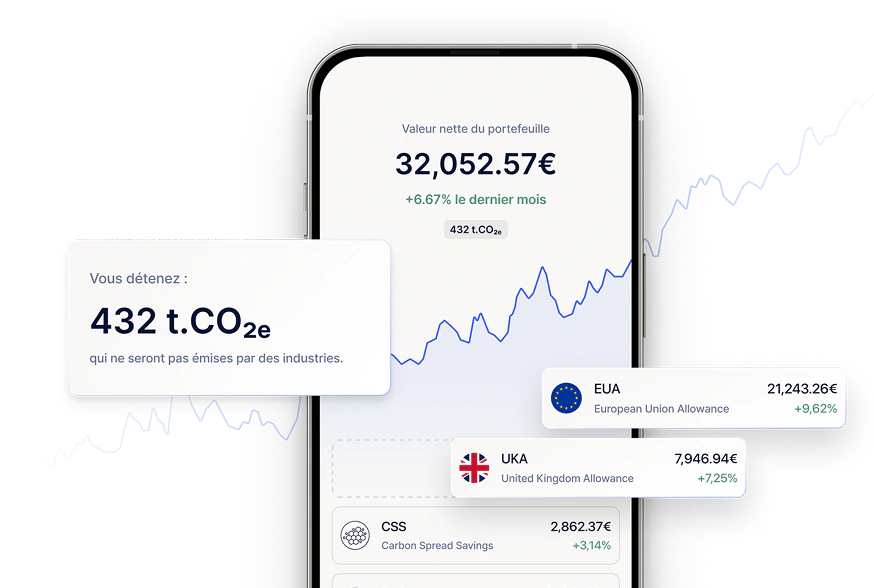
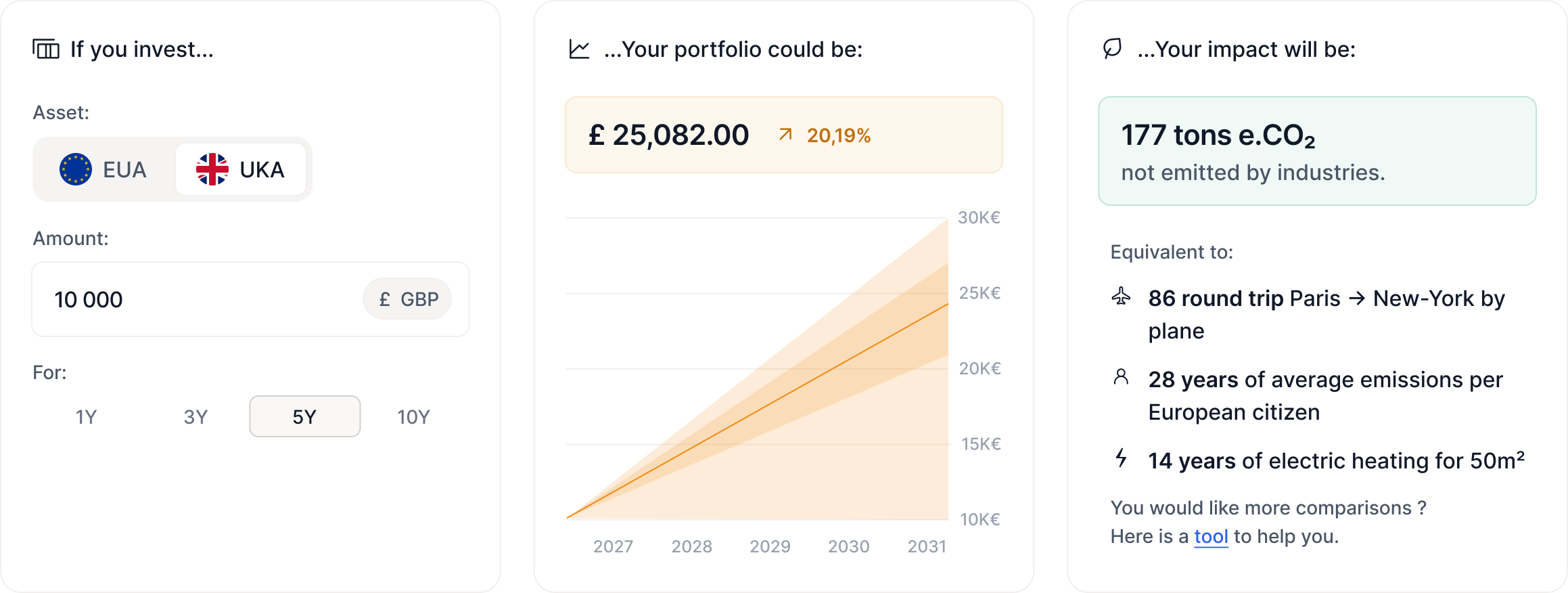
Homaio gives you access to European carbon allowances (EUAs), an asset class that combines potential financial performance with direct climate impact. Diversify your wealth with an asset uncorrelated from traditional markets, accessible from €1,000.