Investing €500 in the stock market in 2026: a practical guide

You’re thinking about taking your first steps into the financial markets with €500 in your pocket, but the idea feels as intimidating as trying to climb a mountain in sandals? It’s a common thought, but deeply mistaken. Far from being anecdotal, this amount is an excellent lever to get familiar with how the stock market works, build good habits, and lay the first stone of financial wealth without taking disproportionate risks.
Putting €500 to work is, above all, an act of learning. It’s an opportunity to understand concretely how fees, volatility, and patience work. The goal is to turn a modest amount of capital into a solid foundation for your financial future by adopting a structured, thoughtful approach.
Fundamental principles before investing €500
Before you even think about buying your first market asset, a few basic rules apply—whether your capital is €500 or €100,000. Skipping these steps means exposing yourself to mistakes that could turn your first experience into a costly disappointment.
Emergency savings: your safety net
The first absolute rule is to have emergency savings. This is a reserve of money that’s immediately available to handle unexpected expenses (car repairs, health costs, etc.). Without this cushion, the slightest setback could force you to sell your investments at the worst possible time.
It’s commonly accepted that this savings should represent between 3 and 6 months of your regular expenses. If you haven’t reached that threshold yet, your €500 will be better placed there. Products like the Livret A or the LDDS are perfect for this: the capital is guaranteed, the money is instantly available, and the interest is tax-free.
Define your goals and your investment horizon
Once your emergency savings are in place, ask yourself the “why” behind this investment.
- What do you want to achieve?
- Prepare a medium-term project (down payment for a purchase, travel)?
- Start building capital for retirement?
- Generate additional long-term income?
Your answer will determine your time horizon. A distant goal (more than 8–10 years) allows you to accept a larger share of risk in exchange for potentially higher returns. A short-term goal (less than 5 years), on the contrary, requires prioritizing safety and liquidity. With €500, the healthiest approach is to target the long term.
Choosing the right tax wrapper: PEA (French equity savings plan) or CTO?
Choosing the account that will hold your investments is a strategic decision, especially to optimize taxes. For a French beginner, two main options are available.
The PEA
The PEA is often the most sensible choice to start investing in European stocks. Its main advantage is its very attractive tax treatment: after 5 years of holding, capital gains are fully exempt from income tax (only the 17.2% social contributions remain due).
With €500, a PEA is ideal. It allows you to invest in a wide range of European stocks and funds (ETFs), which is more than enough to build a diversified portfolio.
The CTO
The CTO is more flexible than the PEA. It has no geographic restrictions, so you can hold stocks from all over the world (US, Asian, etc.) and other types of assets.
However, this flexibility comes at a cost: its tax treatment. Each capital gain is, by default, subject to the flat tax (PFU) of 30% (12.8% tax + 17.2% social contributions). For a small amount of capital, this taxation can quickly eat into your gains. The CTO mainly becomes relevant if you’re targeting specific securities that aren’t eligible for the PEA.
Expert tip
For a first investment of €500, the PEA is the default choice. Its favorable long-term tax treatment is a major advantage that will maximize the performance of your capital, even if modest. Only open a CTO if you have a very specific reason to invest in non-European securities.
Which strategies for a first €500 investment?
The classic beginner’s mistake is to try to “play” the stock market by buying one or two “trendy” stocks. With €500, this approach is almost guaranteed to fail. A single stock can cost more than €500, and even if it doesn’t, your portfolio will severely lack diversification.
The power of ETFs (trackers)
The simplest, most effective, and recommended solution to get started is to use ETFs (Exchange Traded Funds), also called “trackers.” An ETF is an investment fund that replicates the performance of a stock index (such as the CAC 40, the S&P 500, or the MSCI World).
By buying a single unit of an MSCI World ETF, for example, you invest simultaneously in more than 1,500 companies across more than 20 developed countries. You get maximum diversification at minimal cost. It’s the smartest way to spread risk with a small amount of capital. To explore this topic in more depth, you can learn about the differences between stocks and bonds to better understand how these funds are composed.
Scheduled investing (DCA)
Should you invest your €500 all at once or in several installments?
Investing the amount in one go (Lump Sum) exposes you immediately to the market. If the market goes up, great. If it goes down, your portfolio will be negative.
A calmer strategy is scheduled investing, or DCA (Dollar Cost Averaging). It consists of investing fixed amounts at regular intervals (for example, €100 per month for 5 months). This method smooths your entry point: you buy more units when the market falls and fewer when it rises. It’s an excellent way to reduce stress and build savings discipline.
Concrete allocation examples for your €500 portfolio
Here are a few allocation examples to help you visualize how to split €500. These portfolios are provided for educational purposes only and do not constitute investment advice. Your allocation should depend on your own risk profile and goals.
About PEA-eligible ETFs
To invest in global indices like the MSCI World or the S&P 500 via a PEA, you need to choose so-called “synthetic” ETFs. These use financial instruments to replicate the performance of non-European indices while meeting the PEA eligibility criteria. The vast majority of online brokers offer them.
Control fees: the crucial point for small amounts
With €500 of capital, fees can have a devastating impact on your performance. Every euro taken represents a significant percentage of your investment.
Be vigilant on several points:
- Brokerage fees: These are the fees charged by your broker for each buy or sell order. Favor new-generation online brokers that offer very low pricing, or even free trading on certain ETFs.
- Custody fees: Some traditional banks charge fees simply for holding your securities. Avoid them. Online brokers generally don’t apply them.
- ETF internal fees: Each ETF has annual management fees, deducted directly from its performance. They’re generally very low (often between 0.10% and 0.40% per year), but it’s worth comparing them.
A simple €5 brokerage fee on a €100 investment represents 5% of your capital. Your investment therefore has to generate a 5% gain just to cover that fee. That’s why choosing a low-cost broker is fundamental.
Beyond the stock market: diversify to build resilient wealth
Starting with €500 in the stock market is a fantastic step. It’s a learning experience that prepares you to manage larger sums. As your wealth grows, it will become essential to look beyond stocks and bonds to build a truly robust asset allocation.
Traditional markets are often correlated with one another. When a crisis hits, it’s not uncommon to see all stock indices plunge together. That’s why it makes sense to gradually incorporate uncorrelated assets, whose performance is less dependent on the traditional economic cycle.
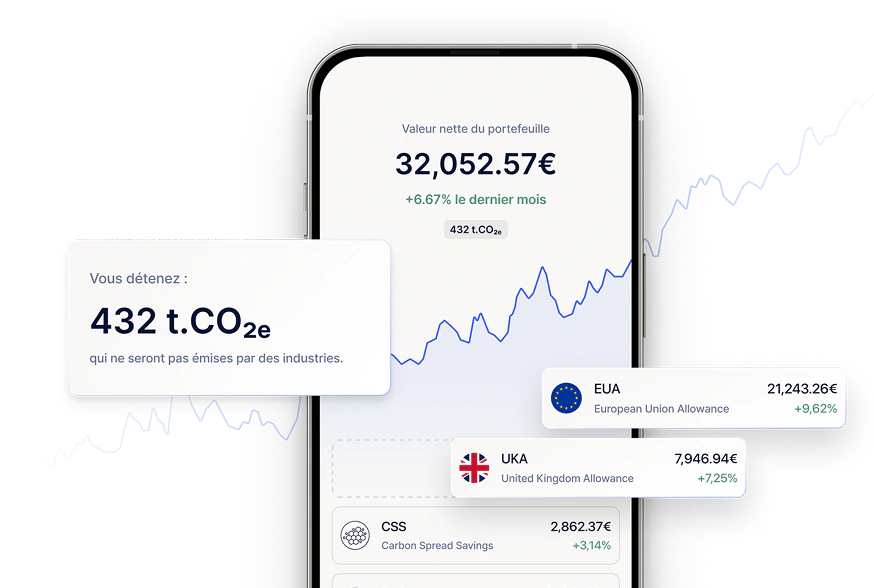
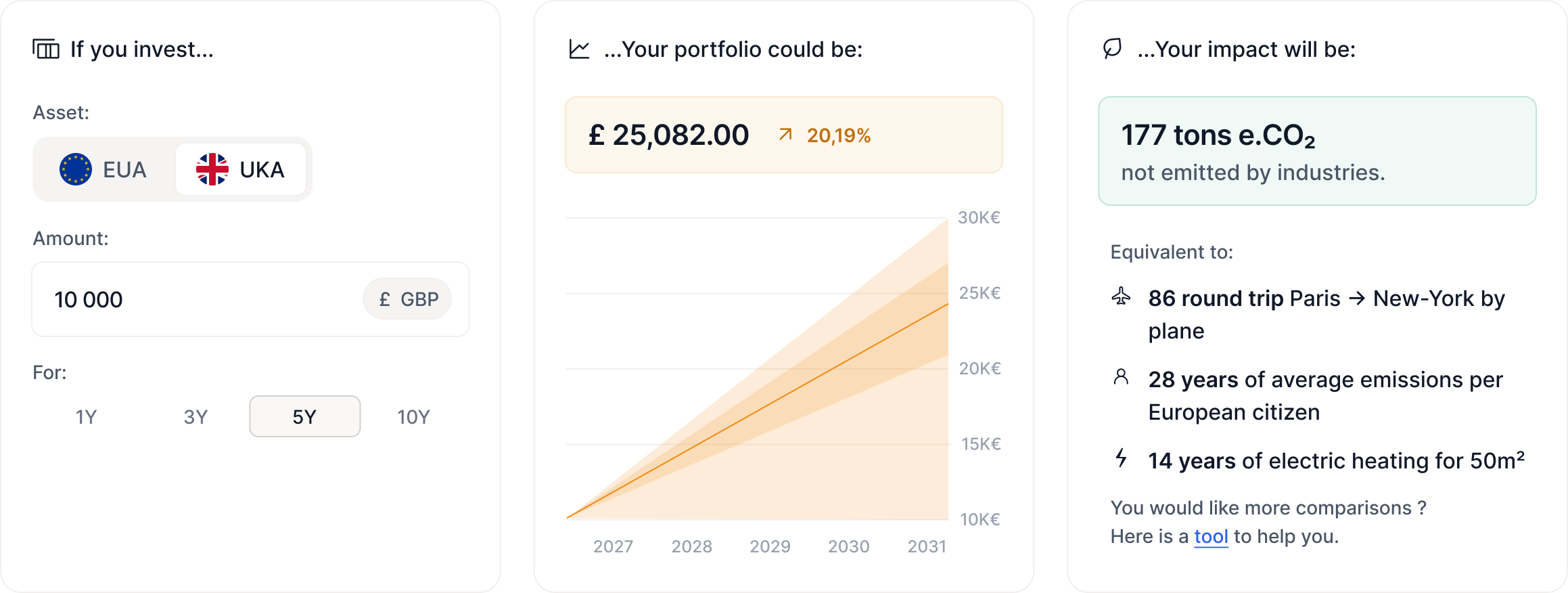
This is where innovative asset classes come into play. For example, investing in climate assets such as European carbon emission allowances (EUA) offers a unique approach. At Homaio, we enable investors to access this regulated market, historically reserved for institutions. By buying and retiring the right to pollute, you exert direct financial pressure on industries to accelerate their decarbonization, while gaining exposure to an asset whose value is primarily driven by European environmental policies.
While the initial investment is higher (from €1,000), it clearly illustrates the next step in diversification: finding profitable and responsible investments that provide both performance potential and tangible impact.
Risk warning
Any investment—whether in the stock market or other asset classes—carries a risk of capital loss. Past performance is not indicative of future results. It is essential to invest only the money you can afford to lose and to fully understand how each product works before getting started.
Investing €500 is much more than a simple financial transaction; it’s the start of a journey. This first step will teach you patience, discipline, and the importance of diversification. By starting small, prioritizing simple and low-cost strategies like ETFs within a PEA, you put all the odds on your side so that this first step becomes the beginning of a long and fruitful wealth-building adventure.
FAQ
Is it really sensible to invest such a small amount as €500?
Absolutely. Starting with €500 helps you get familiar with brokerage platforms, understand market volatility, and build good habits without the psychological pressure that comes with investing large sums. It’s an excellent training ground that can serve as the foundation for a regular investment strategy. Wealth is built brick by brick.
Can I hope to get rich with €500?
You need to be realistic. €500 won’t make you a millionaire overnight. The goal isn’t quick wealth, but rather to get started and benefit from the power of compounding over the long term. If this initial investment is followed by regular contributions, even modest ones, it can turn into meaningful capital after several decades.
What is the best platform to invest €500?
The “best” platform depends on your needs, but for a beginner with a small amount of capital, the key criteria are: zero or very low brokerage fees, no custody fees, and a simple, intuitive interface. Modern online brokers (neo-brokers) are often the best fit, because their cost structures are designed for small investors. Take the time to compare offers before opening your account.
Go further: invest in the carbon market
Homaio gives you access to European carbon allowances (EUAs), an asset class that combines potential financial performance with direct climate impact. Diversify your wealth with an asset uncorrelated from traditional markets, accessible from €1,000.