Investing €1,000 in the stock market in 2026: a step-by-step plan

You have €1,000 set aside and you’re wondering how to grow it beyond your Livret A? That’s an excellent initiative. Far from being a trivial amount, this sum is an ideal springboard for entering the financial markets, getting familiar with how they work, and laying the first stone of a solid wealth-building plan—without taking disproportionate risks.
Investing €1,000 in the stock market isn’t reserved for an elite. Above all, it’s a matter of method, strategy, and patience. By following a clear plan, you can turn this starting capital into a diversified, high-performing portfolio over the long term.
Before investing: the essential prerequisites
Before you begin, two reflection steps are crucial. They determine the relevance of—and your peace of mind throughout—your entire investment approach. Ignoring these fundamentals would be like building a house without foundations.
Do you have an emergency fund?
The golden rule of investing is simple: only invest money you are prepared to lose. The stock market fluctuates, and it is essential not to be forced to sell your positions at the worst possible time to cover an unexpected expense.
Before investing your €1,000, make sure you have an emergency fund. This “emergency fund” should represent 3 to 6 months of your everyday expenses. It should be held in liquid, low-risk vehicles such as the Livret A, the LDDS, or the LEP (if you are eligible). It’s your safety net.
A non-negotiable principle
Think of your emergency fund as the base of your financial pyramid. The stock market and other higher-risk investments come after. Investing the €1,000 meant for a car repair or an unexpected bill is the best way to turn an opportunity into a source of stress.
What is your investor profile?
Your strategy should reflect your personality and your goals. Ask yourself two key questions:
- What is your time horizon? Are you investing for a project in 3 years, 10 years, or for retirement in 30 years? The longer the horizon, the more risk you can generally afford to take in pursuit of higher returns.
- What is your risk tolerance? Could you sleep soundly if your portfolio lost 20% of its value in a few weeks? Your ability to tolerate volatility will define your portfolio allocation.
Generally, there are three main profiles:
- Cautious: You prioritize capital safety and accept lower returns. Your horizon is often short to medium term.
- Balanced: You look for a compromise between performance and risk-taking. You understand that markets fluctuate and you have an investment horizon of at least 5 to 8 years.
- Dynamic: Your goal is to maximize long-term performance. You are willing to accept significant volatility to pursue higher returns.
Choosing the right tax wrapper for €1,000
The tax wrapper is the “container” in which you will hold your investments. Choosing it is strategic because it determines the rules of the game, especially in terms of taxation—which has a direct impact on your net return.
The plan d'épargne en actions (PEA)
For a first investment in European equities, the PEA (French equity savings plan) is often the most relevant tool. It offers a major tax advantage: after 5 years of holding, capital gains are fully exempt from income tax (only social charges of 17.2% remain due).
Accessible with just a few tens of euros, it is perfectly suited to getting started with €1,000 and focusing on European stocks or ETFs (index funds).
The compte-titres ordinaire (CTO)
The CTO is more universal. It has no geographic restrictions, allowing you to invest in stocks from around the world (American, Asian, etc.) and across a wider variety of financial products.
Its flexibility comes at a cost: taxation. Each capital gain is, by default, subject to the Prélèvement Forfaitaire Unique (PFU), or “flat tax,” of 30% (12.8% tax + 17.2% social charges). It’s an option to consider if you are targeting securities that are not eligible for the PEA.
How to allocate €1,000 in the stock market: strategies and examples
With €1,000, the goal is not to make speculative bets, but to build a healthy, diversified foundation. Forget the idea of finding the “next gem” that will do x100. The key to success lies in a structured approach.
The formidable simplicity of ETFs
For a beginner, ETFs (Exchange-Traded Funds), also called “trackers,” are close to perfect instruments. An ETF is a fund that replicates the performance of a stock market index (such as the CAC 40, the US S&P 500, or the global MSCI World index).
By buying a single share of an MSCI World ETF, you invest simultaneously in more than 1,500 companies across more than 20 countries. It’s the simplest and most effective solution to achieve maximum diversification with a small amount of capital. In addition, their management fees are extremely low compared with traditional funds.
Portfolio models with €1,000
Here are examples of simple and effective allocations, achievable via a PEA with ETFs.
*Note: A Nasdaq 100 ETF is not eligible for the PEA. This allocation would require opening a CTO or using an Assurance vie.
One-time investment or regular contributions?
With €1,000, investing in one go (lump sum) is entirely appropriate to gain immediate market exposure. However, for your next contributions, consider a scheduled investing strategy (DCA - Dollar Cost Averaging). By investing a fixed amount (e.g., €100) each month, you smooth your entry price and reduce the impact of market volatility.
The action plan: from idea to execution
In practical terms, here are the steps to make your first investment.
- Choose and open your account: Opt for a well-known online broker recognized for competitive fees. The process of opening a PEA or a CTO is now entirely digital and takes only a few minutes.
- Fund the account: Make a transfer of €1,000 from your bank account to your new investment wrapper.
- Find the right ETF: Each financial product has a unique code, the ISIN. Once you’ve chosen the ETF (for example, an MSCI World ETF), search for it on your broker’s platform using this code to make sure you don’t pick the wrong one.
- Place the buy order: Indicate the number of shares you want to buy. For a first order on a highly liquid ETF, a “market order” (which executes immediately at the best available price) is the simplest option.
- Monitor and be patient: Once the order is executed, you are officially an investor. The last step—and the most difficult—is to let time do its work. Don’t check your portfolio every day, and stay the course with your long-term strategy.
Beyond stocks: diversify with uncorrelated assets
Once you’ve gotten your foot in the stock market door, an smart diversification strategy is to add uncorrelated assets. These are investments whose value does not move in tandem with equity markets, which helps cushion shocks in the event of a downturn.
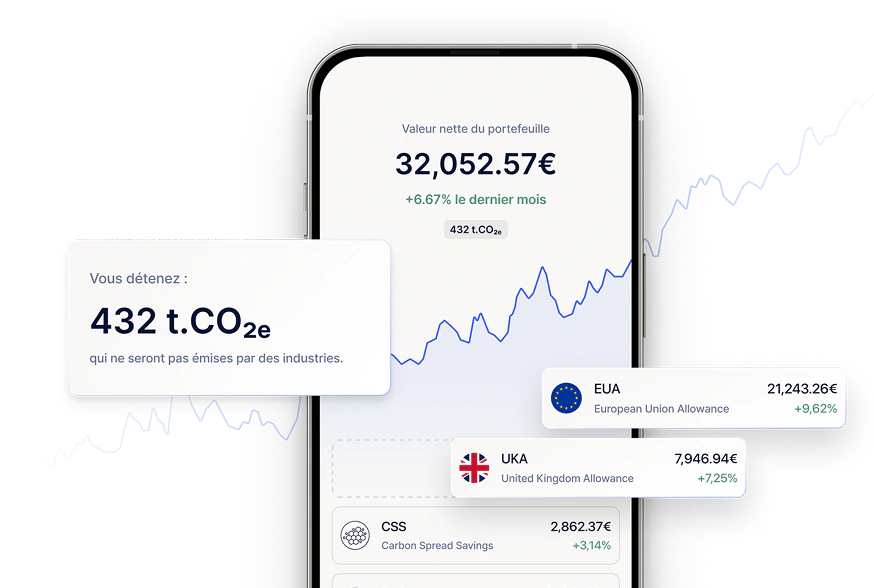
The regulated market for European carbon allowances (EU ETS) is a fascinating example of this new asset class. Historically reserved for industrial players and institutions, it is now accessible to individuals. The principle is simple: in Europe, the most polluting industries must buy “rights to pollute” to offset their emissions. The number of these permits decreases each year, creating upward pressure on their price to encourage companies to decarbonize.
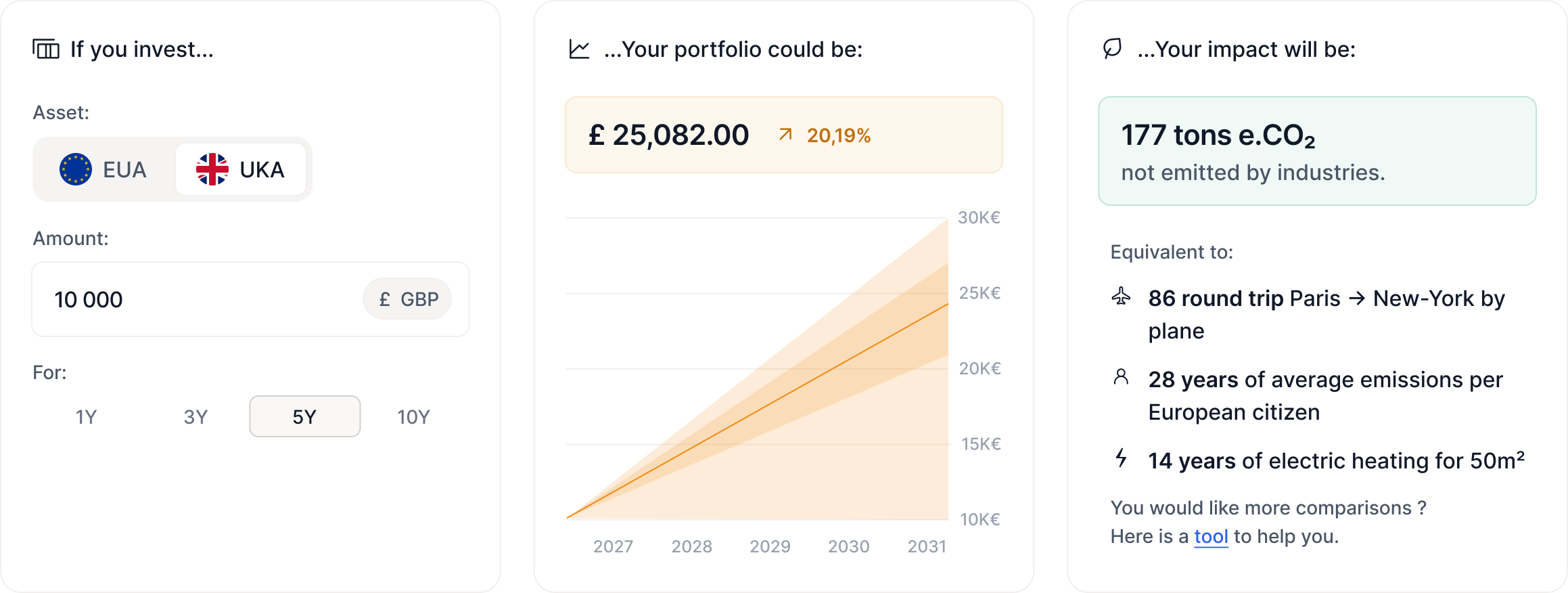
As the first European platform allowing individuals to invest in these carbon allowances, we offer direct access to this impact asset. With a minimum investment set at €1,000, it is possible to allocate part of your capital to an investment that combines two objectives:
- Direct environmental impact: Each allowance purchased via our platform is withdrawn from the market, mechanically reducing the number of permits available to polluters.
- Potential financial performance: The carbon price is driven by European climate regulation rather than the results of CAC 40 companies, offering valuable diversification benefits through low correlation.
Integrating this type of climate asset into your overall strategy can be a relevant way to build a resilient portfolio aligned with strong convictions. It’s one of the options to explore for profitable small investments.
Investing €1,000 in the stock market is a foundational step. It’s the first move that demystifies a world often seen as complex. By adopting a methodical approach, choosing simple tools like ETFs, and keeping a long-term view, you give yourself the best chance of putting your money to work. Patience and discipline will be your best allies in turning this first attempt into real financial success.
FAQ - Investing €1,000 in the stock market
What is the best platform to get started?
For a beginner, online brokers are often the best fit. They offer some of the lowest transaction fees on the market, which is crucial to avoid seeing returns eroded—especially with a €1,000 capital base. Compare offers based on brokerage fees, custody fees (which should be zero), and the usability of the interface.
How long should you keep your money invested?
Equity investing should be approached with a long-term mindset. A 5-year horizon is a minimum, and 8 to 10 years or more is ideal. This timeframe helps smooth market volatility and fully benefit from the power of compound interest. Investing in the stock market for a short-term project is extremely risky.
What are the real risks with €1,000?
The main risk is a loss of capital. The value of your investment can fall, and you could get back less than your initial stake if you sell at the wrong time. However, the risk is limited to the amount invested, i.e., €1,000. By diversifying through a global ETF, you pool risk: the bankruptcy of a single company will have only a minor impact on your overall portfolio.
Can I invest in individual stocks with €1,000?
Technically, yes. However, it is very difficult to achieve sufficient diversification with only €1,000 by buying shares company by company. You would be disproportionately exposed to the health of just a few firms. To get started, ETFs remain the most cautious and effective solution for building a solid portfolio foundation. You can always explore other investment avenues later.
Go further: invest in the carbon market
Homaio gives you access to European carbon allowances (EUAs), an asset class that combines potential financial performance with direct climate impact. Diversify your wealth with an asset uncorrelated from traditional markets, accessible from €1,000.