How to invest €50,000 in 2026: choosing between safety, returns, and time horizon

You have €50,000 in capital and you’re wondering how to make it grow? The first thing to know is that there is no single “best” investment. The ideal investment strategy depends entirely on you: your personal goals, your time horizon, and your risk tolerance.
We do not provide personalized advice, but we give you the keys to understand the options available to you.
How to invest €50,000: the right method before choosing a vehicle
Before looking at financial products, a reflection step is essential. It is what will determine the success of your investment strategy. Ask yourself the three fundamental questions.
Define your goal: safety, a project, income, or retirement
Why do you want to invest this €50,000? The goal defines the strategy.
- Secure your capital: Your priority is not to lose money. You accept a low return in exchange for an almost total guarantee of your capital. This is the role of emergency savings.
- Finance a medium-term project: Buying a primary residence, children’s education, a trip around the world... You need your capital in 3 to 8 years.
- Generate additional income: You are looking to obtain a regular income stream to supplement your salary or pension.
- Prepare for retirement: Your horizon is distant (more than 10 years). You can accept more risk to aim for a higher increase in capital value.
Choose based on your time horizon: short, medium, or long term
The length of time you can lock up your money is a decisive criterion.
- Short term (less than 3 years): The objective is capital preservation. Low-risk and liquid investments (available at any time) should be prioritized.
- Medium term (3 to 8 years): You can start diversifying with a portion in moderately risky investments to seek a better return.
- Long term (more than 8 years): Over this period, more dynamic investments, such as equities, can express their performance potential despite short-term volatility.
Assess your risk level and the portion to keep available
Risk is the counterpart of a higher expected return. It materializes through the possibility of a capital loss. It is crucial to define the level of fluctuation in your investment that you are willing to accept without it affecting your sleep.
Finally, never invest all of your savings. Always keep emergency savings in readily available savings accounts (equivalent to 3 to 6 months of current expenses) to deal with unexpected events.
The best investments for €50,000 depending on your profile
Once your profile is defined, you can explore the different asset classes and investment vehicles. Here is an overview of the most common solutions, classified by level of risk.
Safe investments: savings accounts, term deposits, euro funds
These investments are designed for those who prioritize absolute capital safety.
- Regulated savings accounts (Livret A, LDDS): The capital is guaranteed by the French state. Funds are available immediately and interest is exempt from taxes and social charges. Their ceilings and interest rates are set by public authorities.
- Term deposits: You lock up a sum of money for a fixed period (from a few months to several years) in exchange for an interest rate known in advance. The capital is guaranteed.
- Euro funds (via assurance vie): This is the secure component of assurance vie. The capital is guaranteed by the insurer (excluding entry fees). The return is generally a little higher than that of savings accounts, but the funds are subject to social charges each year.
Balanced investments: diversified assurance vie, bonds, cautious ETFs
For a medium-term horizon, a blend of safety and performance is often sought.
- Multi-support assurance vie: This wrapper makes it possible to combine euro funds (secure) and unit-linked investments (UC) invested in financial or real estate markets. The split between these two buckets makes it possible to adjust the level of risk. Warning: capital invested in UC is not guaranteed.
- Bonds: By buying a bond, you lend money to a state or a company, which commits to repay you on a specific date and to pay you interest (coupons). The main risk is issuer default.
- Cautious ETFs: ETFs (or trackers) are funds that replicate the performance of a stock market index. Some ETFs are made up of a mix of equities and bonds with a cautious allocation, limiting volatility. They carry a risk of capital loss.
More dynamic investments: equity ETFs, indirect real estate, SCPI
These vehicles are intended for investors with a long horizon and a higher risk tolerance.
- Equity ETFs: Invested via a Plan d'Épargne en Actions (PEA) or a securities account, they provide exposure to the performance of global equity markets at lower fees. They are highly volatile and carry a significant risk of capital loss.
- Indirect real estate (SCPI): Sociétés Civiles de Placement Immobilier make it possible to invest in a rental real estate portfolio (offices, retail, etc.) and receive regular income. Liquidity is low and the unit value can vary. Income and capital are not guaranteed.
Comparison table of the main investments
To help you visualize the options, here is a summary of the characteristics of each major investment family. Expected return is only an indication and is never guaranteed for risk-bearing vehicles.
Examples of allocating €50,000
These allocations are theoretical examples and do not constitute advice. They illustrate how to allocate €50,000 across different risk profiles, including a safety bucket.
Conservative profile
Objective: Preserve capital above all, accept a modest return.
- Emergency savings (Livret A/LDDS): €10,000 (20%)
- Euro funds (assurance vie): €30,000 (60%)
- Conservative unit-linked investments (bond ETFs, SCPI via assurance vie): €10,000 (20%)
Balanced profile
Objective: Seek a balance between capital safety and the pursuit of long-term performance.
- Emergency savings (Livret A/LDDS): €5,000 (10%)
- Euro funds (assurance vie): €15,000 (30%)
- Global equity ETFs (via PEA or assurance vie): €20,000 (40%)
- SCPI (directly or via assurance vie): €10,000 (20%)
Dynamic profile
Objective: Maximize long-term capital growth, accepting high volatility.
- Emergency savings (Livret A/LDDS): €5,000 (10%)
- Euro funds (assurance vie): €5,000 (10%)
- Global equity ETFs (via PEA): €35,000 (70%)
- Diversification investments (e.g., SCPI, Private Equity): €5,000 (10%)
Risk warning
The balanced and dynamic profiles include a significant portion of investments that carry a risk of capital loss. The value of these investments may fluctuate down as well as up, and you may not recover your entire initial investment.
How much can €50,000 invested earn?
It is impossible to predict future returns with certainty. However, we can run cautious simulations to illustrate the potential gain.
Examples of annual and monthly returns by vehicle
These figures are gross assumptions, before fees and taxes, and are in no way guaranteed.
Important reminder: Past performance is not indicative of future performance.
Why net return depends on fees, taxation, and risk
The stated (gross) return is not what you actually receive. To calculate your net gain, you need to deduct:
- Fees: Entry fees, annual management fees, transaction fees... They vary enormously from one product to another and can significantly impact performance.
- Taxation: On capital gains and income, you must pay social charges (17.2%) and income tax (depending on your marginal tax bracket or via the Prélèvement Forfaitaire Unique of 12.8%, i.e., 30% in total). Some wrappers such as the PEA or assurance vie offer reduced taxation after a certain holding period.
Mistakes to avoid before investing €50,000
Investing is a marathon, not a sprint. Here are a few common traps to avoid.
Chasing the best return without looking at liquidity
An investment that advertises a very high return may hide low liquidity. This is the case with real estate or SCPI, where reselling your units can take several weeks or months. Make sure the lock-up period for your money is compatible with your plans.
Investing everything in the same place
The old saying “don’t put all your eggs in one basket” is a pillar of investing. Diversification (varying investment types, geographic exposure, asset classes) helps reduce the overall risk of your portfolio. If one segment underperforms, others can offset it.
Neglecting emergency savings and fees
Not having a safety cushion is the worst mistake. If an unexpected event occurs, you would be forced to sell your investments at the wrong time, potentially at a loss. Likewise, annual management fees of 2% on an investment that earns 5% cut your performance by 40%. Always compare fees.
FAQ: investing €50,000
What is the best investment for €50,000?
There is no single answer. The best investment is the one that matches your goals (preparing for retirement, buying real estate...), your investment horizon (3, 5, 10 years or more), and your risk tolerance. The best strategy is often to diversify by combining several investments.
What income can you get with €50,000?
Generating significant income with €50,000 is difficult. As a purely indicative example, €50,000 invested with a net return of 4% per year would generate €2,000 per year, or about €167 per month. For a life annuity (paid until death), a market simulation suggests that €50,000 could be converted into an annuity of about €440 per month after 20 years of saving (with an assumed return of 5% and a conversion rate of 4%), but this figure depends on many factors (age, life expectancy, contract terms).
Where to invest a large sum of money without risk?
The investments considered the least risky are those where capital is guaranteed. In France, these are mainly regulated savings accounts (Livret A, LDDS), whose capital is guaranteed by the state, and the euro funds of assurance vie contracts, guaranteed by insurers. In exchange, their return is very low, often below inflation.
How to invest €50,000 as safely as possible?
Absolute safety does not exist in investing. To invest €50,000 with maximum safety, you should prioritize capital-guaranteed vehicles (savings accounts, euro funds). It is also prudent to spread this amount across several vehicles and institutions to diversify guarantees (for example, the Fonds de Garantie des Dépôts et de Résolution covers bank deposits up to €100,000 per client per institution).
How to invest €50,000 in the short term?
For a short-term project (less than 3 years), the priority is to preserve capital and ensure that funds are available. The most suitable solutions are savings accounts (Livret A, LDDS), taxable bank savings accounts (“super savings accounts”), and term deposits. They offer low returns but maximum safety and liquidity.
Investing €50,000 in real estate: is it a good idea?
Investing €50,000 directly in rental real estate is often difficult, as this amount generally represents the down payment for a more expensive property. A more accessible alternative is indirect “paper real estate” via SCPI, which allow you to buy units in a real estate portfolio. It is a long-term investment, not very liquid, and it involves risks (a drop in unit value, rental vacancy).
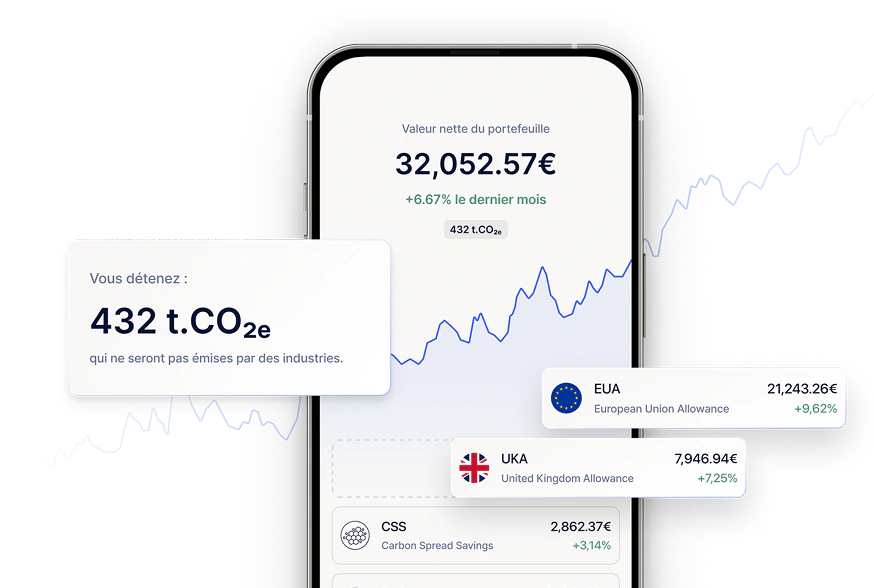
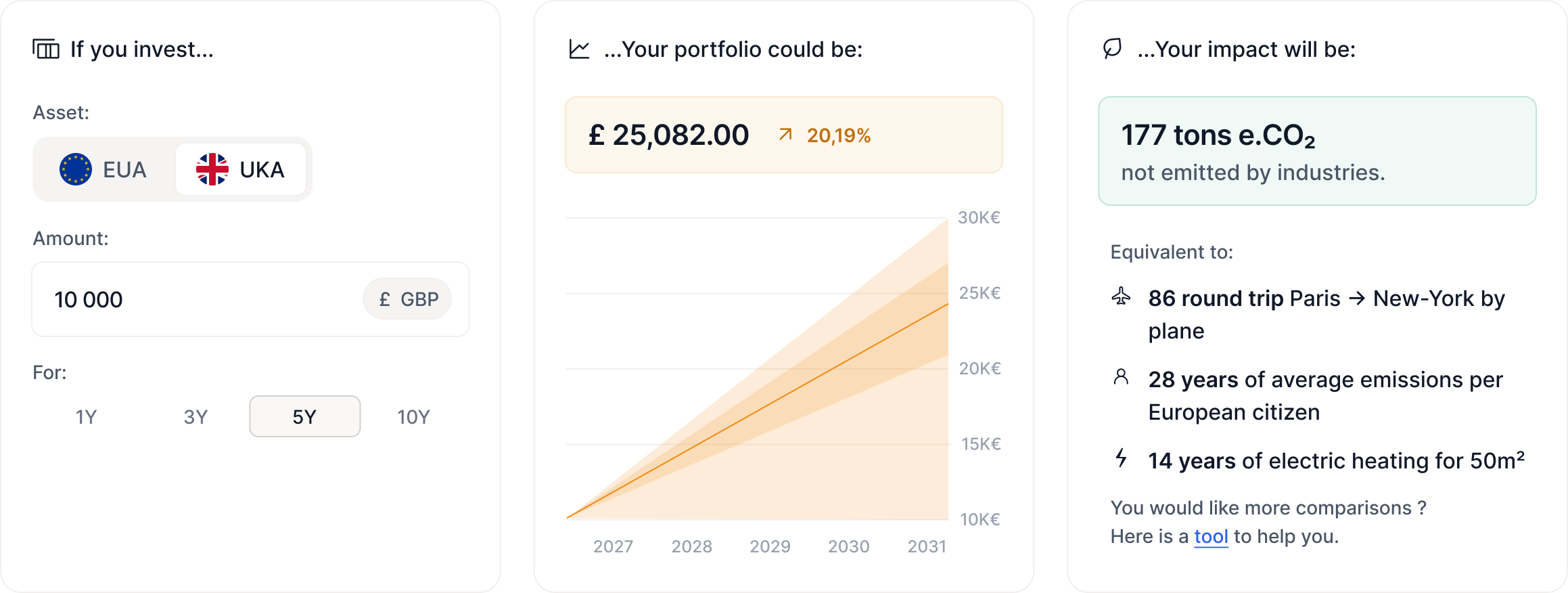
Go further: invest in the carbon market
Homaio gives you access to European carbon allowances (EUAs), an asset class that combines potential financial performance with direct climate impact. Diversify your wealth with an asset uncorrelated from traditional markets, accessible from €1,000.