How to invest €20,000 in 2026: choices by time horizon, risk and goals

Investing €20,000 is an important step to build or diversify your wealth. There is no single solution, because the ideal investment depends entirely on your personal goals, your time horizon and your risk tolerance. The best approach is to define a clear strategy before choosing financial products.
A diversified strategy can include secure savings accounts for the short term, life insurance in euro funds for caution, and a Plan d’Épargne en Actions (PEA) (French equity savings plan) with ETFs to target higher long-term returns. The key is to spread this amount across different asset classes to balance safety, potential return and access to funds.
The method to invest €20,000 well: 3 essential criteria
Before asking yourself which product to choose, the first step is to define the framework for your investment. A good allocation always stems from thinking about three fundamental pillars.
1. Your investment time horizon
This is the length of time during which you can tie up your money without needing it.
- Short term (less than 3 years): The main goal is preserving capital for a defined project (real-estate down payment, buying a car, travel). Safety and liquidity take priority over return.
- Medium term (3 to 8 years): You can accept a moderate share of risk to seek a return higher than inflation, while keeping an accessible exit option.
- Long term (more than 8 years): The goal is to grow capital significantly, for example for retirement or wealth transfer. You can afford to invest in more volatile assets like equities, because time smooths market fluctuations.
2. Your risk tolerance
Risk is the trade-off for higher potential returns. It is crucial to assess the level of loss you are willing to accept psychologically and financially.
An investment with no risk of capital loss, such as the Livret A, offers limited returns. Conversely, investing in the stock market can generate much higher performance, but exposes you to sometimes significant drops in value.
3. Your liquidity needs
Liquidity refers to how easily and quickly you can get your money back without loss of value. An emergency fund must be perfectly liquid. A retirement investment can be much less so.
Overview of investments for €20,000 based on your goal
Once your profile is defined, you can explore the different wrappers and investment vehicles. Here is a selection of the most common options, grouped by objective.
Goal: safety and short term — savings accounts and secure funds
If you plan to use your €20,000 within 1 to 3 years, the priority is to protect your capital.
- Regulated savings accounts (Livret A, LDDS): Capital is guaranteed, funds are available immediately, and interest is exempt from income tax and social levies. The Livret A cap is €22,950, so you can place your entire €20,000 there. This is the basic solution for emergency savings.
- Term Accounts (CAT): You lock up your money for an agreed period (from a few months to several years) in exchange for an interest rate set in advance, often higher than savings accounts. Liquidity is lower.
- Money market funds: Accessible via a securities account or life insurance, these funds invest in very short-term debt instruments. Their return follows central bank policy rates and they carry very low capital risk.
Goal: cautious medium term — life insurance in euro funds
Life insurance is a versatile wrapper. For a cautious profile, the preferred option is the euro fund.
The capital invested in a euro fund is guaranteed by the insurer (excluding entry fees). It offers a moderate but stable return. It is an excellent alternative to savings accounts for a medium-term horizon, especially since it benefits from favorable taxation after 8 years of holding. With €20,000, you can open a contract and benefit from this tax holding period.
Life insurance: much more than a euro fund
A life insurance contract is called "multi-support" because it also allows you to invest in more dynamic unit-linked funds (UC) (equities, real estate, etc.). It is an ideal tool to adjust your allocation over time without changing products.
Goal: long-term performance — the PEA, stocks and ETFs
To target significant capital growth over more than 8 years, equity markets have historically been the best-performing asset class.
- The Plan d’Épargne en Actions (PEA): This is the most attractive tax wrapper for investing in the stock market. After 5 years, capital gains are exempt from income tax (only the 17.2% social levies remain due).
- ETFs (Exchange Traded Funds): Also called "trackers", these are funds that replicate the performance of a stock market index (such as the CAC 40 or the MSCI World). They let you instantly diversify your investment across hundreds of companies at low cost. An MSCI World ETF is often recommended for getting started.
Investing €20,000 in the stock market via a PEA in a World ETF is a simple and effective long-term strategy.
[image alt="Diagram illustrating the diversification of a €20,000 investment portfolio across equities, bonds and real estate."]
Goal: real estate diversification — SCPI ("paper real estate")
Investing directly in rental real estate with €20,000 is difficult. "Paper real estate" offers an accessible solution.
Sociétés Civiles de Placement Immobilier (SCPI) pool the savings of many investors to buy and manage a diversified property portfolio (offices, retail, warehouses...). In return, you may receive rental income in proportion to your investment.
Advantages of SCPI:
- Accessible from a few hundred euros.
- Management delegated to professionals.
- Risk is spread across many properties and tenants.
Points to watch:
- Entry fees are often high (around 10%).
- Limited liquidity: reselling units can take time.
- Income is not guaranteed and depends on economic conditions.
A portion for diversification assets (with caution)
Some more speculative assets can be included in a very small portion (5% maximum of your portfolio) if you understand the risks.
- Gold: Considered a safe haven, it can protect a portfolio during crises but generates no income. Investing in gold can be done via coins, bars or specialized funds (ETC).
- Crypto-assets: Extremely volatile, they offer very high upside potential but also a risk of total loss. This investment should be limited to a minimal share of your savings and to experienced investors.
Comparison table of investments for €20,000
Examples of €20,000 allocations for three profiles
These allocations are provided for illustrative purposes only and do not constitute investment advice. They must be adapted to your personal situation.
Cautious profile
Goal: preserve capital with a slight return.
- €10,000 (50%): Euro fund (via life insurance).
- €8,000 (40%): Regulated savings accounts (Livret A / LDDS) for emergency savings.
- €2,000 (10%): SCPI for diversification and potential income.
Balanced profile
Goal: a compromise between capital growth and risk control.
- €8,000 (40%): World ETF (via a PEA).
- €8,000 (40%): Euro fund (via life insurance).
- €4,000 (20%): SCPI.
Dynamic profile
Goal: maximize long-term performance while accepting high volatility.
- €14,000 (70%): World equity ETFs and/or thematic ETFs (via a PEA).
- €4,000 (20%): SCPI for diversification.
- €2,000 (10%): Euro fund for the safety bucket.
[image alt="Pie chart showing the allocation of a dynamic €20,000 portfolio, with the majority in ETF equities."]
What are the 5 traps to avoid to protect your savings?
Investing €20,000 is an opportunity, but mistakes can be costly. Here are the most common ones.
- Putting all your eggs in one basket: Diversification is the golden rule. Don’t invest everything in a single stock, a single SCPI or a single sector.
- Chasing the "deal of a lifetime": Promises of very high returns often hide extreme risks or scams. A realistic investment won’t make you "rich with €20,000" in one year.
- Forgetting fees: Entry, management, exit fees... they can eat into a significant share of your performance. Always compare fees before choosing a product.
- Ignoring taxation: A 5% gross return can quickly turn into 3.5% net after taxes. Optimize taxation by using wrappers such as the PEA or life insurance.
- Reacting emotionally to market moves: Panic-selling during a downturn is often the worst decision. Long-term investing requires keeping a cool head and sticking to your initial strategy.
Watch out for inflation
An investment that earns 2% while inflation is at 3% makes you lose purchasing power. Your goal should always be to target a net return (after fees and taxes) higher than inflation to truly build wealth.
Frequently asked questions (FAQ)
What is the best investment for €20,000?
There is no universal "best" investment. The optimal choice depends on your profile:
- For safety: Savings accounts (Livret A) and euro funds within life insurance.
- For long-term returns: A PEA invested in a World ETF.
- For additional income: SCPI.
The best strategy is often to combine several of these solutions.
What is the most profitable investment right now?
Historically, stocks have been the most profitable asset class over the long term. However, "profitable" is always synonymous with "risky". Past performance does not guarantee future performance, and an investment that performs very well one year can suffer heavy losses the next.
Where is the best place to invest €20,000?
To invest as well as possible, start by defining your goals. If you need this money in the short term (less than 3 years), prioritize secure investments like savings accounts. If your horizon is more than 8 years, a diversified allocation across a PEA (for equities), life insurance (for euro funds) and SCPI (for real estate) is a balanced approach.
How much do €20,000 invested earn per month?
The monthly gain depends entirely on the investment’s annual return. Here are illustrative simulations (gross, before fees and taxes):
- With a 2% annual return: €400 per year, or about €33 per month.
- With a 4% annual return: €800 per year, or about €67 per month.
- With a 7% annual return: €1,400 per year, or about €117 per month.
These figures are theoretical averages. Returns, especially for equities, are neither linear nor guaranteed.
Can you become rich with €20,000?
This amount is an excellent starting point for building wealth, but it is not enough to "become rich" overnight. The key is patience and the power of compound interest: by reinvesting gains each year over a long period, your capital can grow exponentially. €20,000 invested at 7% per year would become more than €78,000 in 20 years, without any additional contributions.
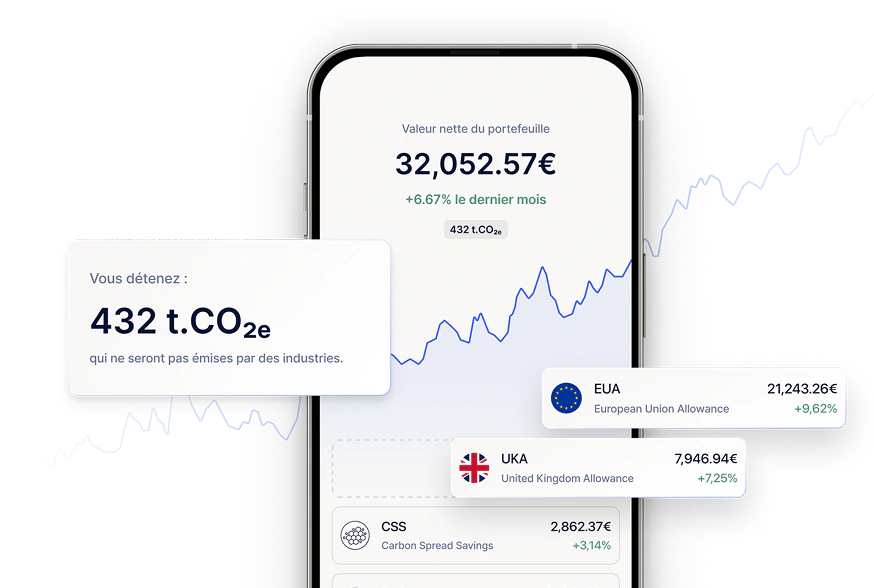
Go further: invest in the carbon market
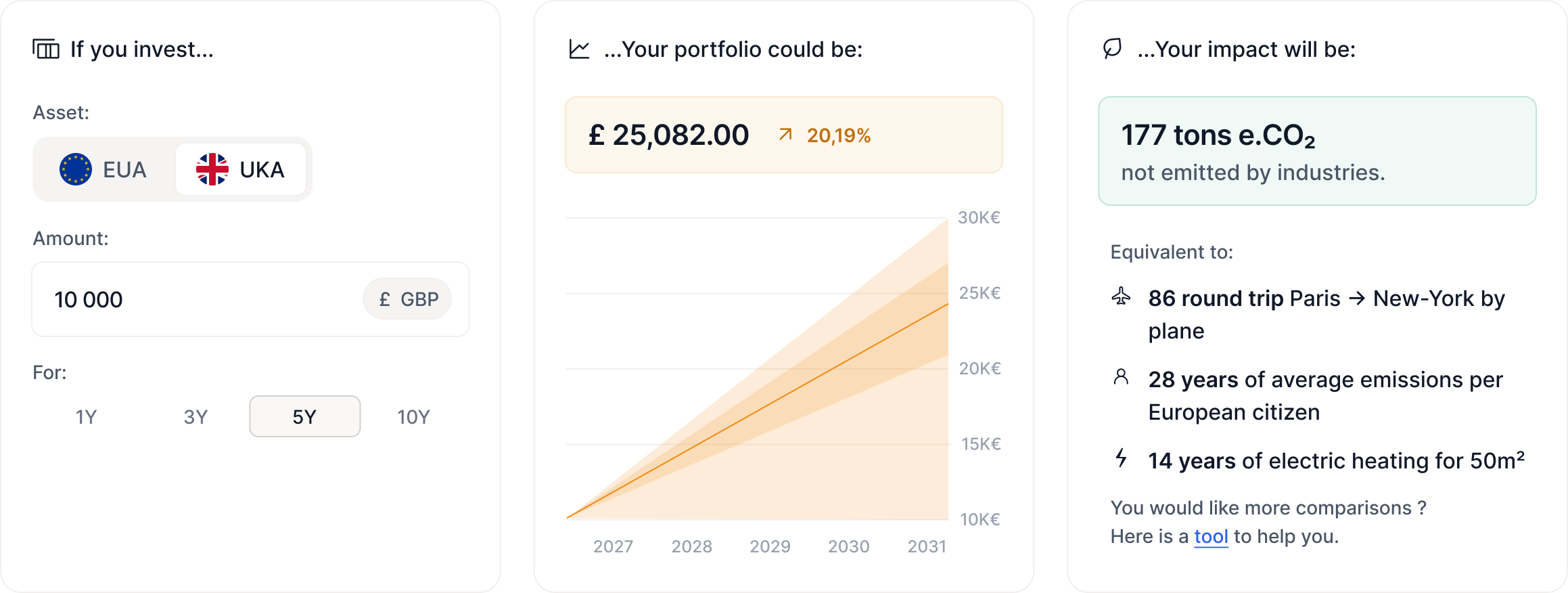
Homaio gives you access to European carbon allowances (EUAs), an asset class that combines potential financial performance with direct climate impact. Diversify your wealth with an asset uncorrelated from traditional markets, accessible from €1,000.