Planning Ahead for 2026 – How a PEA Works: rules and contribution limits

Looking to boost your savings while optimizing your long-term tax position? The Plan d’Épargne en Actions (PEA) is often presented as the ultimate solution for investing in the stock market. But how does this wrapper actually work, beyond the promise of tax advantages?
The PEA is much more than a simple securities account. It’s a regulated savings product, a structure designed by the French state to encourage investment in the European economy. While it may seem complex at first glance, its mechanisms are in fact logical and accessible, even for a beginner investor. Understanding how it works is the first step to making the most of it.
What is the Plan d’Épargne en Actions (PEA)?
The PEA is a tax wrapper that allows you to acquire and manage a portfolio of shares in European companies while benefiting from a particularly attractive tax framework, especially after a certain holding period.
Its primary goal, since it was created in 1992, is to channel household savings into financing companies across the continent. It is not a miracle product, because equity investing always involves a risk of capital loss. It should therefore be considered with a long-term perspective.
Contrary to a common misconception, the PEA isn’t only for finance experts. It’s a powerful and flexible tool that can suit different profiles, from passive investors who delegate management to active investors who pick their own securities.
The PEA’s internal mechanism: a closed system
To fully understand how the PEA works, you need to understand its dual structure. The plan is made up of two inseparable compartments that work in perfect synergy:
- The cash account: This is the entry and exit point of your PEA. It receives your cash contributions (bank transfers, cheques). It also collects the day-to-day proceeds of your portfolio: dividends paid by companies, capital gains realized when selling securities. Funds are taken from this account to buy new assets.
- The securities account: This is the safe of your PEA. It holds all the securities you’ve purchased: shares, fund units, ETFs, etc. These assets are kept there and their value fluctuates with financial markets.
This “closed system” is one of the PEA’s biggest strengths. As long as cash stays inside the wrapper (in the cash account), you can sell securities, receive dividends, and reinvest those amounts without triggering any taxation. Taxation only comes into play when you decide to withdraw money from the plan.
Who can open a PEA, and under what conditions?
Eligibility rules for the PEA are simple and clearly defined by law. To open a plan, you must meet three main conditions:
- Be an adult individual.
- Have your tax residence in France.
- Not already hold a PEA.
The principle is strict: one PEA per person. A married couple or partners in a PACS can, however, hold two—one each. Since the 2019 Pacte law, an exception exists for young people aged 18 to 25 who are still attached to their parents’ tax household: the PEA Jeunes.
Key date to remember
The tax “age” of your PEA, which determines its benefits, does not start on the date the contract is signed, but on the date of the very first contribution, even a minimal one. This is crucial information for your long-term strategy.
The different types of PEA and their contribution limits
There isn’t just one PEA, but several types—each with its own features and limits.
One fundamental point to master concerns the limits. These amounts do not limit the total value of your portfolio, but only the cumulative amount of your contributions.
For example, if you contribute 150 000 € to your standard PEA, you reach the limit and can no longer make new contributions. However, if thanks to your investments’ performance the value of your plan reaches 250 000 €, you are fully compliant. Capital gains are not included when calculating the limit.
Also note that the limits for the standard PEA and the PEA-PME are linked. An investor can combine both, but total contributions across the two wrappers cannot exceed 225 000 €.
Which securities can be held in a PEA?
The PEA is designed to support the European economy. As a result, eligible assets are strictly regulated:
- Shares and similar securities: Shares, investment certificates, SARL units... in companies whose registered office is in a Member State of the European Union or the European Economic Area (Norway, Iceland, Liechtenstein).
- Collective investments (OPC): Units of funds (FCP) or SICAV invested at a minimum of 75 % in shares and securities of eligible European companies.
- Trackers (ETFs): These index funds are also eligible if they comply with the same 75 % exposure rule to European assets.
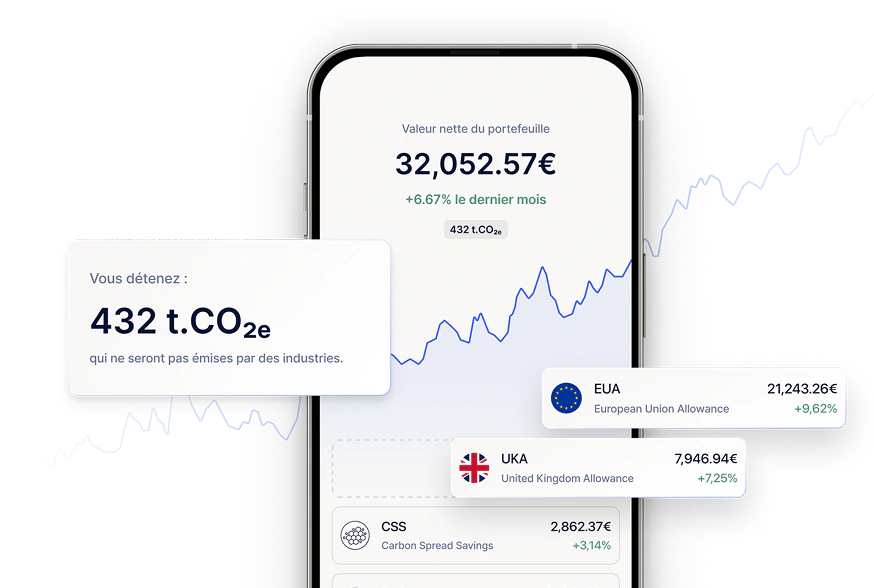
This geographic focus is a constraint, but also a philosophy. It makes the PEA an excellent tool for gaining exposure to equity markets in the Old Continent. For global diversification, it must be complemented by other wrappers (such as the ordinary securities account) or other asset classes. A modern investment strategy can, for example, combine exposure to traditional equities via a PEA with an allocation to uncorrelated assets linked to the carbon markets for a more resilient portfolio aligned with environmental challenges.
Brexit and eligibility
Since the United Kingdom’s withdrawal from the European Union, securities of British companies are no longer eligible for the PEA. Holders of such securities had to sell them or transfer them to an ordinary securities account.
PEA taxation: the importance of the 5-year threshold
This is where the PEA shows its full potential. The taxation of your gains depends entirely on how long you have held the plan, with one magic threshold: 5 years.
Tax treatment before 5 years of holding
If you make a withdrawal before the fifth anniversary of your plan, there are two consequences:
- Automatic closure of the PEA: Any withdrawal, even partial, results in its definitive closure.
- Taxation of gains: Your net capital gains are subject to the Prélèvement Forfaitaire Unique (PFU), or “flat tax”, at a rate of 30 % (12,8 % income tax + 17,2 % social contributions).
There are cases where income tax is exempt (but not social contributions) for early withdrawals linked to major life events (dismissal, disability, etc.).
Tax treatment after 5 years of holding
After 5 years, capital gains in your PEA are fully exempt from income tax. Only social contributions of 17,2 % remain due on the gains portion of your withdrawal.
In addition, the Pacte law introduced considerable flexibility: a withdrawal after 5 years no longer closes the plan. You can continue to top it up with new contributions (within the limit), making it an extremely flexible wealth-management tool to prepare for a project, supplemental income, or retirement.
Patience is a tax strategy
Market history teaches us that volatility is a constant. The PEA’s 5-year rule isn’t just a constraint—it’s an incentive to adopt a long-term view. Resisting the temptation of an early withdrawal doesn’t only protect you from closure; it allows you to benefit from one of the most powerful tax advantages available to individuals, turning 12,8% of potential taxes on your gains into growth capital.
Managing your PEA day to day
You can open a PEA with a bank, an online broker, or an insurer (for a PEA assurance). Beyond choosing the institution—which will depend on fees and services—you will need to choose a management approach.
- Self-directed management: You are in full control. You choose the securities yourself and place your buy and sell orders. This option offers total freedom but requires time, knowledge, and good emotional discipline.
- Managed (discretionary) management: You delegate management of your portfolio to professionals. They handle asset allocation according to your risk profile. It’s a comfortable solution for those who do not want to—or cannot—be actively involved.
It’s also worth knowing that a PEA is not a lifetime commitment to one institution. You can transfer your PEA from one bank to another. This operation, although sometimes lengthy, is tax-neutral: you keep the age of your plan, which is essential. The different approaches to investing can help guide you in choosing your strategy.
The PEA is a marathon, not a sprint. Its mechanics—based on time and a gradually improving tax treatment—make it a cornerstone for anyone looking to build long-term wealth by investing in the European economy. Its flexibility after 5 years makes it a first-class wealth tool. A thorough understanding of its rules is the key to making optimal use of this exceptional scheme.
FAQ
What’s the difference between the contribution limit and the PEA’s value?
The contribution limit (for example, 150 000 € for a standard PEA) is the maximum total amount of money you can deposit into your plan. The PEA’s value, on the other hand, is the sum of the cash account and the market value of your securities account at a given time. This value can far exceed the limit thanks to capital gains, without creating any regulatory issue.
Does a withdrawal before 5 years always close the PEA?
Yes, as a general rule, any withdrawal (even 1 €) before the 5th anniversary of your plan triggers automatic closure and taxation of gains. However, there are exceptions, notably in the case of creating or taking over a business within 3 months following closure, or for certain “life accidents” (disability of the holder, their spouse or PACS partner, dismissal, etc.).
Can you hold US stocks or cryptocurrencies in a PEA?
No. The PEA is strictly reserved for securities of companies whose registered office is located in the European Union or the European Economic Area. US, Asian, or any other non-EEA stocks, as well as other assets such as commodities or cryptocurrencies, are excluded. To invest in these asset classes, you need an ordinary securities account or specialized platforms.
What happens if the PEA holder dies?
The holder’s death automatically closes the PEA on the date of death. The cash and securities it contains are included in the estate. Gains accumulated since the plan was opened are fully exempt from income tax, but remain subject to social contributions. The heirs will receive the cash or the securities, which can then be held in their own accounts.
Go further: invest in the carbon market
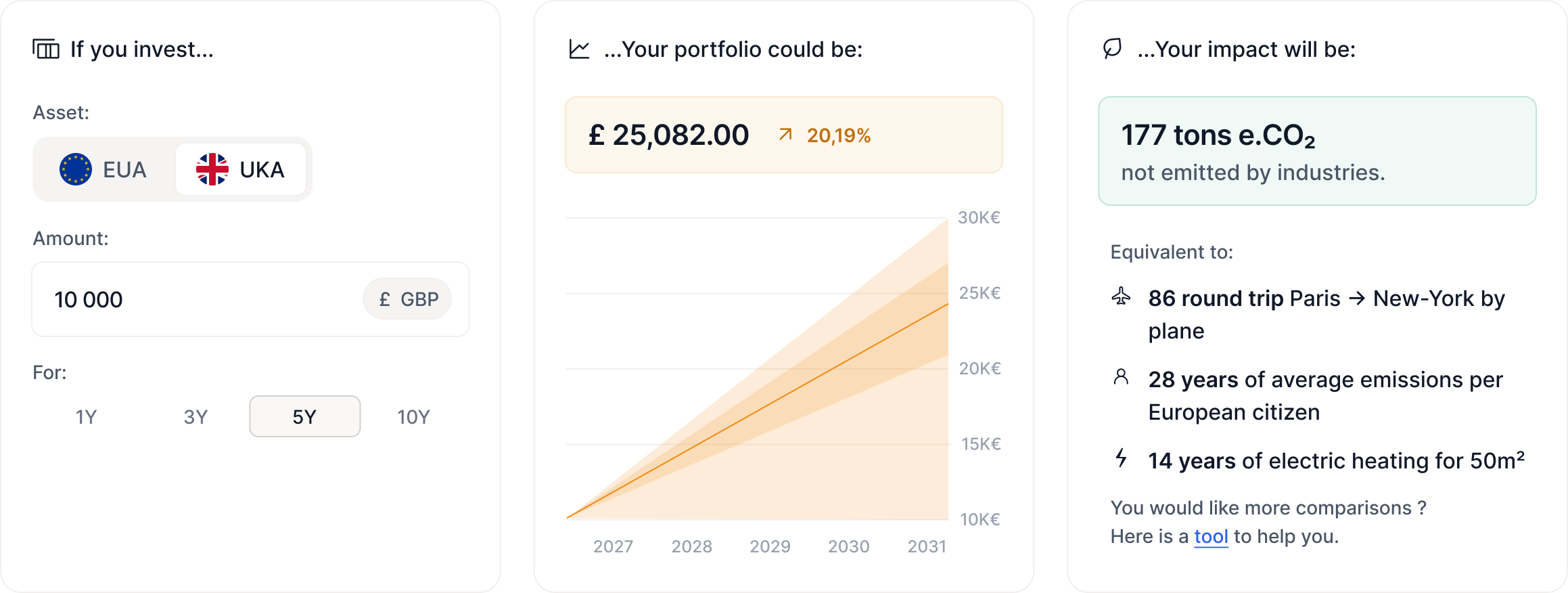
Homaio gives you access to European carbon allowances (EUAs), an asset class that combines potential financial performance with direct climate impact. Diversify your wealth with an asset uncorrelated from traditional markets, accessible from €1,000.