Efficient Frontier: a simple guide for retail investors

In finance, finding the perfect balance between expected return and accepted risk is a constant quest. The efficient frontier is a powerful theoretical concept that provides a framework for thinking about how to achieve it.
Far from being a magic formula, it is a tool that helps visualize the best possible combinations of investments to build a diversified portfolio.
Let’s break down this fundamental concept together—its origin, its usefulness, and above all its limitations in the real world.
Efficient frontier: a simple definition
The efficient frontier is a curve that graphically represents the set of investment portfolios offering the best expected return for a given level of risk.
In other words, for a certain level of risk you are willing to accept, there is, in theory, no portfolio that can offer better performance than those located on this “frontier”.
All portfolios located below this curve are considered “sub-optimal” because they offer either lower returns for the same risk, or more risk for the same return.
Be careful not to confuse
The term “Efficient Frontier” refers to a financial theory. It is also used as a brand name for certain products, notably life insurance (Assurance vie) contracts. This article deals only with the theoretical concept and not a specific product.
Harry Markowitz’s theory in a few words
The efficient frontier is the cornerstone of the Modern Portfolio Theory, developed by economist Harry Markowitz in 1952—a body of work that earned him the Nobel Prize in Economics.
Markowitz’s revolutionary idea was simple but profound: don’t judge an asset solely on its own merits (its individual risk/return trade-off), but on its contribution to the overall risk and return of a portfolio.
His key contribution was to demonstrate mathematically that it is possible to reduce a portfolio’s overall risk without sacrificing return, by combining assets that do not move in the same way. This is the power of portfolio diversification.
How to read the relationship between risk and return
In finance, risk and return are inseparable. Generally, the higher the potential gain of an investment, the higher the risk of loss as well. “Risk” is often measured by volatility, i.e., the magnitude of changes in an asset’s price.
The efficient frontier is represented on a chart:
- The horizontal axis (X) measures risk (volatility).
- The vertical axis (Y) measures expected return.
Each point on this chart corresponds to a combination of assets—i.e., a portfolio. The curve formed by the best possible portfolios is the famous efficient frontier.
What is an efficient portfolio?
A portfolio is said to be “efficient” if it lies on the efficient frontier. This means it meets one of these two conditions:
- It maximizes expected return for a defined level of risk.
- It minimizes risk for a given level of expected return.
In short, it is an optimized portfolio. There is no “waste”: each unit of risk taken is, in theory, rewarded with the best possible potential gain.
Why diversification can reduce risk
The magic of diversification relies on the notion of correlation. Correlation measures how two assets move relative to each other.
Imagine you only sell ice cream. Your business thrives in summer but collapses in winter. Now, if you also sell hot chocolate, whose sales surge in winter, you smooth your income over the year. Your two activities are “uncorrelated”.
In finance, it’s the same principle. By combining assets that are weakly or negatively correlated (when one rises, the other tends to stagnate or fall), losses in some can be offset by gains in others. The overall portfolio thus becomes less volatile, and therefore less risky, than if you had invested in only one type of asset.
What are the main asset classes?
To build a diversified portfolio, investors allocate their capital across different “families” of investments, called asset classes. Each has its own risk and return profile.
Diversification is not only about buying several stocks, but about investing across different asset classes.
Stocks, bonds, cash, alternative assets
The four major traditional asset classes are:
- Stocks: Shares in a company’s equity. They offer the highest long-term return potential, but also the highest volatility.
- Bonds: Debt securities issued by a government or a company. They are generally less risky than stocks and act as a “shock absorber” in a portfolio.
- Cash (or money market): Current accounts, savings accounts, money market funds. Risk is almost zero, but returns are very low, often below inflation.
- Alternative assets: This very broad category includes real estate, commodities, private equity, as well as more recent assets such as carbon allowances. They provide additional sources of diversification.
What role do ETFs play in a diversified allocation?
For a retail investor, buying dozens of individual stocks and bonds can be complex and costly. ETFs (Exchange-Traded Funds), also called “trackers”, are very useful tools to simplify this process.
An ETF is a fund that replicates the performance of a stock market index (such as the CAC 40 or the S&P 500). By buying a single ETF share, you instantly invest in hundreds, or even thousands, of different companies.
They make it easy and low-cost to access broad diversification within the same asset class (stocks, bonds) or within a geographic area.
A concrete example of allocation and trade-offs between assets
Let’s take a simplified example, without specific numbers, to illustrate the trade-off.
Imagine two portfolios:
- Conservative Portfolio: Composed mostly of government bonds and a small portion of stocks in large, stable companies.
- Growth-Oriented Portfolio: Composed mostly of growth stocks and alternative assets, with a small portion of bonds.
The Conservative portfolio would sit on the lower-left part of the efficient frontier: its risk and expected return are low. The Growth-Oriented portfolio would be on the upper-right: higher risk and higher expected return.
Neither is “better” in absolute terms. The choice depends entirely on the investor’s profile. This is the very essence of the trade-off: choosing the point on the frontier that matches one’s own balance between the pursuit of performance and tolerance for volatility.
Limitations of the efficient frontier in practice
Markowitz’s theory is a pillar of modern finance, but it is not perfect. It is crucial to understand its limitations in order to use it as a thinking framework rather than an absolute truth.
A model, not a crystal ball
The efficient frontier is calculated from past data. Yet past performance does not predict future performance. Relationships between assets can change abruptly, especially during crises.
Model assumptions and uncertain data
The model relies on several assumptions that are rarely met in reality:
- The data are uncertain: The calculations require estimating future returns, volatilities, and correlations. These estimates are inherently imprecise and can vary significantly.
- Investors are rational: The model assumes decisions are made solely on the basis of risk and return, ignoring emotions such as fear or greed, which play a major role in practice.
- Correlations are not stable: In the event of a major financial crisis, it is often observed that all risky asset classes tend to fall at the same time. Diversification then temporarily loses some of its effectiveness.
Why two investors can choose different portfolios
Even if the efficient frontier were perfect, it would not dictate a single “best portfolio” for everyone. It offers a menu of optimal portfolios.
The final choice depends on personal factors:
- Risk tolerance: Your psychological ability to withstand market declines.
- Time horizon: A young investor with 30 years ahead can afford more risk than someone nearing retirement.
- Financial goals: Preparing for retirement, buying a property, or funding your children’s education are goals that call for different strategies.
Each investor will therefore choose the point on the frontier that best matches their situation and personal sensitivity.
FAQ on the efficient frontier
What is the efficient frontier?
The efficient frontier is a theoretical curve in finance that represents all portfolios offering the highest expected return for a given level of risk. It is a visual tool for identifying the most optimized combinations of assets.
What is an efficient portfolio?
An efficient portfolio is a combination of investments that lies on the efficient frontier. This means there is no other portfolio offering a higher return for the same level of risk, or a lower risk for the same level of return.
What are the 4 asset classes?
The four main asset classes are:
- Stocks (shares in companies).
- Bonds (debt securities).
- Cash (cash and money market investments).
- Alternative assets (real estate, commodities, etc.).
What is Harry Markowitz’s theory?
Harry Markowitz’s Modern Portfolio Theory, for which he received a Nobel Prize, is the idea that an investment should not be assessed in isolation but for its contribution to the overall risk and return of a portfolio. It shows that diversification by combining weakly correlated assets makes it possible to reduce overall risk without necessarily sacrificing performance.
Warning: This article is provided for informational and educational purposes only. It does not constitute investment advice, a recommendation to buy or sell, or a solicitation. All investments involve risks, including the risk of loss of capital. Past performance does not guarantee future results.
Go further: invest in the carbon market
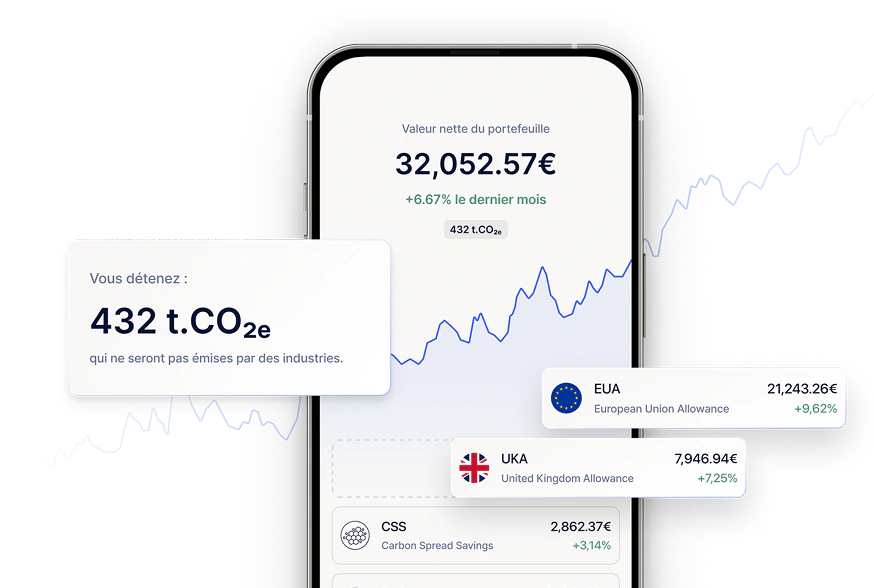
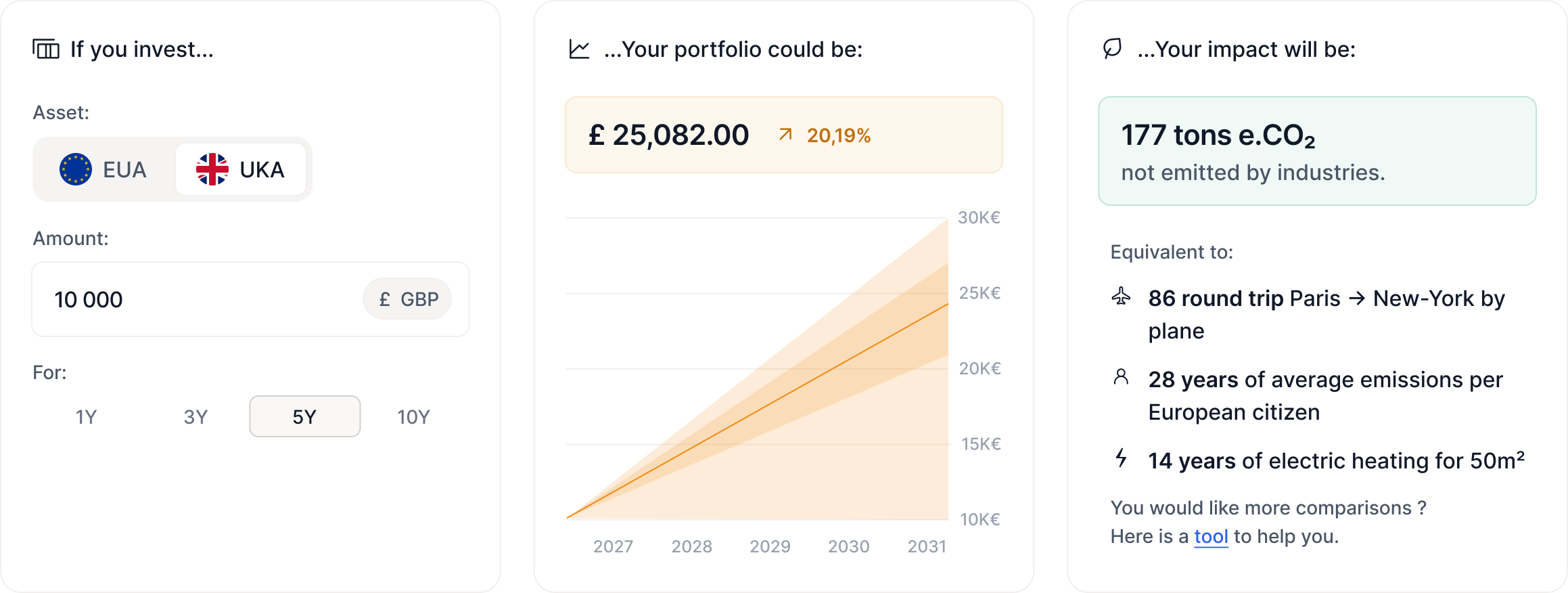
Homaio gives you access to European carbon allowances (EUAs), an asset class that combines potential financial performance with direct climate impact. Diversify your wealth with an asset uncorrelated from traditional markets, accessible from €1,000.