CAC 40 companies: essential 2026 guide

Do you often wonder what the rise or fall of the CAC 40 announced every evening on the TV news really means? Beyond a simple green or red number, this index is the true pulse of France’s largest companies and, by extension, a powerful mirror of our globalized economy.
Understanding the companies that make it up means deciphering the dynamics that shape not only financial markets, but also our day-to-day lives—from our savings to employment. Let’s dive behind the scenes of this must-watch barometer of the Paris Stock Exchange.
What is the CAC 40? Definition and role
The CAC 40, whose acronym means Cotation Assistée en Continu, is the main stock market index of the Paris marketplace, managed by the operator Euronext. It is not a share you can buy directly, but an indicator that summarizes the performance of a basket of 40 carefully selected stocks.
Launched on 31 December 1987 with a base of 1,000 points, it was created in a context of modernizing financial markets, just after the October 1987 crash. Originally, CAC stood for “Compagnie des Agents de Change,” recalling the old organization of the Stock Exchange before brokerage firms took over. Today, its name reflects its nature: its value is calculated and published continuously every 15 seconds, from 9:00 to 17:30, during market opening days.
Its role is twofold. On the one hand, it serves as a barometer of the economy. The overall trend of the CAC 40 is often interpreted as a sign of investor confidence—or lack of confidence—in the economic outlook for major French companies. On the other hand, it is a reference point (benchmark) for fund managers and savers, who can compare the performance of their own investments with that of the index.
How are companies selected for the CAC 40?
Joining the very exclusive CAC 40 club is the result of a rigorous selection process, ensuring that the index remains representative of the flagships of the French economy listed on Euronext Paris.
Selection and weighting criteria
The selection of the index’s 40 members is overseen by an independent scientific council of Euronext. Several key criteria are analyzed to determine which companies deserve their place:
- Free-float market capitalization: This is the most important criterion. It is not the company’s total value, but the value of shares actually available on the market and accessible to the public. Stakes held by the State, founding families, or other companies in a strategic and lasting way are excluded from this calculation. A high free float ensures that the share price truly reflects the market’s view.
- Share liquidity: For a company to be in the CAC 40, its shares must be traded very actively and in large volumes. Strong liquidity ensures that investors can buy or sell shares easily without disproportionately influencing the price.
- Sector representativeness: The scientific council ensures the index offers a diversified overview of the economy. It therefore covers major sectors such as finance, luxury, energy, industry, healthcare, and technology.
Each company’s weighting in the index is then proportional to its free-float market capitalization. As a result, the biggest companies such as LVMH, L’Oréal, or TotalEnergies have a much greater impact on the CAC 40’s movements than the index’s smaller constituents.
Revisions to the composition
The life of a stock market index is not set in stone. To ensure it remains relevant, the CAC 40’s composition is reviewed every quarter. During these reviews, the scientific council analyzes recent months’ market data and may decide to remove a company that no longer meets the criteria and replace it with another that is more successful or more representative.
These “musical chairs” are closely watched by investors, because an entry into or exit from the CAC 40 has major consequences, especially for index funds (ETFs) that must adjust their portfolios accordingly.
What is the list of CAC 40 companies?
The composition of the Paris Stock Exchange’s flagship index reflects the strengths of the French economy, with a strong presence of luxury, industry, finance, and energy.
Here is the list of the 40 companies that currently make up the CAC 40 (this list is subject to quarterly changes):
How can you find the up-to-date list?
The CAC 40’s composition changes. To view the most recent list and real-time data, it is recommended to refer to official sources such as the Euronext stock market operator’s website or trusted financial portals.
Why is the CAC 40 important for you?
Far from being a topic reserved for finance experts, movements in the CAC 40 have tangible effects on the lives of millions of French people, often indirectly.
A barometer of the national economy
Even though its limitations are real, the index remains a leading indicator of economic health. A sustained rise in the CAC 40 signals investor confidence in large companies’ ability to generate profits, invest, and hire. Conversely, a prolonged drop can foreshadow an economic slowdown.
The performance of these 40 giants feeds through the entire economy via their investments, their orders placed with thousands of subcontractors (often SMEs), and the wages they pay. Their financial health therefore has a direct impact on the national economic fabric.
Its impact on your savings
You are probably more connected to the CAC 40 than you think. A large share of French people’s savings is invested, at least partially, in shares of companies in the index through very common products:
- Assurance vie in unités de compte: many contracts offer funds invested in European equity markets, where CAC 40 companies occupy a prominent place.
- Savings plans (PEA (French equity savings plan), PEE, PER): these tax wrappers are designed for investing in equities, and CAC 40 stocks often form the core of the portfolio.
- Index funds (ETFs or trackers): these increasingly popular investment products make it possible to replicate the CAC 40’s performance simply and at lower cost. By buying a share of a CAC 40 ETF, you invest simultaneously in the index’s 40 companies.
So when the CAC 40 rises, the value of your savings is very likely to follow the same trend—and the opposite in the event of a decline.
Beyond the index: investing with a vision
While the CAC 40 provides a snapshot of established economic giants, modern investors are increasingly turning toward assets that not only seek performance, but also deliver tangible change. Impact investing, particularly in areas such as climate finance, opens up a new path.
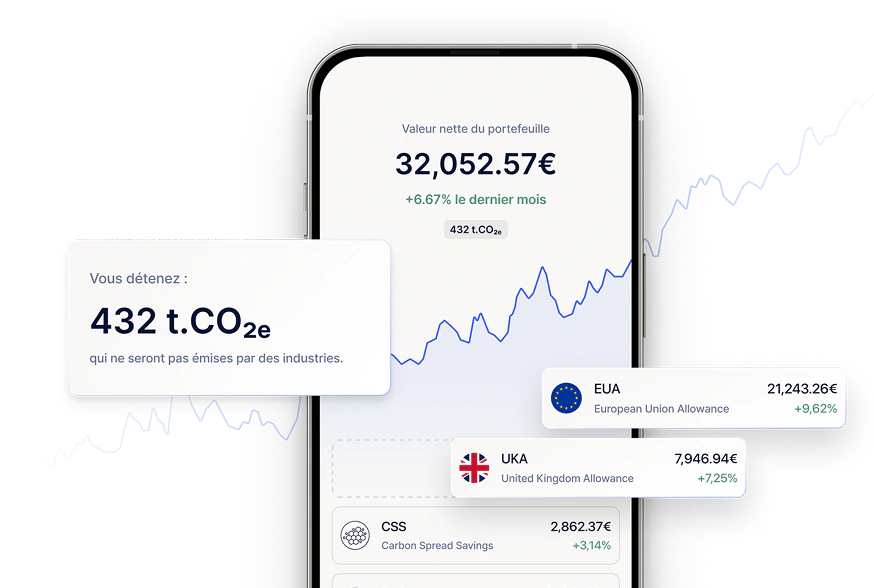
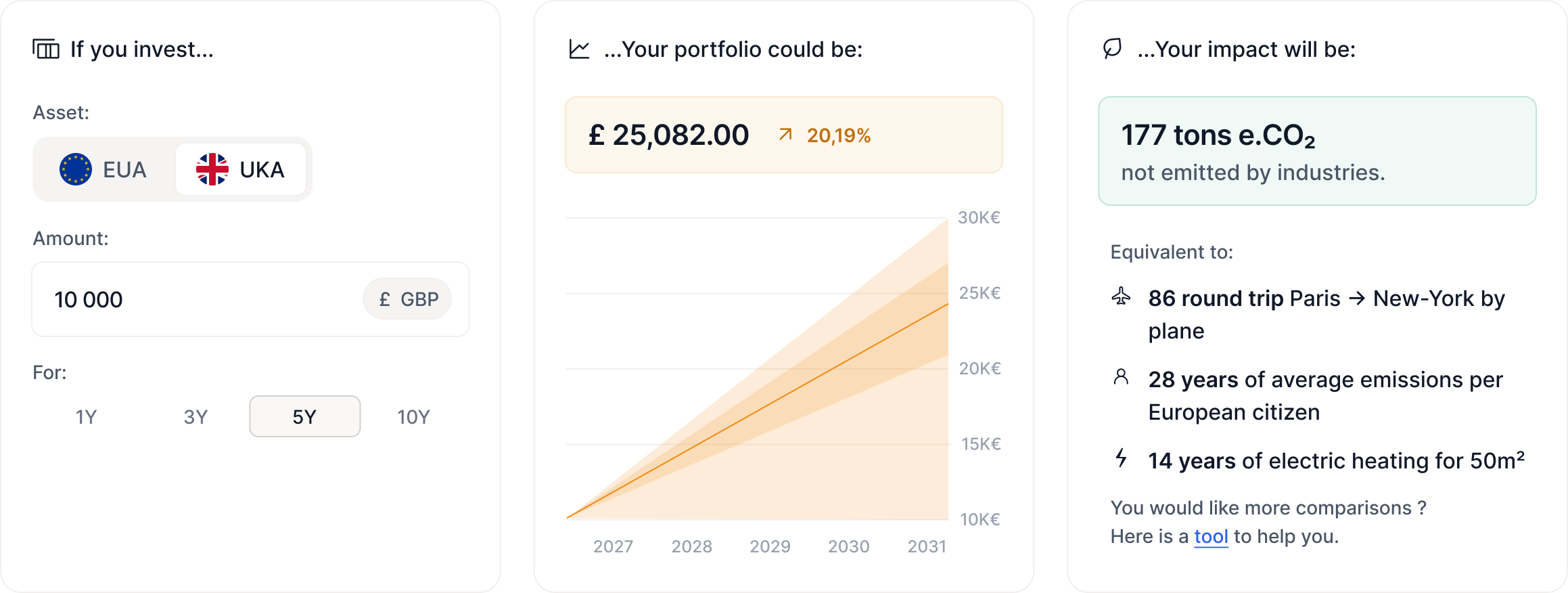
Rather than gaining exposure to a diversified but “generalist” basket of shares, it is now possible to target assets whose very mechanism contributes to environmental goals. For example, instead of investing in a CAC 40 company that communicates about its transition, why not invest directly in the mechanism that forces it to do so? That is the proposition of platforms like Homaio, which is democratizing access to the regulated market for European carbon allowances.
This financial asset, historically uncorrelated with traditional equity markets, is directly linked to the carbon price that industrial players (many of which are part of the CAC 40) must pay for their emissions. By enabling individuals to buy and retire these allowances from the market, this type of investment increases the financial pressure on polluters, encouraging them to accelerate their decarbonization. It is a way to align one’s portfolio with long-term issues, moving from being a spectator to being an agent of change.
Expert tip: think diversification and decorrelation
Stock market history teaches us a crucial lesson: diversification is the only protection against unpredictability. During the 2008 crisis, while equity indices were plunging, certain uncorrelated assets showed remarkable resilience. That is why exploring alternative markets, such as regulated carbon allowances, is not just a trend, but a fully fledged risk-management strategy. Be careful: any diversification must be thought through and adapted to your profile, because past performance never guarantees future results.
Limitations and criticisms of the CAC 40
Despite its importance, it is essential to keep in mind that the CAC 40 is not a perfect reflection of the French economy. It has several significant biases:
- High internationalization: Most CAC 40 companies are multinationals that generate a large share of their revenue abroad. Their performance therefore depends more on global conditions than on French domestic consumption. The CAC 40 can thus rise while the French economy stagnates, and vice versa.
- Under-representation of SMEs: The index completely ignores the economic fabric of small and medium-sized enterprises (SMEs) and ETIs (Entreprises de Taille Intermédiaire), which are nevertheless the main employers in France and engines of innovation.
- Ignoring dividends: The CAC 40 index (mnemonic code: PX1) most often discussed in the media does not take into account dividends paid by companies to their shareholders. To measure the true performance of a long-term investment, you need to look at the CAC 40 GR (Gross Return) index, which reintegrates gross dividends. Over several years, the performance gap between the two is considerable.
In conclusion, while CAC 40 companies are pillars of our economic landscape, the index itself must be interpreted with nuance. It is a powerful tool—an indicator of trends among the largest market capitalizations—but it does not, by itself, capture the complexity and richness of the French economy.
For investors, it represents a base and a reference, but building resilient wealth aligned with one’s values encourages looking beyond, toward new asset classes that address tomorrow’s challenges—particularly that of the ecological transition.
FAQ
What are the 40 CAC 40 companies?
The list of the 40 CAC 40 companies is shown in the table above. It includes global leaders across varied sectors such as luxury (LVMH, Kering, Hermès), energy (TotalEnergies, Engie), banking (BNP Paribas, Société Générale), aerospace (Airbus, Safran), and healthcare (Sanofi). It is important to note that this composition is reviewed quarterly and may change.
How is the CAC 40 calculated?
The CAC 40 is a free-float market-cap weighted index. This means each company’s weight in the index depends on the value of shares that can be freely traded on the market. Its value is updated every 15 seconds during Paris Stock Exchange opening hours, reflecting in real time the price movements of the 40 shares that make it up.
Does the CAC 40 really reflect the French economy?
It is a partial and skewed reflection. It represents the financial health of the 40 largest companies listed in France, most of which are multinationals highly exposed to global markets. It therefore does not take into account the performance of SMEs, ETIs, and unlisted companies, which nevertheless make up the bulk of the economic fabric and employment in France.
How can you invest in the CAC 40?
It is not possible to buy the “CAC 40 index” directly. However, a retail investor can easily gain exposure to its performance in several ways. The most common is to buy shares of an ETF (Exchange Traded Fund), also called a “tracker.” This investment fund passively replicates the composition and performance of the index at very low fees. These products are available via a compte-titres, a PEA, or certain assurance-vie contracts. Before any investment, it is advisable to consult a financial advisor.
Go further: invest in the carbon market
Homaio gives you access to European carbon allowances (EUAs), an asset class that combines potential financial performance with direct climate impact. Diversify your wealth with an asset uncorrelated from traditional markets, accessible from €1,000.