Best investments for seniors in 2026: security and returns

Once you retire, managing your wealth takes on a new dimension. How can you preserve your hard-earned capital, generate additional income to enjoy your best years, and calmly prepare the transfer to your loved ones?
Faced with a universe of financial options, every decision becomes strategic. It is no longer about taking disproportionate risks, but about building an intelligent asset allocation that combines security, controlled returns, and tax optimization.
The challenge is to find the right balance—the one that matches your life goals, your family situation, and your personal sensitivity.
Define your wealth strategy before choosing
There is no universal solution. The ideal investment for your neighbor will not necessarily be yours. The first step—essential—is to clearly define your personal roadmap based on specific criteria.
Key criteria: risk profile, time horizon, and objectives
As you get older, your perception of risk changes. Your investment horizon shortens, and the main objective often becomes preserving capital. The ability to withstand temporary losses decreases, because there is less time to see markets recover after a sharp drop.
Most seniors therefore move toward a defensive or moderate risk profile. This does not mean giving up all returns, but rather prioritizing stability and consistency.
Ask yourself the right questions:
- What is your liquidity need? Do you need to be able to access part of your savings quickly in case of an unexpected event (health, repairs)?
- What is your main objective? Are you looking to obtain regular additional income, to grow your capital to pass it on, or simply to protect it from inflation?
- What is your tolerance for fluctuations? Are you willing to accept slight volatility to aim for a better return, or would the slightest drop keep you up at night?
The most common wealth objectives
Your answers to these questions will outline your strategy. Seniors generally pursue one or more of the following objectives:
- Obtain supplemental income to maintain your standard of living.
- Prepare the transfer of your wealth to your children and grandchildren within a tax-optimized framework.
- Protect your spouse in the event of death.
- Anticipate potential loss of autonomy and the associated costs.
- Enjoy your capital to carry out projects (travel, leisure) without depleting it excessively.
Only once these objectives are clarified does the choice of investment vehicles become relevant.
Traditional investments favored by seniors
Certain financial products are particularly well suited to retirees’ needs, thanks to their security, flexibility, or tax advantages.
Assurance vie: the Swiss Army knife of senior savings
A favorite investment of the French, Assurance vie is a must-have multipurpose tool. It makes it possible to combine security, performance, and wealth transfer. An Assurance vie contract mainly consists of two types of holdings:
- Euro funds: Capital is guaranteed. They offer maximum security, ideal for the portion of your savings you do not want to expose to any risk.
- Unit-linked funds (UC): Capital is not guaranteed. They allow you to invest across various markets (equities, bonds, real estate) to aim for a higher return, in exchange for the risk of loss.
The key advantage of Assurance vie lies in its inheritance tax treatment.
- For payments made before age 70, each named beneficiary benefits from an allowance of 152 500 €. Capital transferred through this wrapper therefore largely escapes standard inheritance tax.
- For payments after age 70, the total allowance is 30 500 € (all beneficiaries combined), but the gains generated are fully exempt.
The age-70 threshold is psychological
Many savers think you should no longer contribute to an Assurance vie after 70. This is a mistake. Even if the allowance is lower, it remains a significant advantage compared with normal inheritance tax. In addition, capital gains remain fully exempt, making it an excellent tool to continue growing your wealth.
Real estate: paper real estate and innovative solutions
Real estate remains a safe haven, but direct management can be burdensome. For seniors, more flexible solutions exist.
The Sociétés Civiles de Placement Immobilier (SCPI) allow you to invest in a diversified real estate portfolio (offices, retail, healthcare) with no management hassle. You buy units and receive potential rental income, net of fees.
A particularly smart strategy is splitting ownership of SCPI units.
- Buying the usufruct: You pay only a fraction of the unit price (for example, 60%) and receive 100% of the rents over a defined period (5 to 10 years). This is an excellent solution to generate substantial additional income.
- Buying the bare ownership: You pay a discounted price (for example, 40% less) and receive no income during the split period. Ultimately, you recover full ownership at no extra cost. This is an ideal strategy to prepare wealth transfer at a lower tax cost.
The viager is another option. It allows you to sell your property while continuing to live in it, in exchange for an initial lump sum (the "bouquet") and a lifetime annuity. It is a solution to monetize your wealth and secure regular income until the end of your life.
Exploring alternatives for diversification and impact
Securing does not mean depriving yourself of every opportunity. Allocating part of your wealth to diversification investments can be relevant to energize your portfolio and, why not, give it meaning.
The Plan Épargne Retraite (PER): still a relevant option?
Even though its name suggests retirement preparation, the PER remains an interesting tool once retirement has arrived. It can be used not to save, but to optimize wealth transfer.
Like Assurance vie, the PER offers advantageous inheritance tax treatment—different and complementary. In the event of the holder’s death, the rules depend on their age and the nature of the contract. This is a solution to review with an advisor to integrate it into an overall transfer strategy.
The story of diversification
In the 1950s, economist Harry Markowitz theorized the "modern portfolio". His idea, rewarded with a Nobel Prize, was simple: do not put all your eggs in one basket. Historically, the most resilient portfolios are not those that contain only the "safest" assets, but those that combine assets that do not react in the same way to economic events. This is why allocating a small portion (5% for example) to an asset uncorrelated with traditional markets is a proven strategy to reduce overall risk.
Investing in line with your values: the case of carbon allowances
For seniors concerned about the legacy they will leave to future generations—one that is not only financial—new asset classes are emerging. Investing in carbon allowances is a striking example.
The principle is simple: in Europe, the most polluting industries must buy "rights to pollute" to offset their CO2 emissions. As an investor, via specialized platforms like Homaio, you can buy these allowances. By removing them from the market, you reduce the number of permits available, which mechanically increases their price. This provides a financial incentive for industrial players to accelerate their ecological transition.
It is an investment that aligns return potential with direct environmental impact.
- An uncorrelated asset: The value of carbon allowances is primarily driven by European climate regulations, not by swings in equity or bond markets. It is an excellent diversification tool.
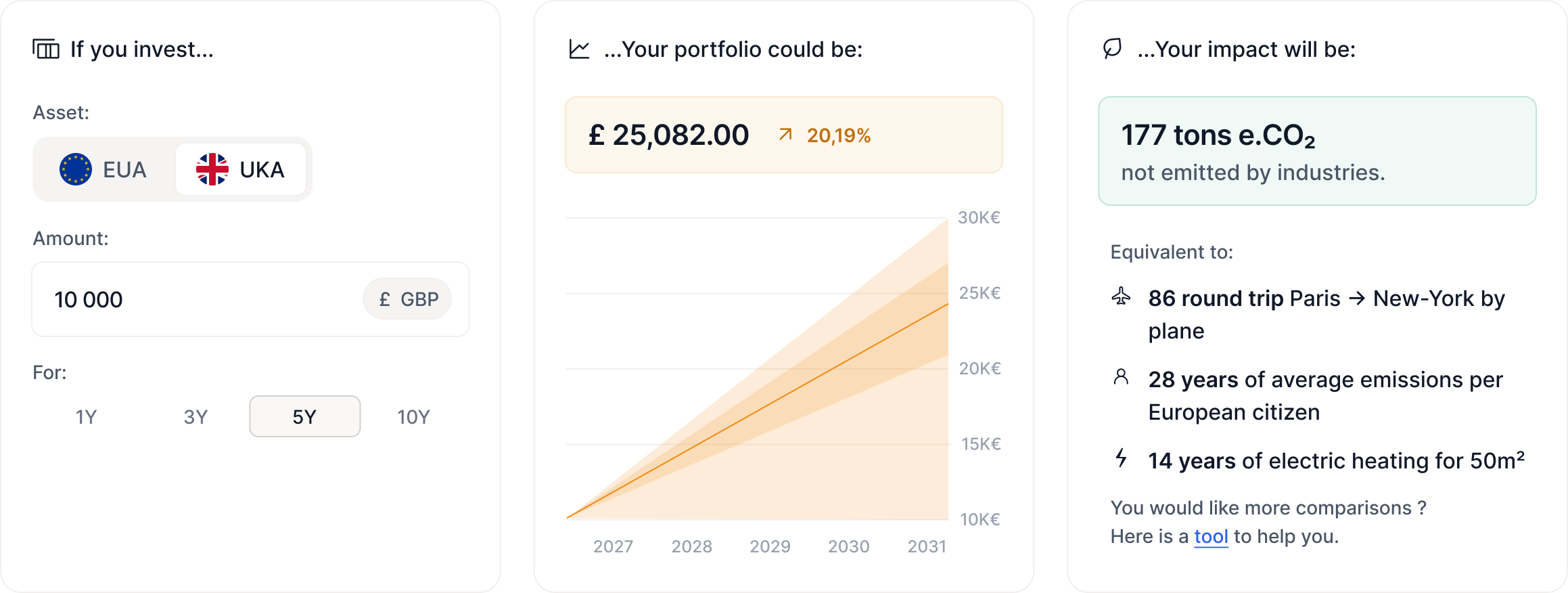
- A measurable impact: Each allowance purchased corresponds to one tonne of CO2 that will not be emitted by an industrial player. You can concretely track your contribution to the fight against global warming.
- A notable performance history: In the past, this market has posted high returns, even though past performance is not indicative of future performance.
This investment, which offers no capital guarantee, is intended for a portion of the wealth of an informed senior who wants to combine meaning and performance. It is essential to properly understand how regulated carbon markets work before committing. It is a pillar of modern climate finance.
Summary: how to build your senior portfolio?
Building a retiree portfolio is based on prudent, diversified allocation. Here are allocation examples for illustrative purposes only, which must be adapted to each personal situation.
This table is not investment advice
These allocations are theoretical examples and cannot replace a personalized analysis of your wealth, financial, and tax situation. It is imperative to consult a wealth management advisor before any investment decision. Investing involves a risk of capital loss.
Managing your wealth in retirement is a balancing act. The goal is to protect your capital while ensuring a comfortable standard of living and preparing your loved ones’ future. Assurance vie, SCPI, and more innovative investments such as carbon allowances offer a range of tools to build a tailor-made, high-performing, and resilient strategy. The key to success lies in a clear definition of your objectives and thoughtful diversification of your assets.
FAQ - Frequently asked questions about investments for seniors
What is the best investment after 70 or 80?
There is no single "best" investment, but rather an adapted combination. After 70 or 80, the absolute priority is security and liquidity. The euro funds of an Assurance vie, regulated passbook accounts (Livret A, LDDS) for emergency savings, and possibly the usufruct of SCPI for regular supplemental income are very relevant options.
How can you protect your capital from inflation in retirement?
Inflation erodes the value of savings that are "sleeping". To counter it, you need to seek returns higher than your inflation rate. Euro funds sometimes struggle to reach this objective. Diversifying into real estate via SCPI, whose rents are often indexed to inflation, or a moderate allocation to unit-linked funds within an Assurance vie can help maintain your capital’s purchasing power.
Is Assurance vie still attractive after 70?
Yes, absolutely. Even if the tax advantage for wealth transfer is reduced for payments made after 70 (an allowance of 30 500 €), it remains beneficial. Above all, the capital gains generated by these payments are fully exempt from inheritance tax. It is an excellent tool to grow your capital and pass it on, even at an advanced age.
Is it risky for a senior to invest in SCPI?
Like any real estate investment, SCPI involves risks: capital is not guaranteed and income is not assured. However, the risk is strongly pooled because you invest in dozens, or even hundreds, of different properties. It is far less risky than buying a single property directly. For you, it is an excellent way to receive real estate income with no management constraints.
Go further: invest in the carbon market
Homaio gives you access to European carbon allowances (EUAs), an asset class that combines potential financial performance with direct climate impact. Diversify your wealth with an asset uncorrelated from traditional markets, accessible from €1,000.