Becoming a Rentier in 2026: A Complete Guide to Strategies, Capital, and Risks

Becoming a rentier in 2026: calculations, realistic strategies
The dream of becoming a rentier—living off income from your assets without depending on a salary—fuels many fantasies. Far from clichés and get-rich-quick promises, reaching this goal is above all a long-term project that requires discipline, patience, and a clear strategy.
This comprehensive guide demystifies the journey to becoming a rentier. We will cover, without taboo, the necessary calculations, possible investment strategies, realistic amounts, and pitfalls to avoid. The goal is not to sell a dream, but to provide a pragmatic roadmap to build your financial independence, whether you are aiming for a simple income supplement or full autonomy.
Becoming a rentier: a simple definition and a misconception to avoid
A rentier is a person who receives sufficient income from their assets (real estate, financial investments, etc.) to cover all of their expenses. This does not mean doing nothing, but rather no longer having the obligation to work to meet one’s needs.
This situation is often confused with the broader concept of financial independence, which is the ability to make life choices without being constrained by financial considerations. Becoming a rentier is therefore a form of culmination of financial independence.
The most persistent misconception is that it is easy. Becoming a rentier is not the result of chance or a stroke of luck. It is the outcome of a deliberate strategy, based on saving, regular investing, and prudent risk management over many years—甚至 decades.
How much do you need to become a rentier? The calculation method
The most common question is: "How much capital do I need?" The answer depends entirely on your lifestyle. Fortunately, the calculation is fairly simple and is based on two elements: your annual expenses and a prudent withdrawal rate.
Start from your monthly and annual expenses
The first step, non-negotiable, is to know your expenses precisely. List everything you spend each month: housing, food, transportation, leisure, taxes, insurance, etc.
- Monthly expenses x 12 = Required annual expenses
It is this annual amount that your passive income will need to cover. If you spend 2 500 € per month, your need for passive income will be 30 000 € per year, after tax. That is your target net annuity.
Use a prudent net return and a sustainable withdrawal rate
Once your annual need is defined, how do you translate it into capital? We use the concept of a "sustainable withdrawal rate" (or SWR, Safe Withdrawal Rate). This is the percentage of your capital you can withdraw each year without (theoretically) ever depleting it, because the capital continues to work and replenish itself.
Historically, the famous "Trinity Study" popularized the "4% rule". It suggested that a retiree could withdraw 4% of a stock-and-bond portfolio each year with a very high probability that the capital would last at least 30 years.
Today, for prudence, many experts recommend a more conservative rate, between 3% and 4%, to account for inflation, crises, and a potentially longer time horizon.
The formula is therefore:
- Required capital = Annual expenses / Sustainable withdrawal rate (in %)
For example, for 30 000 € in annual expenses and a 3.5% withdrawal rate:Required capital = 30 000 € / 0,035 = 857 143 €
Examples of capital based on several living standards
To give you a more concrete idea, here is a simulation of the capital required based on the target net monthly income, using a prudent withdrawal rate of 3.5%.
Assumption: The income generated is net of taxation. Reality will depend on how your investments are structured. These figures are orders of magnitude to illustrate the calculation.
Can you become a rentier starting from nothing?
Yes, but it requires total commitment and time. Starting from zero means the road will be longer, but the basic mechanisms remain the same.
Saving, increasing income, and time horizon
The cornerstone is the savings rate. This is the percentage of your income that you set aside each month. The higher this rate, the faster you build your capital. To achieve this, there are two levers:
- Reduce your expenses: Adopt a frugal lifestyle during the wealth-building phase.
- Increase your income: Seek promotions, change jobs, create a side activity.
The time horizon is crucial. Thanks to [compound interest](https://www.homaio.com/fr/glossary/compound-interest), your money generates interest, which in turn generates interest. The earlier you start, the more powerful this "snowball" effect becomes. Starting from nothing and saving 500 € per month for 30 years in an investment yielding 7% per year (assumption) results in a capital of more than 600 000 €.
Real estate leverage and the limits you need to know
For those starting from nothing, buy-to-let real estate investing is often seen as an accelerator. Its main advantage is credit leverage. You use the bank’s money to buy a property that is then repaid (partly or entirely) by the tenant’s rent. You build wealth with a limited personal down payment.
However, this powerful tool carries risks:
- Debt: A loan commits you over the long term.
- Rental risks: Vacancy, unpaid rent, damage.
- Costs and taxes: Property tax, repairs, condominium fees, taxation on rental income.
Leverage is not magic; it amplifies gains but also potential losses.
[image alt="Diagram illustrating the growth of capital with and without the effect of compound interest."]
The main strategies to generate an annuity
There is not just one path to becoming a rentier, but several strategies, often complementary. Here are the most common ones.
Buy-to-let real estate: rent, down payment, borrowing, and vacancy
The real estate rentier is the best-known profile. The idea is to buy properties (apartments, houses, parking spaces) to rent them out and earn recurring rental income.
- Advantages: Tangible asset ("bricks and mortar"), ability to use credit leverage, relatively stable income.
- Limits: Time-consuming management (finding tenants, repairs), low liquidity (you can’t sell an apartment with one click), significant costs (notary, agency, maintenance), risk concentration in a single property.
- Realistic return: The advertised gross rental yield (annual rent / purchase price) is often attractive (5-8%). But the net yield (after costs, taxes, repairs, vacancy) is much lower, often between 2% and 4%.
SCPI: accessibility, returns, and constraints
Sociétés Civiles de Placement Immobilier (SCPI) allow you to invest in commercial real estate (offices, retail, warehouses) by buying units. This is "paper" real estate.
- Advantages: Accessible from a few hundred euros, fully delegated management, excellent diversification (dozens or hundreds of buildings), pooling of rental risks.
- Limits: High entry fees (8-12%), liquidity not guaranteed and lower than the stock market, no direct leverage effect (except via consumer credit).
- Realistic return: The average distribution rate has historically been between 4% and 5% per year, before tax.
Stocks and ETFs: dividends, withdrawals, and volatility
Investing in the stock market means buying shares in companies (stocks). The annuity can come from two sources:
- Dividends: A portion of profits that companies pay to shareholders.
- Withdrawals from capital: Selling a small portion of your portfolio each year.
For a beginner, the best approach is often to invest via ETFs (Exchange-Traded Funds). These are baskets of stocks that track a stock index (such as the CAC 40 or the S&P 500), offering instant diversification at very low cost.
- Advantages: High long-term performance potential, excellent liquidity, easy global diversification, very low management fees with ETFs.
- Limits: Short- and medium-term volatility (markets can fall), requires psychological discipline to avoid panicking during downturns.
A note on returns
Historically, major global stock indices have generated an average annualized return of around 8% to 10% gross. However, it is crucial to think in terms of returns net of inflation and fees, and to accept that this figure is only an average and not a guarantee for the future.
Assurance vie and PEA: wrappers and taxation
Assurance vie and the Plan d'Épargne en Actions (PEA) (French equity savings plan) are not investments in themselves, but tax wrappers. They are regulatory frameworks that allow you to hold other assets (funds, ETFs, stocks, SCPI) while benefiting from favorable taxation on gains, especially after several years of holding.
- PEA: Ideal for investing in European equities (via individual stocks or ETFs). After 5 years, capital gains are exempt from income tax (but not from social charges). It is the most powerful tool for building stock-market capital in France.
- Assurance vie: Very flexible, it allows you to invest across a wide range of vehicles (secure euro funds, riskier unit-linked investments such as ETFs or SCPI units). Taxation becomes very favorable on withdrawals after 8 years.
An effective annuity strategy often combines these two wrappers to optimize the taxation of future income.
Real estate or stock market: what should you choose to become a rentier?
This is the big debate. There is no single answer, because the two approaches have very different risk and management profiles. The best solution is often a mix of both.
Real estate offers a sense of control and stable income, while the stock market offers simplicity, liquidity, and greater growth potential over the very long term.
Becoming a rentier with 50,000 euros: realistic scenarios
Let’s be clear: 50 000 € is not enough to become a rentier and stop working. Applying our 3.5% withdrawal rate, this capital would generate 1 750 € per year, or about 145 € per month.
However, 50 000 € is an excellent starting capital to implement a powerful strategy. Here are two possible scenarios:
Scenario 1: The real estate accelerator
- Action: Use the 50 000 € as a down payment to obtain a bank loan of 150 000 € to 200 000 €.
- Objective: Buy one or two rental properties whose rents cover the loan payment and costs (a "self-financing" deal).
- Result: After 20 years, the loan is repaid and you own an asset base generating full rental income, forming the beginning of your annuity.
- Risks: Debt, rental management, real estate market risk.
Scenario 2: The power of time in the stock market
- Action: Invest the 50 000 € in a PEA invested in a diversified ETF (MSCI World type). Continue adding 300 € per month.
- Objective: Let compound interest work over the long term.
- Result (hypothetical): With an average annualized return of 7%, this capital could reach around 450 000 € in 25 years. A solid foundation for your future annuity.
- Risks: Market volatility, discipline required not to sell.
Taxation, risks, and common mistakes
The path to becoming a rentier is full of pitfalls. Vigilance is required on several points.
Do not confuse gross return with income that is actually available
This is the most common mistake. A gross return of 6% does not mean you will receive 6% in your pocket. You must systematically deduct:
- Fees: Management fees, transaction fees, notary fees, etc.
- Costs (real estate): Property tax, insurance, maintenance, repairs.
- Taxation: Income tax and social charges. Capital income is heavily taxed in France.
- Inflation: If inflation is 2%, your real purchasing power has decreased by as much.
The only figure that matters is the net-net return, meaning what you have left after all these deductions. A realistic and sustainable net return often falls between 2% and 5% depending on the strategy.
Watch out for inflation
Inflation is the rentier’s silent enemy. A fixed annuity of 2 000 € per month will lose half its purchasing power in about 25 years with average inflation of 3%. Your strategy must therefore aim for capital growth at least equal to inflation to maintain your standard of living.
Why diversification is essential
Never put all your eggs in one basket is the golden rule. Concentrating all your capital in a few apartments in the same city or in the shares of a single company exposes you to the risk of catastrophic loss.
Diversification helps smooth performance and reduce overall risk. A balanced portfolio can include:
- Real estate (physical or paper via SCPI).
- Stocks from different geographic areas (Europe, USA, World via ETFs).
- Potentially other uncorrelated asset classes such as climate assets.
[image alt="Pie chart showing a diversified investment portfolio across stocks, real estate, and other assets."]
5-step action plan to build your annuity
- Define your goal: Calculate your annual expenses precisely and derive the required target capital using a prudent withdrawal rate (3-4%).
- Maximize your savings: Set up an automatic transfer each month. Aim for the highest savings rate possible by optimizing your income and expenses.
- Educate yourself: Take the time to understand the basics of investment strategies (real estate, stock market, taxation). Knowledge is your best asset.
- Choose your strategy and take action: Open the right wrappers (PEA, Assurance vie) and start investing regularly, even with small amounts. Don’t look for the perfect moment—it doesn’t exist.
- Be patient and disciplined: Building wealth is a marathon, not a sprint. Stick to your strategy even when markets are turbulent, and reassess it only once a year or in the event of a major change in your life.
A tip to get started
My personal experience has taught me that the biggest difficulty is taking the first step. Don’t wait until you have significant capital. Opening a PEA and investing 50 € per month in a World ETF is a psychologically powerful act. It anchors the habit of investing and puts you immediately on the right track.
*General informational content, not constituting investment advice, tax advice, or a personalized recommendation. Returns, taxation, and risks vary depending on each person’s situation.*
FAQ on becoming a rentier
How much do you need to become a rentier?
The capital required depends entirely on your standard of living. Calculate your annual expenses and divide that amount by a prudent withdrawal rate (between 0,03 and 0,04). For example, to live on 2 000 € net per month (24 000 €/year), you will need capital of about 600 000 € to 800 000 €.
How do you become a rentier starting from nothing?
It is possible, but it requires a lot of time and discipline. The key is to reach a very high savings rate (by increasing income and/or drastically reducing expenses) and to invest those savings regularly over the very long term to benefit from the power of compound interest.
Can you become a rentier with 50,000 euros?
No, 50 000 euros does not allow you to generate enough annuity income to live on. However, it is an excellent starting point to initiate a strategy—either by using it as a down payment for a credit-financed real estate investment, or by investing it in the stock market to grow it over 20 or 30 years.
What net return is realistic?
You must be very cautious with the numbers. After deducting fees, taxes, and inflation, a sustainable real net return often falls between 2% and 5% per year on average, depending on the level of risk and the strategy adopted (real estate, stock market, etc.). Be wary of promises of higher returns without high risk.
Should you prioritize real estate or the stock market to generate an annuity?
There is no better solution; both have their advantages and drawbacks. Real estate offers tangible control and leverage via credit, but requires active management. The stock market (via ETFs) offers simplicity, diversification, and liquidity, but with higher volatility. The best approach is often to combine both to diversify your income sources and risks.
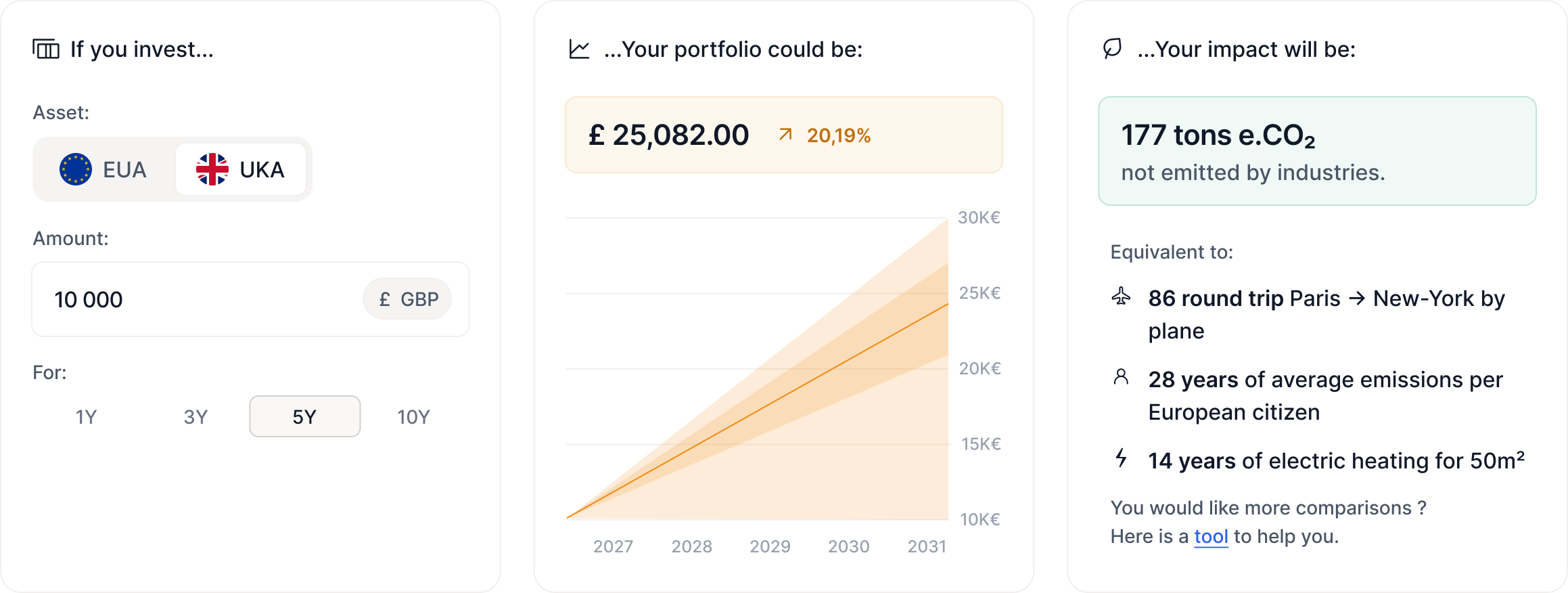
Go further: invest in the carbon market
Homaio gives you access to European carbon allowances (EUAs), an asset class that combines potential financial performance with direct climate impact. Diversify your wealth with an asset uncorrelated from traditional markets, accessible from €1,000.