Assurance vie or PEA: finding the best investment for your 2026 goals

You want to grow your savings but you’re hesitating between two flagship solutions in France: assurance vie and the Plan d'Épargne en Actions (PEA) (French equity savings plan). Which should you choose? Should they be set against each other? The answer isn’t the same for everyone.
The choice between the PEA and assurance vie depends entirely on your personal goals: your investment horizon, your risk tolerance, and what you want to accomplish with your wealth (performance, preparing for a project, passing it on).
Far from being competitors, these two investments are often complementary within a balanced wealth strategy.
A simple explanation of the PEA and assurance vie
Before comparing them, it’s essential to understand the nature of each wrapper. These are not traditional savings products, but tax frameworks designed to hold different types of investments.
The PEA: investing in stocks and ETFs within a dedicated tax wrapper
The Plan d'Épargne en Actions (PEA) (French equity savings plan) is a securities account specifically designed to encourage investment in European companies. Its main advantage is very favorable taxation on capital gains, provided you meet a minimum holding period.
It consists of a cash account (for deposits and cash awaiting investment) and a securities account (which holds your shares, funds and ETFs).
Assurance vie: a more versatile wrapper for saving and passing on wealth
Assurance vie is often seen as the “Swiss army knife” of savings. It is an investment wrapper that provides access to a very wide range of underlying assets, from the most secure to the most dynamic.
It is recognized for its flexibility, its attractive taxation on withdrawals after 8 years, and above all, for its unique legal framework for wealth transfer.
Comparison table: PEA vs assurance vie
To quickly visualize the fundamental differences, here is a summary of the key points.
[image alt="Summary table comparing the characteristics of the PEA and assurance vie."]
Watch out for the risk of capital loss
The PEA and the units of account in assurance vie are investments subject to financial market fluctuations. Their value can rise or fall, and there is a risk of capital loss. Only invest money you can afford not to touch for several years.
Taxation: what really changes between PEA and assurance vie
Taxation is often the criterion that guides the choice. The rules, although different, are attractive in both cases as long as you respect the time factor.
PEA: what the 5-year holding period implies
- After 5 years: In the event of a withdrawal, realized capital gains are fully exempt from income tax. You only pay social contributions (17,2 % currently). The plan remains open and you can continue to contribute.
- Before 5 years: Any withdrawal generally results in the closure of the PEA. Gains are then subject to the “flat tax” of 30 % (12,8 % tax + 17,2 % social contributions).
Assurance vie: contract age, withdrawals and levies
The tax maturity of assurance vie is reached after 8 years. From that point on, withdrawals (called “rachats”) become the most advantageous.
- After 8 years: You benefit from an annual allowance on the gains withdrawn. This allowance is 4 600 € for a single person and 9 200 € for a couple. Beyond that, gains are taxed at a preferential rate.
- Before 8 years: Gains are taxed, generally at the “flat tax” of 30 %.
It is crucial to note that in an assurance vie policy, only gains (the interest portion) are taxed when you make a withdrawal—never the capital you paid in.
What investments can you hold in a PEA or an assurance vie?
The investment universe is one of the major differences between these two wrappers.
European shares, PEA-PME and ETFs in the PEA
The PEA is a specialized wrapper. You can hold:
- Individual shares in companies headquartered in the European Union (or the European Economic Area).
- Mutual funds (OPCVM) invested at least 75 % in European equities.
- ETFs (or trackers), funds that replicate a stock market index at lower cost. This is a very popular solution for easy diversification.
For investors who want to finance small and medium-sized companies, there is also the PEA-PME, which works on the same principle but with a dedicated contribution limit and investment universe.
Euro funds and units of account in assurance vie
Assurance vie offers much broader diversification. It mainly includes two types of holdings:
- Euro funds: Their capital is guaranteed (fully or partially) by the insurer. This is the go-to secure option, ideal for the portion of your savings you do not want to put at risk. However, their returns have declined in recent years.
- Units of account (UC): These options do not guarantee capital but offer higher performance potential. The universe is wide: global equities, bonds, real estate funds (SCPI, OPCI), ETFs...
When the PEA is more suitable
The PEA is an excellent tool if:
- Your main objective is very long-term performance (more than 8-10 years).
- You want to invest mostly in European equities.
- You accept high volatility and the associated risk of capital loss.
- You are looking for the gentlest possible taxation on stock market capital gains.
When assurance vie is more suitable
Assurance vie will be more relevant if:
- You are aiming for maximum diversification of your wealth (shares, bonds, real estate, worldwide).
- You want to adjust risk by combining a secure holding (euro funds) and more dynamic options.
- One of your goals is to prepare for wealth transfer of your capital with favorable taxation.
- You need to keep your savings available for a medium-term project (a withdrawal is possible at any time).
Can you combine assurance vie and a PEA?
Yes, absolutely. Not only is it possible, it is even a very relevant wealth strategy. Combining them lets you get the best of both worlds.
- The PEA can serve as the performance engine for the portion of your savings dedicated to the long term and equity markets.
- Assurance vie can hold the more secure portion of your savings in euro funds, diversify your investments across geographic areas or asset classes not eligible for the PEA, and prepare your estate.
This combination offers an excellent balance between the search for returns, risk control, and tax and estate optimization.
Expert tip: “Take a date” as early as possible
The tax benefits of the PEA and assurance vie are tied to how long they have been open. It is wise to open both wrappers as early as possible, even with a modest initial deposit. This starts the tax clock (5 years for the PEA, 8 years for assurance vie) and keeps all your options open for the future.
Pitfalls to avoid before choosing
Making an informed decision also means knowing common mistakes.
Don’t choose based on taxation alone
The tax advantage is the icing on the cake, not the cake itself. Your choice should first be driven by your life plans, your investment horizon, and your risk appetite. A product that is very tax-efficient but unsuited to your needs is still a bad choice.
Underestimating fees, risk and liquidity
- Fees: Compare entry fees, annual management fees (especially on units of account), and switching fees. Over the long term, they can significantly impact your investment performance.
- Risk: Understand that return potential is always linked to a level of risk. Capital is not guaranteed in a PEA, nor in the units of account of an assurance vie policy.
- Liquidity: An early withdrawal from a PEA can be penalizing. Make sure you have emergency savings available elsewhere.
How to choose based on your profile: 4 concrete scenarios
To help you picture it, here are examples of strategies for different profiles.
- Beginner profile (25 years old): You are starting to save for the very long term. The PEA is an excellent starting point to invest gradually in equity markets via ETFs, and thus maximize growth potential over several decades.
- Real estate project profile (35 years old, 10-year horizon): Assurance vie is ideal. You can “take a date” now to reach the 8-year tax maturity, and adjust your risk exposure by gradually reallocating toward euro funds as your project approaches.
- Balanced profile (45 years old, diversification): The combination of both is perfect. The PEA for the “dynamic equities” sleeve and assurance vie for diversification (international funds, real estate) and securing part of the capital.
- Wealth transfer profile (60 and over): Assurance vie becomes the central tool. Its unique inheritance tax framework makes it possible to pass on significant capital to your beneficiaries (children or others) outside standard inheritance taxes.
Warning: This content is provided for informational and educational purposes only. It does not constitute investment advice, tax advice, or a personalized recommendation. Past performance is not indicative of future performance. Tax regulations may change. Before making any decision, it is recommended that you consult a professional advisor and review the contractual documentation for the products.
FAQ: PEA or assurance vie
Which is better between a PEA and assurance vie?
There is no “best” product in absolute terms. The PEA is often preferred for pure long-term investment in European equities with a performance objective. Assurance vie is more versatile, ideal for diversification, preparing a variety of projects, and optimizing wealth transfer.
Can you combine assurance vie and a PEA?
Yes, and it is even an excellent strategy. Having both makes it possible to combine the power of the PEA for equity investing with the flexibility of assurance vie for diversification, safety, and estate planning.
Is it profitable to have a PEA?
The profitability of a PEA is not guaranteed; it depends entirely on the performance of the shares, funds or ETFs you hold inside it. Historically, equity markets have delivered attractive long-term returns, but that implies accepting significant risk and volatility.
What pitfalls should you avoid with assurance vie?
The main pitfalls are: fees that are too high and eat into performance, a poor understanding of the risk of capital loss on units of account, and withdrawals made before the 8-year tax maturity, which are less advantageous. It is essential to read your contract carefully and choose holdings suited to your risk profile.
Go further: invest in the carbon market
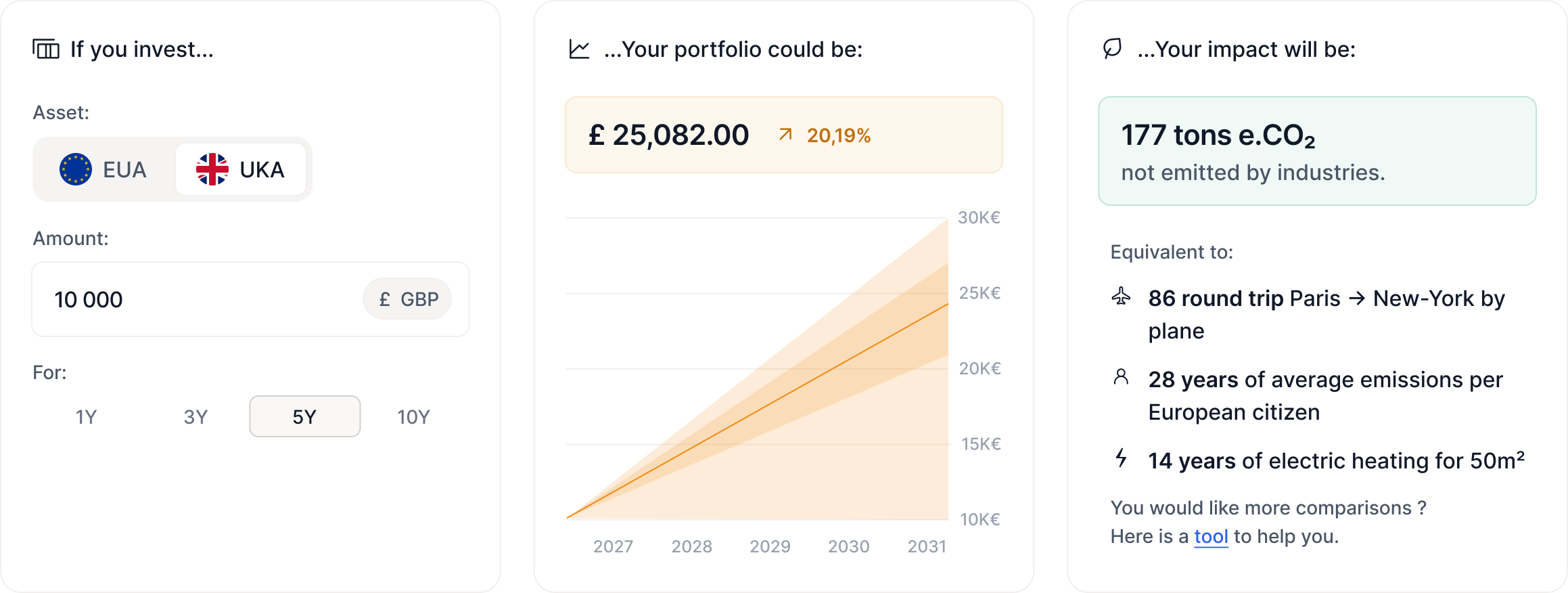
Homaio gives you access to European carbon allowances (EUAs), an asset class that combines potential financial performance with direct climate impact. Diversify your wealth with an asset uncorrelated from traditional markets, accessible from €1,000.