Our top articles

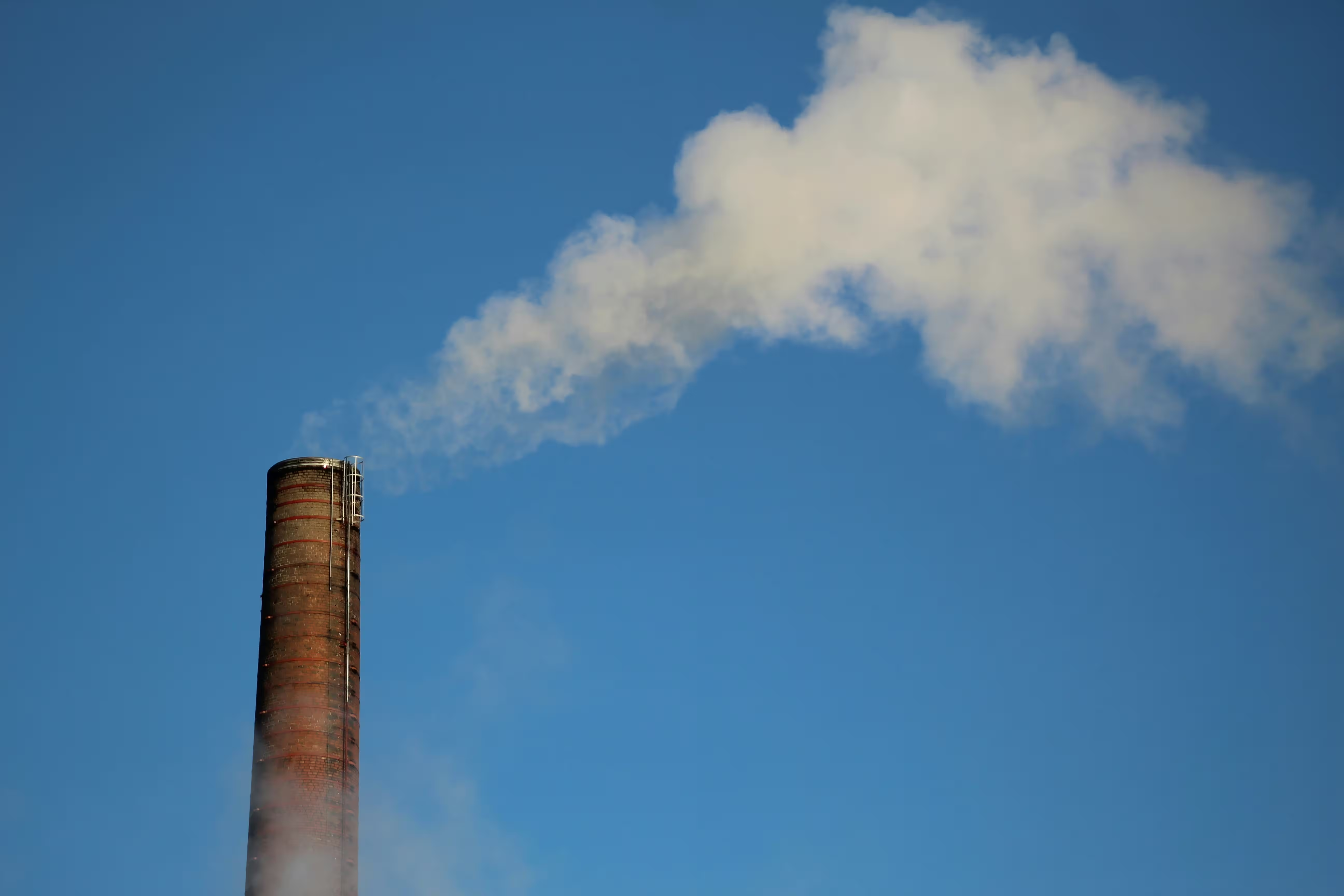
The Carbon Market Under Political Stress: Temporary Volatility or Paradigm Shift?
As European Union Allowance (EUA) prices recently tested a floor around €70, the market appears to be factoring in an unprecedented "political risk premium." Between Italy’s calls for suspension and Germany’s budgetary debates, are the fundamentals of the world's largest carbon market truly under threat? An analysis of the forces at play as the 2026 legislative review approaches.
June 18, 2026

Last news

What are the main characteristics of the EU ETS?
The EU Emissions Trading System (ETS) is a cornerstone of European green finance and climate policies, using a carbon market to reduce greenhouse gas emissions from key sectors. It has evolved through phases, expanded its scope (including aviation and maritime), and contributed to a significant reduction in emissions, and revisions are coming to make the EU ETS even more effective for decarbonization as Europe pursues carbon neutrality by 2050. The EU ETS allows companies to buy carbon allowances, incentivizing them to lower their emissions.
October 15, 2025

What is the social cost of carbon?
The social cost of carbon (SCC) estimates the monetary damages caused by CO2 emissions, influenced by human activity and political considerations. Diverse estimates exist, but current carbon prices may not reflect the high end of SCC estimates. Investing in sustainable development and responsible investing is therefore essential to mitigate environmental damage and promote ethical investments.
October 15, 2025

Are carbon allowances the same as carbon credits?
Carbon allowances in the EU ETS are regulated instruments for capping emissions, while carbon credits are voluntary offsets from various projects. The EU ETS is a much larger market with unique, standardized allowances, whereas carbon credits vary in price and verification. Both contribute to carbon accounting and emissions reduction, but operate under different frameworks.
February 6, 2026

Are carbon allowances permits to pollute?
EU Allowances (EUAs) are not permits to pollute but a cap-and-trade system that incentivizes decarbonization by setting a decreasing limit on overall carbon emissions. This system differs from carbon taxes and voluntary carbon markets, which allow ongoing emissions for a fee, by enforcing a single, declining CO2 budget for the entire economy. Investing in the stock market, including green finance and sustainable investment, is crucial for companies to adopt sustainable practices and reduce emissions within this framework.
October 15, 2025

How does a cap-and-trade scheme work?
Cap and trade schemes incentivize industries to cut carbon emissions through market mechanisms, establishing a carbon budget and issuing tradable carbon allowances. This system creates a financial incentive for reducing emissions and decarbonizing, with the price of allowances determined by supply and demand, encouraging investment in cleaner technologies.
October 15, 2025

Why do we need to put a price on carbon emissions?
To address climate change and its associated costs, governments must implement carbon pricing mechanisms like carbon taxes and emissions trading schemes to hold polluters accountable for their emissions and fund future climate solutions; this promotes responsible investing and incentivizes a transition to green finance and renewable energy. Without carbon pricing, society bears the burden of pollution's heavy price tag.
October 15, 2025

What is the Science-Based Targets Initiative and why does it matter for carbon pricing?
The Science-Based Targets Initiative (SBTi) helps companies set CO₂ reduction targets aligned with climate science and the Paris Agreement. This article explains what SBTi is, its benefits for businesses, how to get validation in 5 steps, and its strategic link to the EU Emissions Trading System (EU ETS).
November 6, 2025

Will climate change policies change after the EU 2024 election results?
Despite recent EU election results, significant changes to established European carbon market and climate policies are unlikely due to the robust legal framework and commitment to emissions reduction targets, making investing in the stock market through EU carbon allowances relatively stable. The EU aims for carbon neutrality by 2050 and continues to lead in green finance and sustainable investment initiatives.
October 15, 2025

What is carbon leakage in the EU ETS?
Carbon leakage occurs when industries relocate to avoid stringent climate policies, increasing emissions in regions with weaker regulations. The EU introduced the Carbon Border Adjustment Mechanism (CBAM) in 2023 to address this by imposing carbon pricing on imports. CBAM aims to reduce carbon leakage and incentivize global climate policy alignment to promote responsible investment.
February 6, 2026