What Performance Can You Expect from UKAs? The 3 Drivers of UK Carbon Allowance Returns

A financial asset before an ESG product
First things first: a UKA is not a carbon offset, nor a voluntary credit. It is a regulated asset, created and backed by the UK government, traded on regulated financial venues (mainly ICE Futures Europe), with public accounting and a solid legal framework.
That changes everything for an investor. We're not talking about greenwashing or debatable methodologies, we're talking about a financial instrument whose price is set by supply, demand and public policy. That is what makes performance readable.
Driver #1: the Convergence Play, a +20% catch-up
This is the central feature of the market right now. Today, one tonne of CO₂ trades at around £55 in the UK vs. roughly €79 in the eurozone. That's a ~20% discount to the European EUA. The gap has already partially closed since May 2025, but it still leaves meaningful residual catch-up potential.
The discount has no structural reason. Both markets target the same objective (Net Zero 2050), cover equivalent sectors, and run on the same mechanics. The gap is purely political, inherited from post-Brexit uncertainty and a Net Zero agenda that wavered between 2022 and 2024.
Since the London summit of May 2025, the UK government has formally announced its intention to link the UK ETS to the EU system. If linkage goes through, which is now the credible path, prices will realign mechanically.
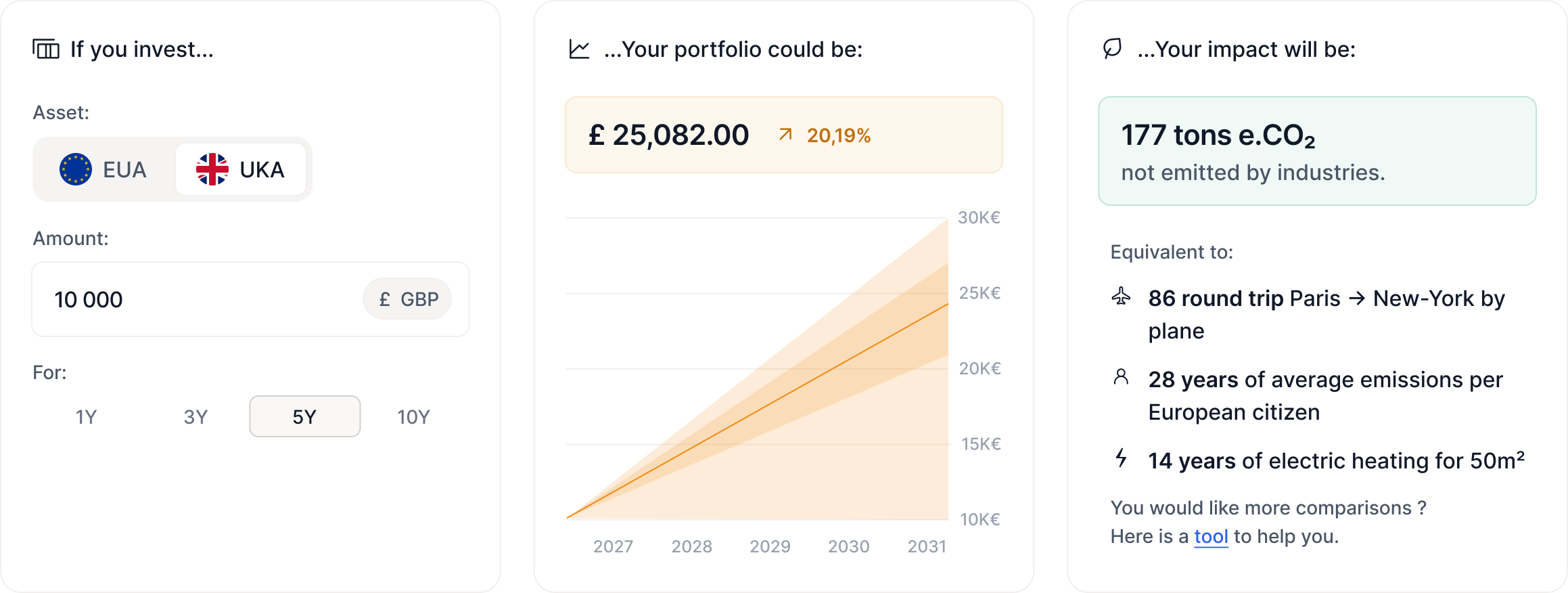
That's the Convergence Play: positioning on UKAs to capture the upside. Residual mechanical potential is in the order of +20 to +25% (today's ~20% discount maps to a mirror upside of ~+24%). For context: Switzerland took 10 years (2011-2020) between first negotiations and entry into force of its EU linkage, but a meaningful share of price convergence happened well before the final signature, as soon as negotiations took a clear direction.
Driver #2: a structurally deflationary asset
Once the catch-up plays out, a deeper driver remains: engineered scarcity.
The UK ETS works on a Cap and Trade principle. Every year, the government sets an emissions ceiling (the Cap), and this Cap shrinks mechanically to follow the 2050 Net Zero trajectory. In practice, the total supply of allowances reduces year after year: by design, by political decision, without any market debate.
What that means for a long-term holder is simple: less supply + stable or growing industrial demand = upward price pressure.
It's the same mechanic that took European EUAs from less than €10 in 2018 to over €80 by 2025. The UK ETS is on the same path, with a few years of political lag, which is precisely what the Convergence Play is closing.
On the framework's solidity: the March 2026 update from the UK Climate Change Committee puts the cost of the Net Zero trajectory at around £4 billion per year (≈ £100 billion cumulative to 2050) for an estimated return of £2 to £4 per £1 invested. A cost-benefit equation that makes the agenda budget-wise defensible, and therefore politically durable.
Driver #3: alignment of reference analysts
The leading specialised research houses (BloombergNEF, ICIS, Veyt) all converge on a bullish UKA trajectory for the decade:
- Short term (2026-2027): a UKA price around £70-75, supported by the first steps of linkage,
- By 2030: most analysts expect a price above £100, with progressive alignment on the EUA trajectory.
These are not promises: they are projections grounded in the Cap reduction trajectory, the historical pace of carbon prices, and the likelihood of UK-EU linkage. But they give a coherent order of magnitude for the upside.
And recent history backs the magnitudes: UKAs have already delivered double-digit annual gains during phases of post-uncertainty realignment.
What about the risks?
A bullish read does not exempt us from a clear-eyed look at risks:
- Political risk: a new UK government could slow the Net Zero agenda, as happened in 2022-2023.
- Negotiation risk: UK-EU linkage could take longer than expected. Although Switzerland took 10 years, the UK could move faster thanks to its common history with the EU ETS, but nothing is guaranteed.
- Cyclical risk: a deep recession would reduce industrial demand for allowances and weigh on prices in the short term.
- Liquidity risk: the UKA market is narrower than the EUA market, volumes are meaningful but more local.
These risks are real. But they sit within a stable regulatory frame: the UK ETS is enshrined in UK law, and the Cap will keep shrinking regardless of short-term political turbulence.
The takeaway
UKA performance rests on three aligned drivers: a +20% residual catch-up under the Convergence Play, engineered scarcity that supports the price long term, and an analyst consensus pointing to >£100 by 2030.
It's rare to find an asset where macro, public policy and physical scarcity all point in the same direction. That is exactly what makes this moment of the UK carbon market particularly interesting for a long-term investor.