What is a UKA? A Complete Guide to UK Carbon Allowances

One allowance, one tonne, one market
A UKA (United Kingdom Allowance) is a tradeable instrument that grants its holder the right to emit one tonne of CO₂ equivalent in the United Kingdom. It is the basic unit of the UK Emissions Trading Scheme (UK ETS), the cap-and-trade system the UK launched in January 2021, just after Brexit.
The mechanism is simple: for every tonne of CO₂ emitted by a power plant, cement factory, refinery or covered airline, the operator must surrender one UKA to the regulator. No UKA, no right to emit. This is Cap and Trade: a state-set ceiling (Cap) and a market (Trade) that allocates allowances among economic actors.
In practice, the UK ETS covers about 25% of UK emissions: power generation, heavy industry, domestic and intra-European aviation. Other sectors (road transport, buildings, agriculture) are covered by separate regulatory tools. The whole thing sits inside the UK's -68% emissions target by 2030 (vs 1990), one of the most ambitious in the developed world.
Where do UKAs come from?
The UK is no newcomer to carbon markets. It actually invented the multi-sector model, launching a pilot scheme back in 2002. It then joined the EU ETS in 2005 and stayed in for 16 years, until Brexit.
Since 1 January 2021, the country has run its own system: similar in design to the EU ETS, but with its own rules, its own regulator (the Department for Energy Security and Net Zero), and its own price.
Real trading kicked off on 19 May 2021 on ICE Futures Europe. From that point on, the UKA price became an independent signal (often correlated with the EUA), but with its own political dynamics. As a sense of scale, nearly £20 billion in auction revenues have been generated by the UK ETS since its launch in 2021 (Source: ICAP, UK ETS Factsheet 99, 2025): this is mature market infrastructure, not an emerging asset.
How is the UKA price set?
Four forces drive the UKA price:
- Supply: the cap is set by the government and shrinks every year to align with the 2050 Net Zero target. Fewer allowances → upward price pressure.
- Industrial demand: a busy economy means more emissions and more demand for allowances.
- The cost of alternatives: as wind, hydrogen and carbon capture get cheaper, demand for allowances falls.
- Political signals: reform announcements, climate agendas, EU negotiations.
As of July 2026, a UKA trades around £55, vs. roughly €79 for its European counterpart (EUA). That price gap is exactly what makes the market interesting for investors, it's known as the UK-EU spread.
The "Convergence Play": why UKAs matter to investors
UKAs currently trade at a ~20% discount to European EUAs. That gap is not set in stone: at the London summit of May 2025, the UK government formally announced its intention to link the UK ETS to the EU system. Part of the discount has already closed on that signal (it stood at ~30% earlier this year).
If linkage goes through, prices will continue to realign. In carbon desk jargon, this kind of trade is called a convergence trade; at Homaio, we call it the Convergence Play: positioning on UKAs to capture the upside as negotiations progress. The residual catch-up potential is in the order of +20 to +25%, on top of the long-term structural drivers (engineered scarcity, Net Zero 2050).
For context: Switzerland took about 10 years (2011-2020) between first negotiations and the entry into force of its EU linkage. For the UK, the clock started in May 2025, with full operationalisation credible by 2028-2030.
Who can hold UKAs?
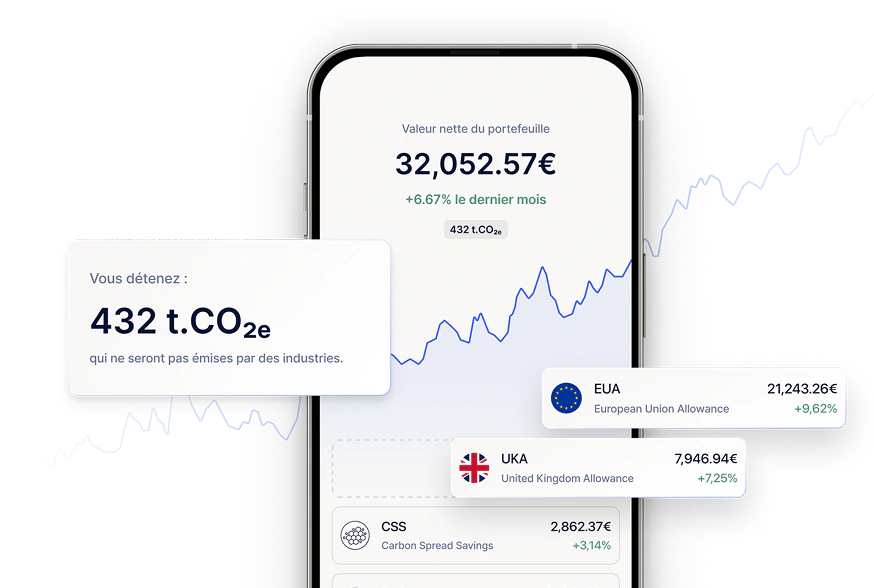
Historically, UKAs sat in the hands of regulated emitters (compliance buyers) and a handful of professional traders. The market has since opened up: non-compliance corporates, institutional investors, funds, and now retail investors via dedicated platforms can buy and hold UKAs.
For a retail investor, holding a UKA means:
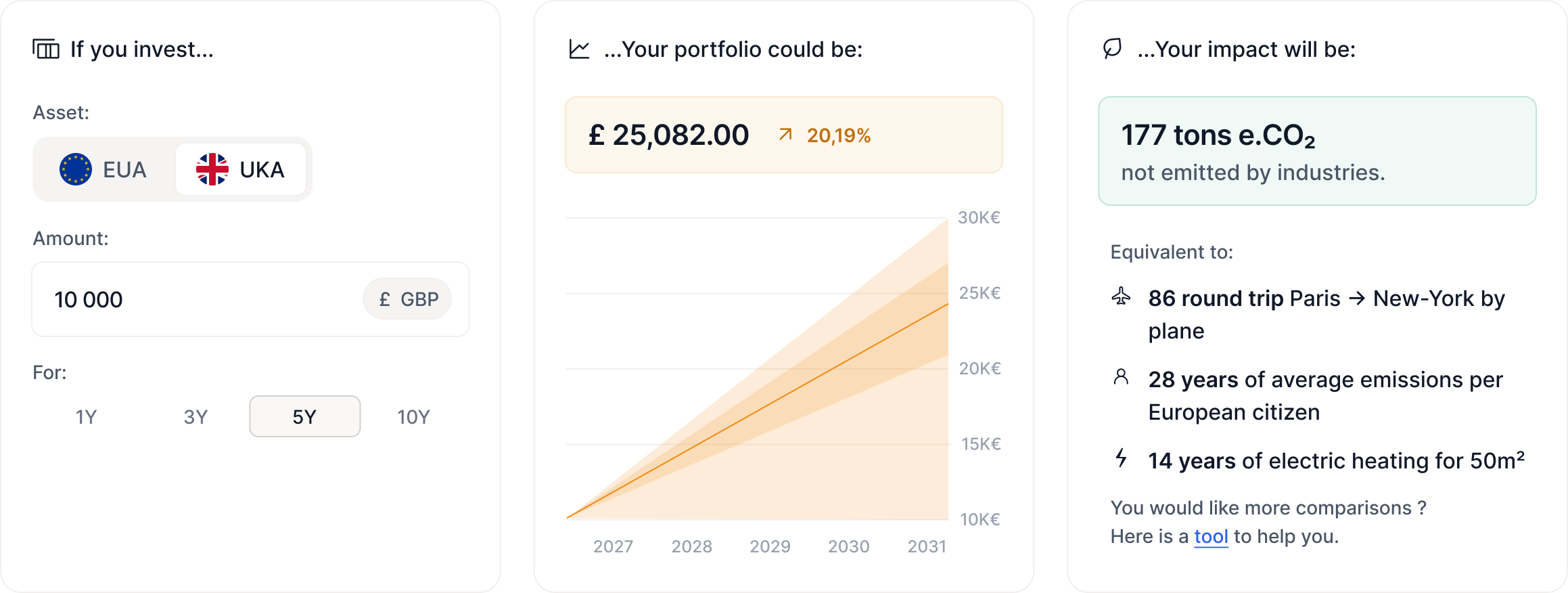
- Removing a right-to-pollute from the market (measurable climate impact),
- Owning a structurally deflationary asset (supply shrinks every year),
- Positioning for the UK-EU Convergence Play.
The takeaway
The UKA is the basic unit of the UK carbon market: a tradeable right to emit one tonne of CO₂, with an annually shrinking supply. It's an asset that combines engineered scarcity and political catch-up potential: two financial drivers rarely found together in the same asset class.
In the short term, convergence with the EU market structures the opportunity. In the long term, the 2050 Net Zero trajectory underpins the value. And at any horizon, every UKA held is one tonne of CO₂ that won't be emitted.