How Individual Investors Can Strengthen Carbon Markets

Between 2005 and 2018, compliance entities and large institutional investors were the only ones to be able to participate in carbon markets. Compliance entities buy European Union allowances to match the CO2 emissions released from their activity, while financial players participate in the European Union Emissions trading scheme for economic profits. The market has been open to this latter group in seek of more stability in the price discovery process (the meeting between demand and supply to assess the carbon allowance price at the time). However, some have been concerned that non-compliance presence can artificially bring about more volatility for EUA prices.
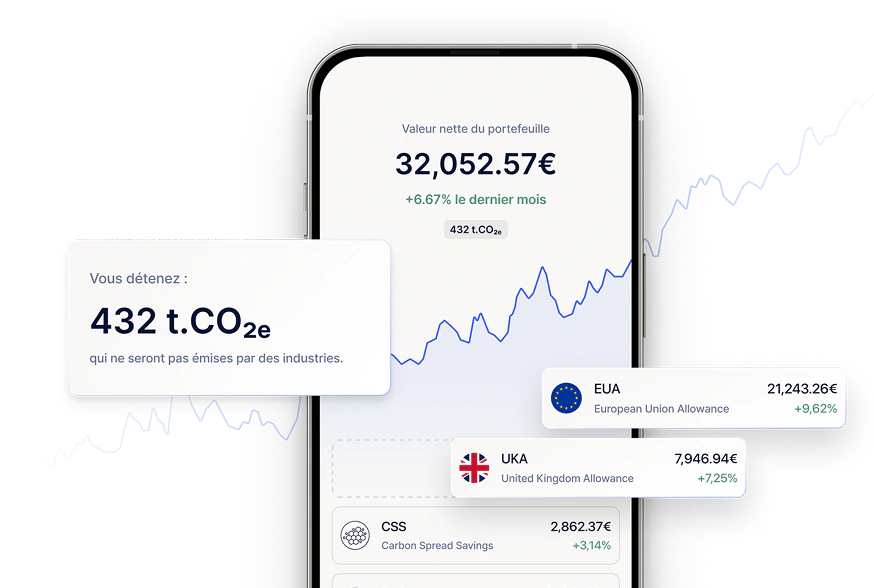
Since the creation of the Homaio platform, yet another type of demand was brought about - that of individual investors. This new type of demand is positive for the EU ETS financials, as buy and hold strategies contribute to long-term price appreciation. In turn, this enhances the bloc’s decarbonization efforts.
- Who can participate in carbon markets?
- Why invest in EUAs? The role of free markets in carbon investing
- The political endorsement of broadening EU ETS market participation for individuals
[[cta-discover]]
Who can participate in carbon markets?
Compliance entities in the EU ETS
Compliance entities (large industrial facilities and power plants) are covered by carbon markets. They buy a sufficient number of carbon allowances to correspond to the volumes of their emissions over the year. So, compliance entities can manage their carbon liabilities, either by reducing emissions or purchasing additional allowances as needed.
Financial players in the EU ETS
Financial actors like institutional investors, hedge funds, and trading firms, also participate in regulated carbon markets. Their goal is to capitalize on investment opportunities. They trade carbon allowances usually as part of their broader investment strategies, seeking to generate returns.
Individual investors in the EU ETS
As we have launched the Homaio platform, individual investors now have access to carbon markets. They can purchase and hold EUAs. This enables anyone to become a carbon investor, combining financial returns with a positive environmental impact. Through the Homaio platform, investors can participate in carbon markets. This democratization of carbon markets allows individuals to align their financial goals with environmental engagement, adding up to the European collective effort to fight climate change.
[[cta-platform]]
Why invest in EUAs? The role of free markets in carbon investing
Large speculators and EU ETS volatility
Large financial institutions often share similar investment objectives, strategies, and timeframes. Their analysts typically approach the markets with a uniform mindset, they are only focusing on financial gains. So, they often collectively engage in simultaneous buying or selling of carbon allowances. However, these synchronized flows can contribute to market volatility, as sudden shifts in demand or supply can swiftly impact EUA prices in one way or another .
Financial demand from compliance entities is not enough
However, carbon markets cannot be restricted solely to compliance buyers. Cap and trade systems depend on the free market principles of supply and demand for price determination, and relying solely on compliance demand is insufficient. Various institutional and academic studies have confirmed this, as seen below.
Academics thoughts on individual demand in carbon markets
The French Centre de recherche sur les stratégies économiques (CRESE) has published a report in 2023 “On the role of financial investors in carbon markets: Insights from commitment reports and carbon literature”. Their main findings are the following:
- The European Union's objectives of reducing emissions and promoting clean technologies can be achieved through the EU Emissions Trading System (ETS).
- Historically, carbon prices were too low to meet these goals.
- Talks emerged on how financial institutions can bring stability in the EU ETS.
- Those players mainly arbitrage positions in the market - they have long (buying EUAs) and short positions (selling EUAs).
- Financial demand contributes to market liquidity.
Institutional thoughts on individual demand in carbon markets
The European Parliament has published a study in December 2022 on “The role of financial operators in the ETS market and the incidence of their activities in determining the allowances’ prices”. The main findings are as follows:
- Buy-and-hold strategies can “squeeze the market”, meaning that new non-compliance demand takes out of the overall carbon budget available to industries.
- The increased number of market participants contributes to reducing the EU ETS volatility.
- Market stability can be further enhanced with more tracking and regulation of financial representatives in the EU ETS.
[[cta-impact]]
The political endorsement of broadening EU ETS market participation for individuals
The example of the Lord Mayor of London
During a recent speech, the Lord Mayor of London emphasized the significance of granting individual investors access to carbon markets to enhance their effectiveness. Drawing from his extensive experience in compliance carbon markets, he highlighted key points in his address as follows: “Each emissions allowance purchased (...) means one less allowance available for polluting: effectively “tightening the cap” for emissions worldwide and raising the price of carbon, while enabling a participating business to show their customers and competitors they’re serious about tackling climate change. “.
Korea is strengthening its ETS through individual financial demand
The Ministry of Environment in South Korea has announced the extension of its compliance carbon market to retail investors. The objective is to support and stimulate the market by "having a wider group of participants to trade in the market". This initiative aims to provide retail investors with an opportunity to participate in the country's compliance carbon market. By expanding access to individual investors, South Korea supports the cap-and-trade mechanism’s efforts towards carbon reduction.
Key Takeaways
- Compliance entities and large financial investors were traditionally the only carbon markets participants.
- Homaio opened the door for individual investors to access the EU ETS and buy EUAs.
- Compliance entities, financial players, and individual investors have different objectives and strategies.
- The democratization of carbon markets increases the market stability and can reduce volatility.
- Political support for expanding market participation to individual investors is growing, with initiatives like those in Korea aiming to strengthen carbon markets.