
<- Back
Master climate finance in 5 minutes.

Get the essential weekly digest in your inbox.

Sign up to our newsletter
Summary

Are EUA prices correlated to other asset prices?

Carbon Market

Investing in carbon allowances (EUAs) offers diversification benefits due to their low correlation with traditional assets like stocks and bonds, acting as a potential hedge against inflation. The EUAs' prices are driven by unique factors tied to the carbon market, making them a distinct component for a responsible investment portfolio with long term price appreciation.
Return to Blog
Sommaire
Book a call

European Union Allowances (EUAs) stand apart from traditional assets and have a unique diversification advantage. Adding carbon allowances to an investment portfolio can not only lower financial risk but also play a crucial role in the global fight against climate change.

Carbon allowances are not like other traditional assets 

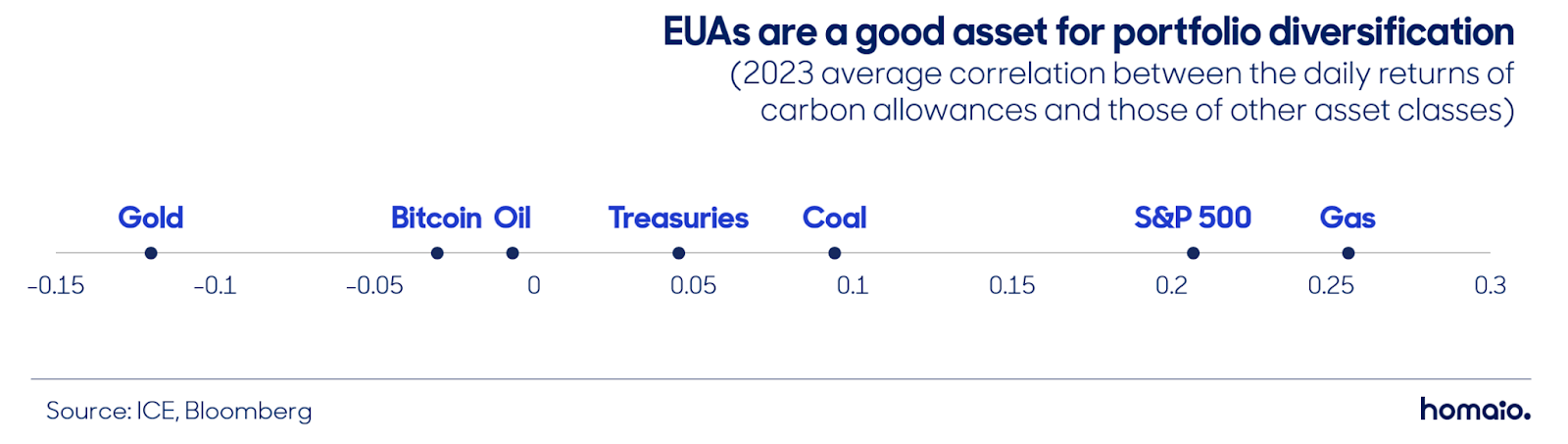
Unlike traditional financial assets such as stocks or bonds, EUA prices are driven by a multiplicity of factors unique to the carbon market, like regulatory decisions, energy market fluctuations, weather conditions... There is no other market that is built with a mission - decarbonization - and that is influenced by such a combination of diverse elements. This distinctiveness makes EUAs often operate in a world of their own, often resulting in a low correlation with conventional assets. For instance, in 2023, the correlation between EUAs and other assets was notably low, with coefficients such as 0.0943 with coal, 0.0453 with US treasuries, and -0.1202 with gold.
EUAs as an inflation hedge

EUAs can act as a hedge against inflation, which is an important consideration to have for investors. When gas prices rise, inflation tends to increase as well, due to higher energy costs being a significant factor in inflation calculations. And this, in turn, erodes purchasing power. However, rising gas prices can also push up EUA prices higher. This dynamic can help preserve or even enhance the value of an investment portfolio during inflationary periods, making EUAs a useful tool for managing inflation risk.

[[cta-discover]]

Diversifying your portfolio by investing in EUAs

Diversification involves spreading assets across different investments to minimize risk. By including assets with low or negative correlation to traditional investments, such as stocks and bonds, investors can reduce the impact of poor performance in any one area. EUAs are particularly suited for this purpose since they are driven by factors that are distinct from those affecting traditional financial markets, as mentioned above. 

[[cta-platform]]

There can be temporary correlation spikes 

Historically, EUAs have shown low correlation with traditional assets. However, there have been instances where this correlation increased temporarily. For example, at the end of 2023, EUA prices exhibited a strong correlation with gas prices due to overlapping factors affecting both markets, such as shifts in energy prices and fuel switching dynamics. Such periods of heightened correlation are usually short-lived and fall back down once EU ETS market participants focus back on carbon fundamentals. In the long run, the European cap-and-trade scheme is designed for price appreciation. 

Do you like this article?

Share it with your network and introduce Homaio to those interested in impact investing!

The Homing Bird

A newsletter to help you understand the key challenges of climate finance.

Sign up to our newsletter

NEWSLETTER

Master climate finance in 5 minutes.

Get the essential weekly digest in your inbox.

Refine your strategy with an expert.

Schedule a free consultation to master our climate assets.

Turn your capital into climate action.
Explore the platform
Where performance meets impact.
Invest with Homaio to align your financial and environmental goals.
Discover
Optimize your diversification.
Add climate assets to your portfolio.
Diversify my portfolio

Utimate guide to carbon markets

Dive into the world of carbon markets, where economics, finance, and environmental science converge. Get your ultimate guide now.

Thank You !
Find our guide with the following link 👉
Download whitepaper
Oops! Something went wrong while submitting the form.
White Paper homaio
The Guide To Invest In Decarbonization

A simple guide to understand everything you need to know about the fundamental asset to invest in climate without sacrificing your financial returns.

See your potential returns in 2 clicks
Launch the simulator
Homaio Simulator
Refine your strategy with an expert.

Schedule a free consultation to master our climate assets.

Understanding in depth

EU Carbon Market: How the Antwerp Summit Sparked a New Battle for Europe’s Industrial Future
February 12, 2026

EU Carbon Market: How the Antwerp Summit Sparked a New Battle for Europe’s Industrial Future

The European Industrial Summit in Antwerp has exposed a significant political struggle over the future of the EU carbon market (EU ETS). Amid calls for price relief from certain industrial member states and a firm defense of the market’s integrity by the European Commission, this article analyzes the causes of the recent flash crash and explains why, despite political volatility, the structural supply deficit continues to support the long-term investment case for carbon.

Carbon Market

Green Investments: The Complete 2026 Guide to Performance and Real Impact
February 6, 2026

Green Investments: The Complete 2026 Guide to Performance and Real Impact

In 2026, the paradigm of green investing has shifted from a niche preference to a structural necessity for wealth diversification. While traditional ESG frameworks often struggle with transparency and real-world results, a new generation of climate finance tools is allowing investors to move beyond labels and toward measurable impact. This guide explores the evolving landscape of sustainable assets, analyzing how institutional-grade instruments—specifically the European Union’s carbon allowance market—now offer private investors a unique path to hedge against climate risk while financing industrial decarbonization. By integrating these high-conviction assets into a portfolio, investors can finally align financial performance with a rigorous net-zero trajectory.

Climate Finance

Sustainable ETFs: How to Invest in Responsible Funds in 2026
February 6, 2026

Sustainable ETFs: How to Invest in Responsible Funds in 2026

Looking for the best Green funds for 2026? We've ranked the top 10 Sustainable ETFs based on performance, fees, and impact. Find out which funds made the cut and how to combine them with Carbon Allowances for a truly diversified portfolio.

Climate Finance

You might also like

EU Carbon Market: How the Antwerp Summit Sparked a New Battle for Europe’s Industrial Future
February 12, 2026

EU Carbon Market: How the Antwerp Summit Sparked a New Battle for Europe’s Industrial Future

The European Industrial Summit in Antwerp has exposed a significant political struggle over the future of the EU carbon market (EU ETS). Amid calls for price relief from certain industrial member states and a firm defense of the market’s integrity by the European Commission, this article analyzes the causes of the recent flash crash and explains why, despite political volatility, the structural supply deficit continues to support the long-term investment case for carbon.

Carbon Market

Green Investments: The Complete 2026 Guide to Performance and Real Impact
February 6, 2026

Green Investments: The Complete 2026 Guide to Performance and Real Impact

In 2026, the paradigm of green investing has shifted from a niche preference to a structural necessity for wealth diversification. While traditional ESG frameworks often struggle with transparency and real-world results, a new generation of climate finance tools is allowing investors to move beyond labels and toward measurable impact. This guide explores the evolving landscape of sustainable assets, analyzing how institutional-grade instruments—specifically the European Union’s carbon allowance market—now offer private investors a unique path to hedge against climate risk while financing industrial decarbonization. By integrating these high-conviction assets into a portfolio, investors can finally align financial performance with a rigorous net-zero trajectory.

Climate Finance

Sustainable ETFs: How to Invest in Responsible Funds in 2026
February 6, 2026

Sustainable ETFs: How to Invest in Responsible Funds in 2026

Looking for the best Green funds for 2026? We've ranked the top 10 Sustainable ETFs based on performance, fees, and impact. Find out which funds made the cut and how to combine them with Carbon Allowances for a truly diversified portfolio.

Climate Finance

You might also like

No items found.