Our top articles

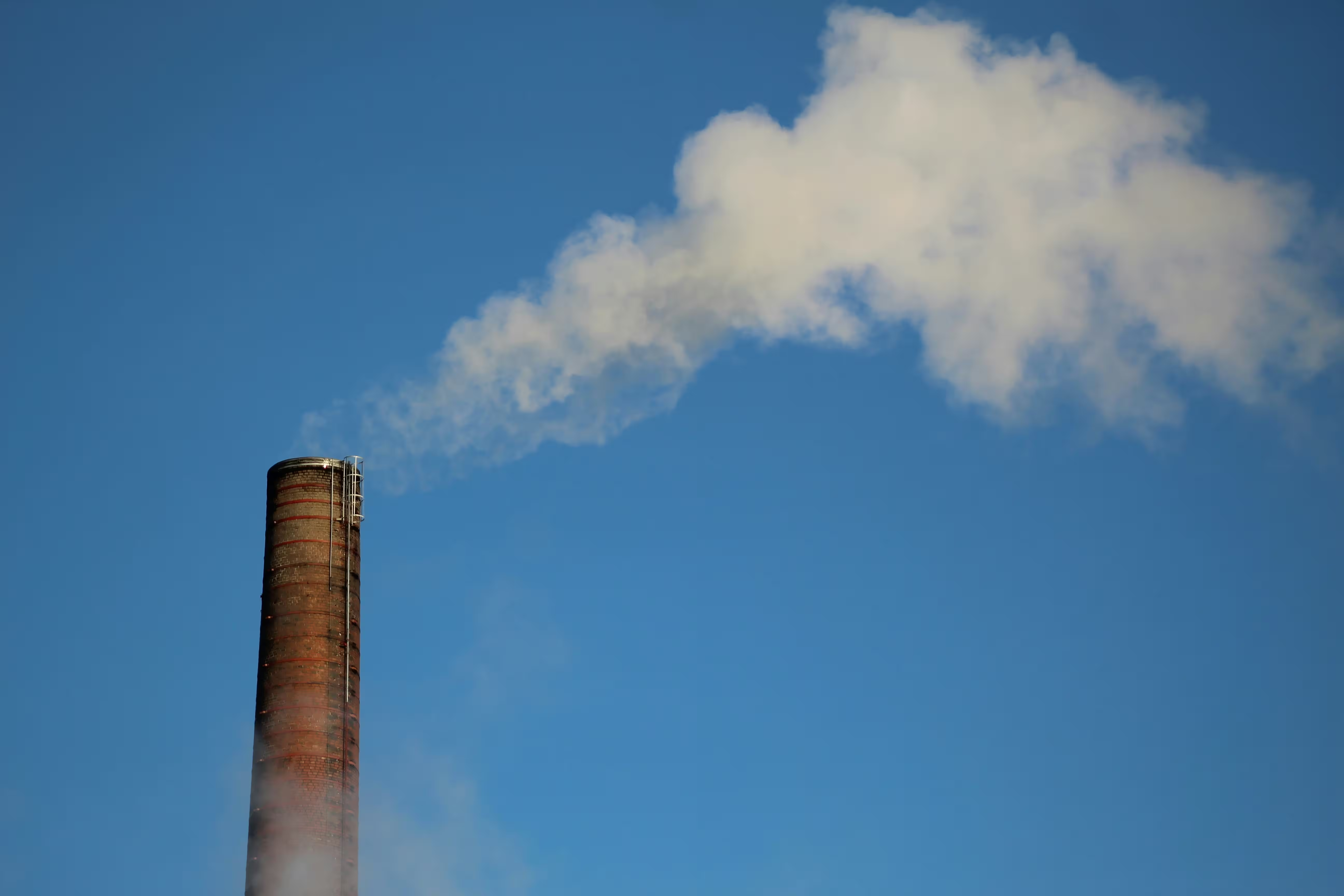
The Carbon Market Under Political Stress: Temporary Volatility or Paradigm Shift?
As European Union Allowance (EUA) prices recently tested a floor around €70, the market appears to be factoring in an unprecedented "political risk premium." Between Italy’s calls for suspension and Germany’s budgetary debates, are the fundamentals of the world's largest carbon market truly under threat? An analysis of the forces at play as the 2026 legislative review approaches.
June 18, 2026

Last news

More than just another “Green Fund”
Many "green" and ESG investments are dubiously sustainable, with funds often investing in polluting industries. Investors are increasingly skeptical, prioritizing effective climate finance tools like European carbon allowances that directly reduce emissions. Consider investing in sustainable development and responsible investing for tangible environmental impact.
October 28, 2025

The Carbon Allowance Tale - Part 3: A Financial Instrument
The European carbon market (EUAs) has evolved into a more mature and stable market, attracting diverse investors and becoming a financial instrument subject to greater oversight. This transformation, driven by policy changes, has made EUAs resemble commodity assets and has increased the volume of responsible investment, ethical investment and green finance. This makes investing in renewable energy more attractive.
June 3, 2025

AGC’s Path to Sustainability: Carbon Cost and the Real Economy
AGC, a major flat glass producer, faces increasing financial pressure from EU carbon emission regulations (EU ETS), spending a significant portion of its operating profit on carbon allowances. To mitigate costs and maintain competitiveness, AGC is investing in decarbonization strategies, including the VOLTA project with Saint Gobain, aiming for substantial CO2 emission reductions and supporting green finance and responsible investing. The company views decarbonization as essential for survival and is adapting to increasing demand for low-carbon materials and socially responsible investments.
June 3, 2025

The Carbon Allowance Tale - Part 2: Adjustments towards a free market
The EU Emissions Trading System (EU ETS) has evolved from an inefficient, heavily regulated scheme to a more mature market using free-market mechanisms to achieve carbon emission reduction targets, aiming for carbon neutrality. Adjustments to EUA supply and demand, including the Market Stability Reserve, have contributed to a more efficient carbon price, supporting sustainable investment and responsible investing. This shows the importance of buying carbon allowances and the effect of carbon tax.
November 6, 2025

The Carbon Allowance Tale - Part 1: An inefficient policy making tool?
The EU Emissions Trading System (EU ETS) aims to reduce greenhouse emissions by setting a cap on CO2 emissions, which decreases over time. Initially flawed by oversupply of carbon allowances, the scheme has evolved through regulatory adjustments to incentivize investment in decarbonization and promote responsible investing in green finance. The EU ETS is a blend of regulatory decisions with a free-market approach.
June 3, 2025

Price action this year
European carbon allowance (EUA) prices stagnated in 2023 due to energy market dynamics impacted by the war in Ukraine, but are expected to rise in 2024 driven by reduced supply, regulatory changes, and market expansion, presenting opportunities for responsible investing. These factors support a bullish outlook for investing in the stock market related to sustainable investment and green finance. The regulatory landscape aims for carbon neutrality and promotes ethical investments through mechanisms like the EU ETS.
June 3, 2025

Reducing emissions with carbon allowances
Emissions Trading Schemes, like the EU ETS, effectively reduce emissions, and investing in carbon allowances can further drive emissions reduction by withholding supply, increasing prices, and leveraging the cancellation effect, encouraging decarbonization. Investing in carbon allowances are responsible investments and ecological investment methods which will help sustainable development.
June 3, 2025

Carbon as an asset class
European Union Allowances (EUAs), representing the right to emit one ton of CO2, have become a liquid asset with significant growth potential for medium-to-long term investors. EUAs exhibit low correlation to other asset classes, relatively high volatility, and increasing scarcity, making them an attractive green investment opportunity. Investing in carbon allowances offers both financial returns and environmental impact, particularly for climate-conscious investors interested in responsible investing.
June 3, 2025

The Age of Carbon
Carbon pricing, especially through emissions trading schemes (ETS), is gaining traction globally as an effective way to reduce emissions, with the EU ETS serving as a successful model. These markets are expanding, attracting financial actors, and evolving into financial markets, offering opportunities for impact investment and green finance. As these markets grow in scope and value, they present opportunities for investors interested in sustainable investment and ethical investments.
June 3, 2025