Our top articles

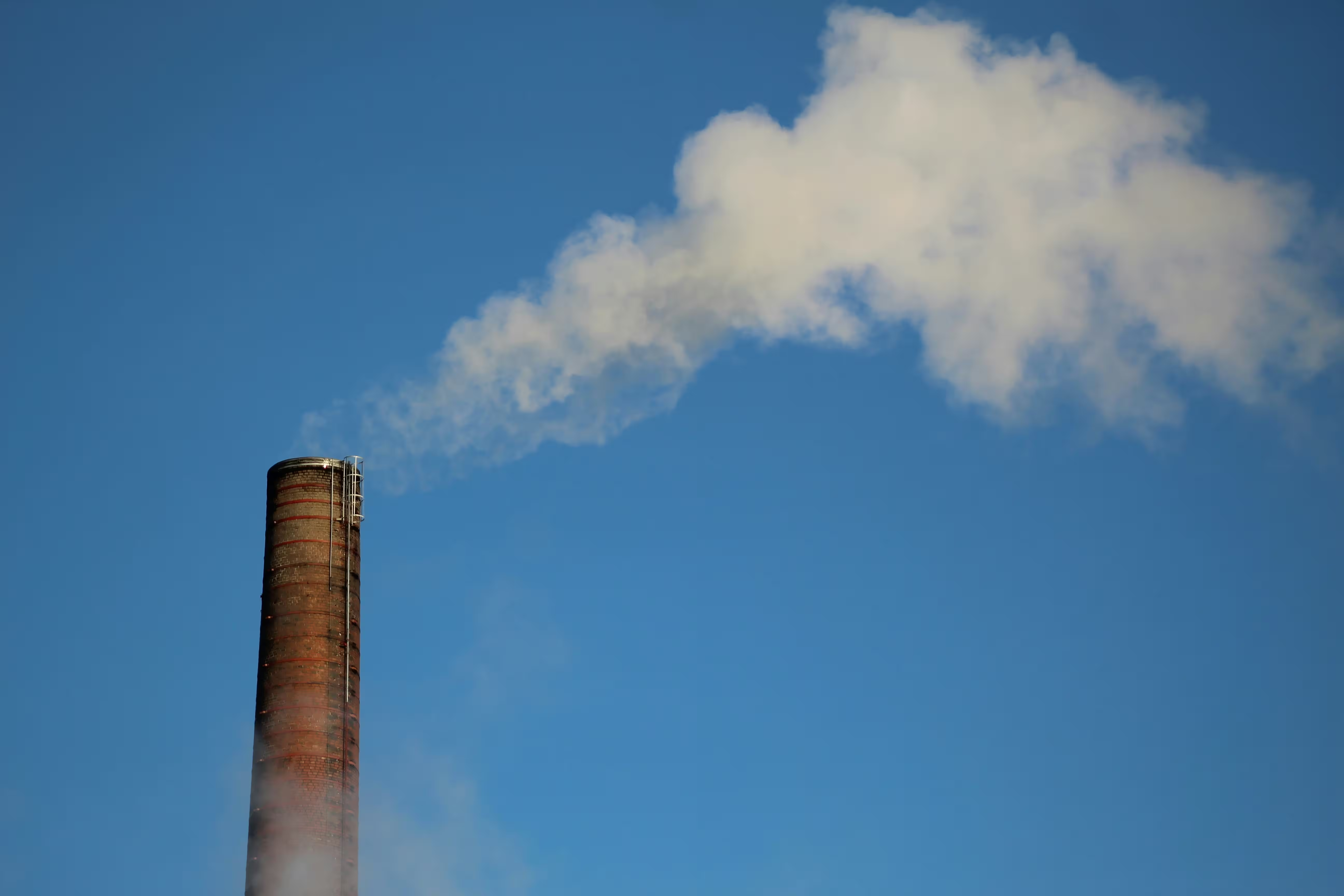
The Carbon Market Under Political Stress: Temporary Volatility or Paradigm Shift?
As European Union Allowance (EUA) prices recently tested a floor around €70, the market appears to be factoring in an unprecedented "political risk premium." Between Italy’s calls for suspension and Germany’s budgetary debates, are the fundamentals of the world's largest carbon market truly under threat? An analysis of the forces at play as the 2026 legislative review approaches.
June 18, 2026

Last news

MaPrimeRénov’ - France
MaPrimRénov is a French government program offering financial assistance to homeowners for energy renovation work, aiming to improve energy efficiency and reduce emissions, contributing to the country's carbon neutrality goals. The program supports investments in sustainable development.
June 3, 2025

IRIS - Greece
The EU-funded IRIS project aims to decarbonize a Greek refinery using carbon capture, utilization, and storage (CCUS) technologies, reducing CO2 emissions and producing e-methanol, contributing to climate neutrality targets and creating jobs. This responsible investment in green finance will help avoid millions of tons of CO2 emissions.
June 3, 2025

What is the Commitment of Traders report in the EU ETS?
The Commitment of Traders (COT) report reveals market participants' behavior in the EU ETS, indicating bullish or bearish sentiment. It categorizes traders (investment firms, funds, commercial enterprises, etc.) and their positions, helping investors make informed decisions, though its broad categories can obscure nuanced behaviors within the carbon market for investing in the stock market.
February 6, 2026

What is the EU carbon market diplomacy task force?
The EU is launching a carbon market diplomacy task force to help other countries establish similar carbon pricing schemes, aiming to bridge differences between systems and combat climate change globally. This initiative follows the EU's 2040 climate goals and reflects increasing global interest in carbon pricing mechanisms, particularly after the implementation of the Carbon Border Adjustment Mechanism (CBAM). The task force will share European expertise to promote uniform carbon pricing approaches.
June 3, 2025

What are free carbon allowances under the EU ETS?
The EU ETS uses free carbon allowances to help industries transition to carbon pricing. These allowances are allocated based on benchmarks, but will be phased out by 2034 for some sectors and replaced by the Carbon Border Adjustment Mechanism (CBAM) to prevent carbon leakage and promote responsible investing and ethical investment. The CBAM ensures imported products face similar carbon costs as those within the EU, supporting the EU's climate targets.
January 30, 2026

Will agriculture be included in the EU ETS?
The EU is exploring ways to integrate agriculture into its Emissions Trading System (ETS) to reduce carbon emissions, including potential carbon tax and carbon allowances, with discussions focusing on different ETS models and the need for better emissions monitoring; While specific targets were not set for agriculture in the EU's 2040 climate goals, integrating agriculture into the EU ETS remains an active topic of discussion. The EU is working towards responsible investment, impact investment and green investment in the agriculture sector.
June 3, 2025

Why is agriculture not covered by the EU ETS in 2024?
Agriculture contributes significantly to EU emissions, and despite some reductions, further substantial cuts are needed to meet climate targets. The sector is not currently under the EU ETS, though its inclusion is debated, and existing policies aim to mitigate emissions. Investing in green finance and sustainable investment solutions is important to consider.
June 3, 2025

MACC Curve: Definition, Examples & Investment Guide
The Marginal Abatement Cost Curve (MACC) helps governments and businesses prioritize investments in green technologies and carbon reduction strategies, such as renewable energy, sustainable investment and carbon allowances, to achieve emission reduction targets within the EU ETS framework. Rising carbon prices make investing in decarbonization more financially viable for companies committed to ethical investment and sustainable development.
January 30, 2026

What is the EU ETS emissions data published in 2024?
EU ETS emissions decreased by 15.5% in 2023, driven by lower power generation emissions due to energy market disruptions, increased renewables, and macroeconomic slowdowns. Sectors covered include energy, industry, and aviation, with maritime added in 2024; a new system (ETS 2) will include building and road transportation sectors from 2027. Germany, Italy, and Poland were the top emitters.
February 6, 2026