Our top articles

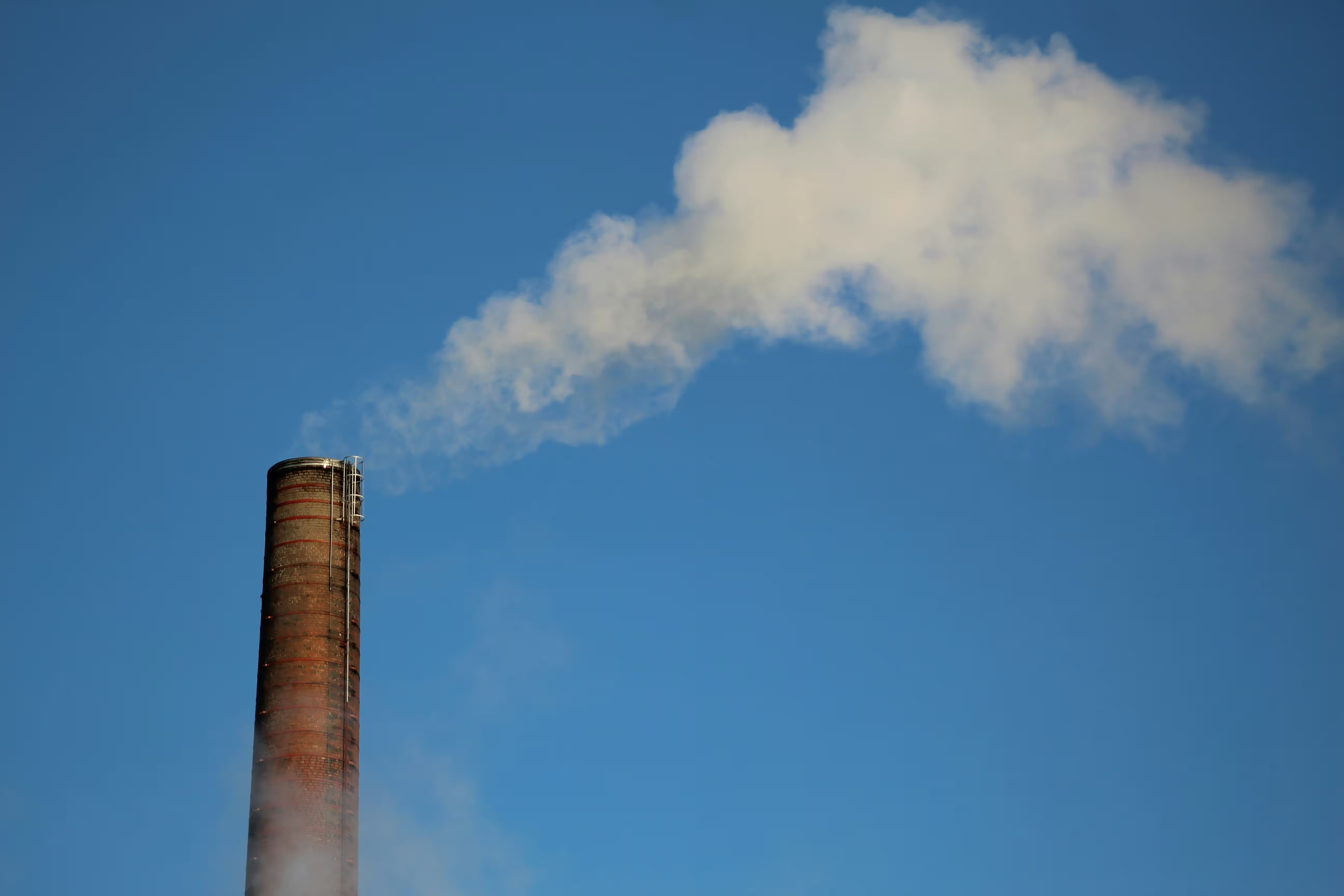
The Carbon Market Under Political Stress: Temporary Volatility or Paradigm Shift?
As European Union Allowance (EUA) prices recently tested a floor around €70, the market appears to be factoring in an unprecedented "political risk premium." Between Italy’s calls for suspension and Germany’s budgetary debates, are the fundamentals of the world's largest carbon market truly under threat? An analysis of the forces at play as the 2026 legislative review approaches.
June 18, 2026

Last news

Can I delete forever my carbon allowances?
Individuals and organizations can impact climate change by purchasing and permanently deleting European Union Allowances (EUAs), effectively reducing the overall carbon budget and strengthening the EU Emissions Trading System. Canceling EUAs guarantees measurable emission reductions, unlike some voluntary carbon offset projects. This allows for ethical investment and responsible investing in a greener future.
October 13, 2025

Are the EUAs that I can buy the same as those that industries buy?
Investing in EU carbon allowances (EUAs) allows individuals to directly impact carbon emissions by removing allowances from the market, influencing the EU's carbon budget, unlike derivative investments. Homaio enables individuals to invest in spot EUAs, supporting responsible investing and the EU's climate goals.
October 13, 2025

How does my EUA investment affect the carbon budget in the EU?
Investing in spot EUAs (European Union Allowances) directly reduces carbon emissions by removing allowances from the market, limiting industries' pollution. This influences carbon market dynamics and can accelerate decarbonization, unlike derivative contracts which are speculative. You can directly influence the carbon budget available to industries.
October 13, 2025

Does the EU ETS provoke carbon leakage?
Carbon leakage, where companies relocate to avoid stringent climate policies, undermines emissions reduction efforts. The EU ETS combats this through free allowance allocation and the Carbon Border Adjustment Mechanism (CBAM), ensuring fair carbon pricing and encouraging global climate policy alignment for responsible investment. These sustainable finance policies aim to support investing in sustainable development and reduce the risk for impact companies.
October 13, 2025

What is the EU ETS diplomacy task force?
The EU is sharing its carbon pricing expertise globally via a new task force to assist other countries in developing and harmonizing their own carbon markets. This initiative supports global climate goals and addresses the increasing international focus on carbon pricing mechanisms, including the EU's Carbon Border Adjustment Mechanism. The EU aims to help accelerate global decarbonization efforts through responsible investment and sustainable finance.
October 13, 2025

Do other countries have an emissions trading scheme (ETS)?
To combat climate change, more countries are adopting Emissions Trading Schemes (ETS), with 36 jurisdictions now using them. These schemes, along with carbon taxes, generated $104 billion in 2023 for environmental projects, but higher carbon prices are still needed globally to meet climate targets. The EU is pioneering carbon pricing, encouraging other nations to develop their own schemes and adapt them to local contexts to promote responsible investing.
October 13, 2025

Who gets the money from the sale of EUAs and what are the amounts?
EU carbon allowance auctions generate billions for member states and EU funds, supporting renewable energy, energy efficiency, and energy independence; revenues are projected around €40.6 billion by the end of 2024. As carbon prices rise, so does funding for sustainable investments and green finance.
October 13, 2025

What are the climate projects financed by the EU ETS ?
The EU ETS uses revenue from carbon allowance auctions to finance public green investment and climate projects. From 2024, 100% of EU ETS revenues will fund climate initiatives, supporting decarbonization and national environmental goals. This mechanism promotes responsible investing in renewable energy and sustainable development across member states.
October 13, 2025

How much have installations under the EU ETS decarbonized?
The EU ETS has significantly reduced carbon emissions in Europe, particularly in the power sector, and is being strengthened to meet climate neutrality goals by 2050 through measures like carbon tax incentives. This encourages investing in renewable energy and responsible investing.
October 13, 2025